






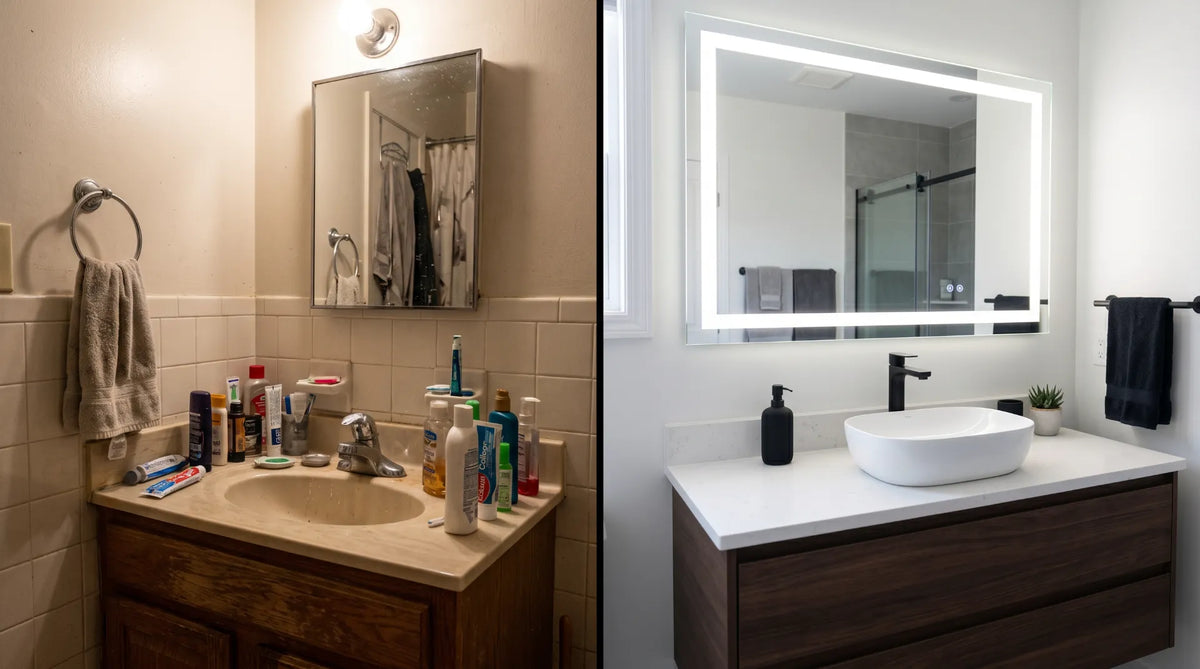
Choosing bathroom fixtures is one of the most consequential decisions in any renovation - and one of the most confusing. This guide covers every fixture category, every major finish, what to spend money on, and what to skip, written specifically for the Canadian market in 2026.
- Why Fixtures Are the Most Impactful Decision in a Bathroom Renovation
- Faucets: Types, Configurations & What to Look For
- Fixture Finishes: Matte Black, Brushed Nickel, Brushed Gold & Chrome Compared
- Sinks: Vessel vs. Drop-In vs. Undermount
- Bathroom Mirrors & LED Mirrors: What's Worth Buying
- Medicine Cabinets vs. Mirror Cabinets: Which One Should You Install?
- Towel Warmers: Types, Benefits & What to Look For
- Shower Niches: Size, Placement & Design
- Soap Dispensers: Built-In vs. Countertop
- Budget Matrix: Where to Spend and Where to Save
- Complete Fixture Buying Checklist
- Frequently Asked Questions
- More From This Series
Tile covers more surface area. Vanities are larger objects. But bathroom fixtures - faucets, hardware, mirrors, towel bars, shower fittings - are the details that define how a bathroom is perceived. They are the elements a buyer touches during a showing, the elements a photographer frames tightly in listing images, and the elements that determine whether a bathroom reads as a $30,000 renovation or a $12,000 one even when the underlying work is identical.
The reason fixtures carry so much visual weight is contrast. In a bathroom where every other element is a field colour - white tile, cream walls, greige vanity - the fixtures are the only dark, metallic, or highly finished elements in the space. They draw the eye. They set the room's tone. A cohesive set of matte black fixtures in a warm-white bathroom signals design intent in a way that a random assortment of chrome and nickel does not, even if the chrome and nickel are individually higher quality.
The most common and costly fixture mistake in Canadian bathroom renovations is purchasing fixtures piecemeal - a faucet from one purchase, towel bars from another, a shower head added later. The result is a bathroom where the finishes almost match, the proportions are inconsistent, and the design lacks the cohesion that signals quality. Choose your finish family first, then source every metal surface in the room from that decision. It costs no more and changes the result dramatically.

A centerset faucet has its handles and spout mounted on a single base plate, with a spread of 4 inches between handle centres. This configuration is the most common in Canadian residential bathrooms, particularly in production homes built since the 1990s. If you're replacing an existing faucet without changing the sink, measure the hole spacing before buying - a centerset faucet fits a three-hole sink with a 4" spread, which covers the majority of standard Canadian bathroom sinks.
For a replacement faucet in this configuration, budget a minimum of $300-$450 CAD for a product with a solid brass body, a ceramic disc cartridge (which eliminates drip and lasts significantly longer than rubber washer alternatives), and a finish warranty of at least five years. Products in the $150-$250 range typically use zinc alloy bodies and lower-grade cartridges - they present well in-store but begin leaking or losing finish within two to four years of regular use.
- Sink hole count and spread measured - 4" centerset confirmed before purchase
- Brass body confirmed - not zinc alloy (check product spec sheet, not just listing description)
- Ceramic disc cartridge confirmed - manufacturer should state this explicitly
- Finish warranty confirmed - minimum five years; premium brands offer lifetime
- CSA certification confirmed - required for all plumbing fixtures sold in Canada

A widespread faucet separates the spout and two handles into three independent pieces that mount through individual holes in the sink deck, typically with a spread of 8 to 16 inches. This configuration reads as more premium than a centerset because the increased visual separation between the components gives the faucet a sense of scale and presence - it fills a wider vanity appropriately rather than appearing small and inset. It is the standard configuration in higher-end bathroom renovations and in designer vanities, where the wider sink deck is proportioned for this format.
Installation is more complex than a centerset - three separate supply lines and a longer-reach spout require more precise alignment and typically benefit from a professional installation. Budget $500-$1,200 CAD for a quality widespread faucet with the same brass body and ceramic disc cartridge standards that apply to centerset models.

Single-hole faucets mount through a single hole in the sink or countertop and integrate the handle and spout into one unit. They are clean, modern, and easy to install - making them a popular choice in contemporary bathroom renovations where a minimal profile is the design goal. A single-hole faucet with a tall neck (sometimes called a "vessel faucet") is required for vessel sinks, where the faucet must clear the height of the basin - typically 150-200mm of clearance above the counter. Specifying a standard-height faucet with a vessel sink is one of the most common fixture mistakes in Canadian bathroom renovations.
The handle style matters as much as the faucet body for the room's overall aesthetic. Lever handles (one flat bar per side) read as contemporary and architectural. Cross handles (four-spoked cross shape) read as traditional or European. Knob handles are rarely specified in current Canadian renovation work. Match your handle style to the overall design language of the bathroom - a cross-handle faucet in a minimalist tile bathroom creates a visual inconsistency that buyers and guests notice even without identifying it.
The finish on a fixture is not purely cosmetic - it determines durability, maintenance requirements, and how the fixture interacts visually with every other element in the bathroom. The Canadian market currently favours four finishes across the full spectrum of bathroom price points. Here is how they compare.
The single most common fixture mistake in Canadian bathroom renovations is finish mixing - the unintentional accumulation of chrome, brushed nickel, and matte black across different fixture purchases made at different times. A chrome toilet paper holder added early, brushed nickel towel bars from a set, and a matte black faucet added during the renovation produces a bathroom that appears unfinished regardless of the quality of individual components.
The rule is straightforward: choose one dominant finish for all primary fixtures (faucet, shower head, towel bars, robe hooks, toilet paper holder). A second finish is acceptable only for secondary decorative elements - a brushed gold mirror frame in an otherwise matte black bathroom, for example. A third finish anywhere in a single bathroom is almost always a mistake. When purchasing replacement fixtures over time, photograph your existing hardware finish before shopping so you can match accurately in-store - nickel and chrome are nearly impossible to differentiate from memory.
The sink type determines the faucet type, the countertop treatment, and the cleaning demands of the vanity area. Each format has genuine advantages and genuine trade-offs - the choice should be driven by bathroom type, usage context, and the buyer profile if resale is a consideration.
| Sink Type | Best For | Trade-offs | Faucet Needed | Resale Signal |
|---|---|---|---|---|
| Undermount | Primary baths, family bathrooms, any high-use application - the most practical format for daily use | Requires solid countertop material (quartz or granite - not laminate) for a flush seal; more complex installation | Centerset or widespread mounted in countertop | Premium Signal - reads as a quality renovation at all price points |
| Drop-In (Self-Rimming) | Mid-range renovations, replacement projects where the countertop is staying - works with laminate countertops | The rim creates a visible seam that collects water and residue - higher cleaning demands and a less clean visual profile than undermount | Centerset or widespread - matches the existing hole configuration | Neutral - common, functional, and buyer-neutral in mid-range markets |
| Vessel | Design-forward powder rooms and primary baths where the sink is a visual focal point - not recommended for family bathrooms with children | Sits above the counter - water and toothpaste splatter lands on the counter surface; children find the height awkward; requires a tall-neck faucet matched to vessel height | Tall vessel faucet - height must be specified to the vessel rim clearance | Design Statement - generates emotional response in design-forward markets; can read as impractical in family-oriented listings |
| Wall-Mounted | Premium minimalist bathrooms, accessible design applications, powder rooms where floor space is limited | Requires wall reinforcement during rough-in - not a retrofit option in most Canadian homes without significant wall work; higher installation cost | Wall-mounted faucet - supply lines run through wall, not countertop | Luxury Signal - reads as high-specification; very limited resale applicability outside premium urban markets |

LED bathroom mirrors have moved from a luxury specification to a mainstream renovation choice in Canada over the past three years, and for good reason - they solve the lighting problem that affects most Canadian bathrooms. The standard bathroom lighting configuration in Canadian production homes (a single overhead or ceiling fixture) creates downward shadows on the face that make the mirror unusable for tasks like applying makeup or shaving. An LED mirror with front-facing or backlit edge lighting provides the even, face-level illumination that eliminates those shadows, without the cost and complexity of installing separate vanity sconces.
A quality LED mirror for a Canadian renovation costs $400-$900 CAD for a single-vanity size (600-900mm wide). Features worth specifying: a demister/anti-fog pad (standard in any bathroom without perfect ventilation - which is most Canadian homes), a colour temperature switch (warm light for evenings, cool/daylight light for task use), and a minimum brightness rating of 1,000 lumens for a mirror in a bathroom without supplementary lighting. Avoid mirrors with integrated Bluetooth speakers or clock displays - these read as gadget-oriented rather than design-oriented, and the electronics create a failure point that reduces longevity.
For double vanities, a single wide LED mirror (spanning the full vanity width) reads as more premium than two individual mirrors. The continuous mirror surface makes the wall appear wider and the bathroom larger - which is one of the most valuable visual effects available in a bathroom renovation. Two individual mirrors are appropriate when the design calls for a defined separation between two sink areas, or when the vanity is wider than 1,500mm and a single mirror would be disproportionately large.
Medicine cabinets and mirror cabinets serve the same storage function - concealed shelving behind a mirrored door - but they differ in specification, depth, and design integration. A recessed medicine cabinet (mounted flush into the wall between studs) is the cleaner, more premium option - it projects nothing from the wall surface, and in a bathroom where wall space is limited, it is often the only storage solution that doesn't make the room feel smaller. A surface-mounted mirror cabinet is easier to install but projects 100-150mm from the wall, which reads as bulky in most bathroom sizes.
| Cabinet Type | Installation | Best For | Cost (CAD) | Design Signal |
|---|---|---|---|---|
| Recessed Medicine Cabinet | Mounted between studs - requires wall opening; difficult retrofit if wiring or plumbing is in the wall | Primary baths and ensuites where a flush, seamless wall appearance is the goal | $350-$900 for cabinet; $200-$400 additional for installation in an existing wall | Premium - reads as purpose-built and architecturally integrated |
| Surface-Mounted Mirror Cabinet | Mounts directly to wall surface - no wall opening required; easiest retrofit option | Rentals, older homes where the wall cannot be opened, or bathrooms where storage volume matters more than profile | $200-$600 for cabinet; minimal installation cost | Neutral - functional and practical; profile reads as less integrated than recessed |
| LED Mirror Cabinet (combined) | Surface-mounted or semi-recessed - integrates mirror lighting with concealed storage in one unit | Bathrooms where both lighting improvement and storage are priorities; growing specification in Canadian renovations | $600-$1,400 for a quality combined unit | Design-forward - delivers both functional and visual improvement in one purchase |
A towel warmer is one of the most effective luxury signals available in a Canadian bathroom renovation at a relatively modest cost - and in a country where bathroom temperatures drop significantly in winter, it is also genuinely functional rather than purely decorative. The two main formats are electric (a self-contained unit that plugs into a GFCI outlet or is hardwired) and hydronic (connected to the home's hot water heating system). Electric is the correct choice for the vast majority of Canadian renovation projects - it requires no plumbing modification, operates independently of the home's heating system, and can be retrofitted into any bathroom that has a GFCI outlet or can have one added.
For an electric towel warmer, specify a wattage appropriate to the rail size: 60-80 watts for a single-bar unit, 120-150 watts for a multi-bar unit that will dry two or more towels. A programmable timer is worth the additional cost - a towel warmer that runs 24 hours a day adds approximately $10-$20 CAD per month to an electricity bill; one on a timer adds $2-$5. For finish, match the towel warmer to your faucet and hardware finish exactly - a polished chrome towel warmer in a matte black bathroom is a significant visual inconsistency.
- GFCI outlet location confirmed - towel warmer must be within reach of a GFCI outlet or hardwired by a licensed electrician
- Wall mounting location confirmed - must hit studs or use appropriate hollow-wall anchors rated for the unit weight
- Finish matched to dominant fixture finish - confirmed in person with a sample if possible
- Wattage appropriate to rail count confirmed - undersized warmers do not dry towels; they only warm them slightly
- CSA certification confirmed on product listing
A shower niche is a recessed shelf built into the shower wall - and it is one of the most high-impact shower improvements available in a bathroom renovation because it eliminates the shower caddy that hangs over the shower head and reads as cluttered and temporary in listing photography. A well-designed niche reads as a custom, purpose-built detail. A poorly designed or incorrectly placed niche is difficult to fix after tiling, so the decisions about size, height, and placement need to be made during rough-in - not after.
| Niche Specification | Standard Recommendation | Notes |
|---|---|---|
| Height from floor | 1,200-1,400mm from shower floor to bottom of niche - comfortable reach height for most adults without bending | If household includes significant height variation, position at the average comfortable reach of primary users |
| Niche width | 300-600mm - must fall between two studs; in Canadian framing, this means 300mm (between 16" OC studs) or 600mm (spanning two bays) | Wider niches require a header - consult a contractor if you're spanning more than one bay on a load-bearing wall |
| Niche depth | 100mm minimum to accommodate shampoo bottles standing upright - 130mm for a more generous shelf that holds wide-base products | Canadian standard stud walls (2×4 construction) give approximately 89mm of usable depth - a 2×6 wall gives 140mm |
| Placement wall | Side wall of the shower - never the exterior wall (risk of condensation and moisture penetration) and not the plumbing wall (pipes reduce available depth) | Confirm with your contractor that the chosen wall has no concealed plumbing, wiring, or insulation that would prevent the niche depth |
| Tile inside niche | A contrasting tile inside the niche (a mosaic, a different format, or a different colour) adds visual interest and defines the niche as a design feature rather than a purely functional recess | If using a contrasting tile, select it before the main tile so the niche tile can influence the overall palette rather than being an afterthought |
A built-in soap dispenser - mounted in the countertop, with the pump rising through a drilled hole and the reservoir below the counter surface - is a detail that distinguishes a thoughtfully finished bathroom from a standard one. It eliminates the soap bottle that sits on the counter, which is one of the small details that makes a bathroom photograph more cleanly and stage more effectively. The cost is modest: a quality deck-mounted soap dispenser for a countertop installation costs $80-$200 CAD, and the countertop hole is drilled during fabrication with no additional cost if specified before the countertop is ordered.
For a renovation where the countertop is staying and drilling is not practical, a high-quality countertop dispenser in the matching fixture finish is a reasonable alternative - it is the dispenser bottle, rather than a generic soap bottle from a grocery store, that creates the visual improvement. A matte black pump dispenser in a matte black bathroom, a brushed gold dispenser in a warm-palette bathroom - these details are small individually and collectively create the cohesion that separates a designed bathroom from an assembled one.
Not every fixture category deserves the same budget allocation. The fixtures you touch daily and the ones visible in listing photography warrant a higher investment than those that operate invisibly. Use this matrix as a starting framework, then adjust based on your total renovation budget and the price point of the home.
| Fixture Category | Spend More | Save Here | Priority |
|---|---|---|---|
| Faucet (vanity) | Solid brass body, ceramic disc cartridge, finish warranty - these determine longevity, not aesthetics alone | The brand name - mid-tier brands with the same spec (brass + ceramic) perform identically to luxury brands at the cartridge level | High |
| Shower head & valve | The rough-in valve - a quality pressure-balance or thermostatic valve lasts the life of the bathroom; a cheap valve fails within five years | The shower head itself - a $150 shower head performs nearly identically to a $600 one at standard water pressure; save here and invest in the valve | High |
| LED Mirror | Demister pad, IP44 rating or higher, CRI 90+ colour rendering - the quality of the light affects how the room looks every time it is used | Size - a well-specified smaller mirror outperforms a large cheap mirror every time; prioritise quality over scale | High |
| Towel bars & hardware | Finish consistency - buy all hardware pieces from the same collection by the same manufacturer; mix-matching between brands rarely produces a true finish match | Individual piece cost - hardware sets from Canadian retailers (Home Depot Pro, Canadian Tire Pro) in brass-core construction are adequate if they're in a consistent finish | Medium |
| Toilet paper holder & robe hook | Finish match to the dominant fixture - this is where visible inconsistency most often appears | Construction method - wall-mounted versions do not need to be heavy-gauge; a well-anchored mid-grade holder in the right finish is equivalent to a premium one functionally | Medium |
| Countertop soap dispenser | Finish match - a dispenser in the wrong finish is more visible than a cheap dispenser in the right one | Mechanism quality - most soap dispensers use similar pump mechanisms; spend on finish, not on the pump | Medium |
| Towel warmer | Wattage rating and programmable timer - an undersized warmer on all the time costs more and performs worse than a properly rated one on a timer | Rail count - a single well-heated bar warms one towel properly; four bars in a small bathroom look cluttered and heat unevenly | Medium |
- Dominant fixture finish selected - all primary fixtures (faucet, shower head, towel bars, toilet paper holder, robe hooks) will be ordered in this finish
- All fixtures sourced from the same manufacturer collection where possible - finish consistency is easier to guarantee within a single collection
- No more than two finishes total in the bathroom - dominant finish for hardware; maximum one secondary finish for a decorative element only
- Chrome excluded or confirmed as a deliberate choice - if chrome, confirmed all existing chrome is the same tone (warm vs. cold chrome)
- Sink hole configuration measured - hole count and spread confirmed before faucet purchase
- Faucet body material confirmed as solid brass - not zinc alloy
- Ceramic disc cartridge confirmed - manufacturer states this explicitly in product specifications
- CSA certification confirmed
- If vessel sink: faucet height confirmed to clear vessel rim by minimum 25mm
- Mirror width confirmed at 80-90% of vanity width - not wider than vanity
- If LED mirror: demister pad confirmed, colour temperature control confirmed, CSA/UL listing confirmed
- If medicine cabinet: recess depth confirmed against wall construction (standard 2×4 stud wall = 89mm usable depth)
- Electrical connection for LED mirror confirmed - wired circuit or nearby GFCI outlet
- Shower valve type confirmed - pressure-balance minimum; thermostatic for premium renovations
- Shower niche placement confirmed on a non-exterior, non-plumbing side wall
- Shower niche waterproofing specified - membrane system confirmed before tiling
- Shower head finish matches dominant fixture finish
- Towel warmer wattage appropriate to bar count - confirmed against room heating requirements
- Towel warmer CSA listed - confirmed on product label
- Towel warmer programmable timer specified - either built-in or smart plug compatible
- Soap dispenser finish matches dominant fixture finish
- All accessories purchased from same manufacturer collection as primary fixtures where available
Shop faucets, fixtures, mirrors, and hardware at Bathify
Browse our curated selection of bathroom fixtures in matte black, brushed nickel, brushed gold, and more - all shipped across Canada. Free shipping on orders over $50.


