






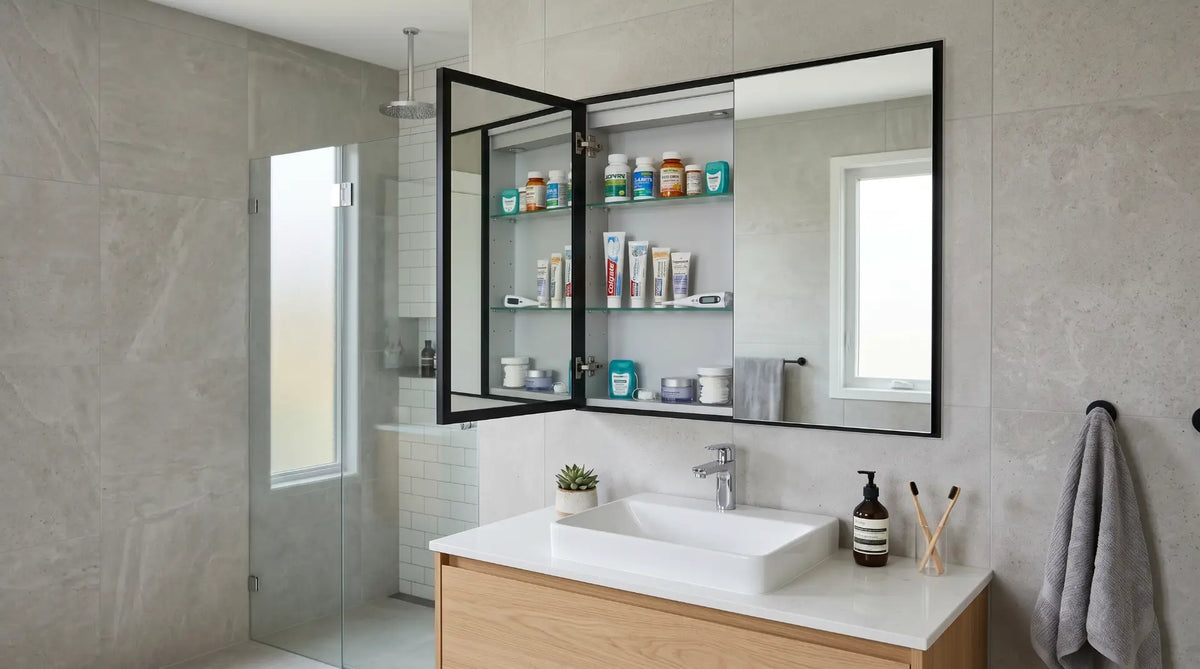
Two products that look nearly identical on a spec sheet and in a showroom - but serve fundamentally different purposes, suit different bathroom types, and are bought wrong constantly. This guide covers every dimension of the decision: storage depth, wall requirements, lighting integration, sizing, finish matching, and what each one actually delivers day-to-day in a Canadian home.
The terms "medicine cabinet" and "mirror cabinet" are used interchangeably at most Canadian hardware stores and by most renovation contractors - and that interchangeable use obscures a meaningful distinction that affects the right choice for your bathroom. A medicine cabinet, in the traditional sense, is a recessed or surface-mount cabinet with a mirrored door and shelving inside - functional storage first, mirror second. A mirror cabinet, in the contemporary sense most commonly encountered in Canadian renovation retail, is a larger, design-forward unit that typically includes integrated LED lighting, sometimes a demister pad, sometimes USB ports or electrical outlets inside the cabinet, and a mirror face that takes on more visual importance than in a traditional medicine cabinet.
The practical overlap between the two categories is significant - both provide a mirror surface and storage behind it. The differences are in size, specification, installation complexity, lighting integration, design character, and price. Understanding those differences before you commit to either is the difference between a bathroom upgrade that works exactly as intended and one that creates new problems - an oversized cabinet on a small wall, a recessed unit cut into a wall that contained a pipe, or an LED mirror cabinet installed in a bathroom with no accessible electrical connection above the vanity.
This guide covers both types completely, gives you the wall-assessment and sizing framework to make the right call before you buy anything, and identifies exactly which scenarios suit each option.
A vanity mirror or cabinet is typically the last fixture selected in a bathroom renovation - chosen after the vanity, faucet, tile, and lighting are already committed. This sequencing means it is often selected quickly, without full consideration of wall type (is there a cavity?), electrical access (is there a junction box above the vanity?), and size relative to the vanity width. All three of these factors can make the first-choice product impossible to install correctly in the actual bathroom. The wall assessment and sizing steps in this guide should happen at the planning stage - not after everything else is already purchased.

A medicine cabinet is defined by its primary function: shelved storage behind a mirrored door, positioned above the bathroom vanity. The mirror face is the door to the cabinet - not a separate mirror with a cabinet added behind it. This means the mirror is typically sized to the cabinet opening rather than to the wall space, which keeps medicine cabinets compact relative to the overall vanity width. Standard medicine cabinet widths run from 40cm (16") to 91cm (36"), with the most common residential sizes between 46cm (18") and 76cm (30").
The defining installation variable for a medicine cabinet is the choice between recessed and surface-mount. A recessed medicine cabinet sits inside the wall cavity - the cabinet body is set between the studs, with only the door and frame visible at the wall surface. This produces a clean, flush installation where the cabinet does not protrude into the bathroom at all, preserving the full depth of the room. A surface-mount medicine cabinet attaches to the wall face like a picture frame - the full cabinet depth (typically 8-12cm) projects out from the wall. Surface-mount is simpler to install (no wall cutting required) but visually adds depth to a room that may already be constrained.
In Canadian homes built with standard wood stud framing, the wall cavity between studs is typically 9cm (3.5") deep - sufficient for a recessed medicine cabinet. In homes with concrete or masonry walls (common in older Canadian urban apartment buildings and basement bathrooms), recessed installation is not possible without specialised wall work, making surface-mount the only option.
Before purchasing any recessed medicine cabinet, the single most important step is confirming what is inside the wall cavity at the installation location. In Canadian bathrooms, the wall directly above the vanity frequently contains electrical wiring (running to the vanity light, the GFCI outlet, or a fan), and sometimes supply plumbing. Cutting a cabinet opening without confirming the cavity is clear risks cutting through live electrical wiring - a serious safety hazard - or damaging a pipe. Use a stud finder to locate the studs framing the cavity, then probe the cavity with a long inspection tool or fibre-optic scope before cutting. If electrical wiring is present inside the cavity, it must be rerouted by a licensed electrician before the cabinet can be recessed. This is the step that catches most DIY recessed cabinet installations off-guard.
- Wall type confirmed - wood stud framing (recessed possible) or masonry/concrete (surface-mount only)
- Wall cavity content checked - no electrical or plumbing in the cavity at the installation location before cutting
- Stud spacing confirmed - standard 16" on-centre framing fits most medicine cabinet widths; confirm before purchasing
- Cabinet width appropriate to vanity width - see sizing guide below
- Frame style selected - frameless (contemporary) or framed (transitional/classic) to match bathroom design
- Hinge side confirmed - most cabinets open left or right; confirm which side clears the wall space and adjacent fixtures

A mirror cabinet, in the contemporary Canadian renovation market, represents a step up in both visual ambition and specification complexity from a traditional medicine cabinet. The defining characteristic is that the mirror face is the primary design element - typically spanning a wider surface than a conventional medicine cabinet, often the full width of the vanity or close to it - and the storage behind it is integrated into a unit that also provides the bathroom's primary task lighting. Most products in this category include built-in LED lighting (front-lit, backlit, or both), and premium units add a demister pad (a heated element behind the mirror glass that prevents condensation after a shower), internal electrical outlets for razors or toothbrushes, and adjustable colour temperature.
Mirror cabinets are almost exclusively surface-mount or semi-recessed units - they are typically too wide to fit between standard 16"-on-centre Canadian framing studs for a full recessed installation, though some narrower models are available in recessed configurations. The larger mirror face and integrated lighting means that a mirror cabinet does what a traditional medicine cabinet plus a separate mirror plus a separate light bar does - consolidating three separate products into one. In bathrooms where the wall above the vanity has limited space for multiple separate fixtures, this consolidation is a meaningful practical advantage.
The electrical requirement is the specification that most often catches Canadian buyers off-guard. A mirror cabinet with integrated LED lighting, a demister pad, or internal outlets requires a hardwired electrical connection - a junction box above the vanity at the installation height. In many Canadian bathrooms, particularly older homes where the original vanity lighting was a single wall sconce rather than an overhead bar, this junction box does not exist and must be added by a licensed electrician before the mirror cabinet can be installed. This is not a deal-breaker - the electrical work is straightforward - but it is a cost and timeline that needs to be budgeted before the mirror cabinet is purchased.
- Primary function is storage - mirror is the door, not the focal point
- Compact size fits most bathroom wall spaces without dominating the room
- No electrical connection required for basic models - surface-mount is a pure DIY install
- Recessed installation produces a flush, clean wall surface when cavity permits
- Lower price point - quality units available from $80-$400 CAD
- Wide availability at all Canadian hardware and home improvement retailers
- Works with any existing vanity light - no need to consolidate lighting into the mirror unit
- Limited mirror coverage - typically narrower than the vanity width
- Integrated LED lighting eliminates the need for a separate vanity light bar
- Wider mirror face provides better coverage - typically spans the full vanity width
- Demister pad (available on mid-range and premium units) prevents mirror fogging after every shower
- Consolidates mirror + lighting + storage into one wall footprint
- Hardwired electrical required - adds installation complexity and licensed electrician cost if junction box not present
- Larger surface footprint means wall space and proportions need more careful planning
- Higher price point - $250-$900+ CAD, with quality units at mid-range $400-$650
- Premium design character - significantly elevates the visual level of the bathroom
| Decision Factor | Medicine Cabinet | Mirror Cabinet | Better Choice |
|---|---|---|---|
| No junction box above vanity | No electrical required - install directly | Requires electrician to add junction box first | Medicine Cabinet |
| Rental property or secondary bathroom | Lower cost, simpler install, easily replaced | Over-specified for rental context - higher cost harder to recoup | Medicine Cabinet |
| Primary ensuite - renovation investment | Functional but limited visual impact | Elevates the bathroom significantly - consolidated lighting + storage + mirror | Mirror Cabinet |
| Bathroom with separate vanity light already installed | Pairs cleanly with existing light - no electrical change | Replaces the existing light - may require removing the old fixture and rerouting wiring | Medicine Cabinet |
| Mirror fogging is a daily frustration | No demister option - standard glass will fog after every shower | Demister pad available - heated element prevents fogging entirely | Mirror Cabinet |
| Bathroom wall space above vanity is limited | Compact cabinet fits most wall configurations | Larger footprint needs careful sizing - may overwhelm a small wall | Medicine Cabinet |
| Two users sharing one vanity | Single cabinet may not provide enough storage for two people | Wider cabinet, more shelving, and better lighting serves two users well | Mirror Cabinet |
| Masonry or concrete wall (apartment, basement) | Surface-mount only - straightforward anchor installation | Surface-mount only - electrical still requires conduit or chase | Either - depends on budget |
| Budget under $300 CAD installed | Strong options available - quality units in the $150-$280 range | Entry-level only - lighting quality and build quality limited at this price | Medicine Cabinet |
| Desire to eliminate separate vanity light bar | Not possible - requires separate lighting above | Mirror cabinet replaces the vanity light bar entirely | Mirror Cabinet |
Cabinet sizing mistakes fall into two categories: too narrow (a small medicine cabinet mounted above a wide double vanity, which reads as an afterthought and provides inadequate mirror coverage for two users), and too wide (a mirror cabinet that runs wider than the vanity, butts up against side walls or towel bars, and makes the wall feel cluttered). The correct sizing framework depends on what type of fixture you are installing.
For a medicine cabinet: the cabinet should be no wider than the vanity basin width, and no narrower than 70% of the basin width. This keeps the cabinet visually proportional to the fixture below it without overhanging the sides of the basin, which reads as unbalanced. For a mirror cabinet intended to provide the primary lighting for the vanity: the cabinet width should equal or closely approach the vanity width - the goal is for the mirror and the light it provides to span the full working width of the vanity.
| Vanity Width | Medicine Cabinet - Recommended Width | Mirror Cabinet - Recommended Width | Notes |
|---|---|---|---|
| 45cm (18") powder room | 36-45cm (14"-18") - sized to basin | Mirror cabinet is over-specified for a powder room - use a simple flat mirror instead | Powder rooms rarely need storage storage behind a mirror - a frameless flat mirror is the cleaner choice |
| 60cm (24") single vanity | 46-60cm (18"-24") | 60cm (24") - match vanity width | A 24" medicine cabinet fits between standard 16"-on-centre studs - ideal for recessed installation |
| 75cm (30") single vanity | 56-75cm (22"-30") | 75cm (30") - match vanity width | Most common single-sink Canadian vanity size - wide selection at this width in both product categories |
| 90cm (36") single vanity | 61-76cm (24"-30") | 90cm (36") - match vanity width | At 36" vanity width, a mirror cabinet begins to clearly outperform a medicine cabinet for two-user coverage |
| 120cm (48") double vanity | Two 46-60cm cabinets side by side | One 120cm (48") cabinet - or two 60cm units side by side | A single wide mirror cabinet above a double vanity is a premium specification - requires careful electrical planning for a centred junction box |
| 150cm+ (60"+) double vanity | Two separate cabinets - one per sink | Two separate 60-75cm mirror cabinets - one per user | At 60" and wider, two separate units read better than one very wide unit - and each user gets their own storage zone |
One of the most common disappointments with LED mirror cabinets is discovering after installation that the integrated lighting, while attractive, does not actually provide good task lighting for grooming. The issue is usually one of two things: backlit-only LED design (which creates a beautiful halo effect around the mirror but casts the face in shadow rather than illuminating it), or poor colour rendering (a low CRI rating that makes skin tones look incorrect - a serious problem for applying makeup or checking skin).
For a mirror cabinet where the integrated LED is the primary vanity light source, the specifications to confirm are: front-lit or side-lit LED strips (illuminating the face directly, not just creating a halo behind the mirror), a colour rendering index (CRI) of 90 or higher (ensuring accurate colour reproduction - critical for makeup and grooming tasks), and adjustable colour temperature between approximately 2700K (warm white) and 4000K (neutral white), which allows the mirror to serve both relaxed evening use and accurate daytime grooming. A mirror cabinet without these specifications will look good in a showroom and disappoint in daily use.
| LED Specification | What to Look For | Why It Matters |
|---|---|---|
| Lighting position | Front-lit or side-lit - strips along the top and/or sides of the mirror face | Front and side lighting illuminates the face directly. Backlit-only creates ambience but does not provide practical task light - fine as a secondary light, poor as the only vanity light |
| Colour Rendering Index (CRI) | CRI 90 or higher - look for this on the product spec sheet | CRI below 80 makes skin tones and colours appear inaccurate. CRI 90+ is the minimum for a mirror cabinet used for makeup application or detailed grooming |
| Colour temperature | Adjustable 2700K-4000K (warm to neutral white) is ideal; fixed 3000K is acceptable | Warm white (2700K) is flattering and relaxing; neutral white (3500-4000K) is more accurate for task work. Adjustable colour temperature gives you both |
| Dimmer capability | Integrated touch dimmer on the cabinet frame | Full-brightness task lighting for mornings; dimmed ambient light for evening - a feature that transforms daily use of the cabinet |
| Demister pad | Heated element behind the glass - listed as a specification, not assumed | Prevents condensation on the mirror surface after a shower - eliminates the frustrating wait for the mirror to clear. Only available on units where it is listed as a feature |
- Wall type confirmed - wood stud framing or masonry/concrete (determines recessed vs. surface-mount)
- For recessed installation: stud locations marked, cavity depth confirmed at minimum 9cm (3.5"), cavity contents checked (electrical, plumbing, or blocking present?)
- Junction box location above vanity confirmed - present and at the correct height for mirror cabinet, or absent (medicine cabinet only or electrician required)
- Stud spacing confirmed for recessed cabinets - standard 16"-on-centre Canadian framing checked against cabinet width
- Vanity width measured - cabinet width selected within proportional range (70%-100% of vanity width for medicine cabinet; matching vanity width for mirror cabinet)
- Side clearance confirmed - minimum 15cm clear on the opening side of the door for access without obstruction
- Installation height planned - mirror centre at approximately 160cm from finished floor, adjusted for household height
- Double vanity: two separate units planned rather than one very wide single unit (recommended for 120cm+ vanities)
- Mounting type confirmed - recessed (cavity clear), surface-mount, or semi-recessed
- Frame style selected - frameless or framed, matching bathroom design
- Hinge side confirmed - door opens without conflict with adjacent walls or fixtures
- Finish confirmed to match dominant bathroom hardware finish
- Shelf count and adjustability confirmed appropriate to household storage needs
- Junction box confirmed present at correct height - or licensed electrician booked to install one
- LED lighting position confirmed - front-lit or side-lit (not backlit-only) for adequate task lighting
- CRI rating confirmed at 90 or higher - check the product spec sheet, not just the listing
- Colour temperature adjustability confirmed - fixed or adjustable; adjustable preferred for primary vanity lighting
- Demister pad confirmed if fogging is a concern - listed as a specification, not assumed
- Door configuration confirmed - single door (up to ~70cm), double door (70cm+)
- Finish confirmed to match faucet, towel bar, and dominant hardware finish in the bathroom
Shop medicine cabinets & mirror cabinets at Bathify
Browse surface-mount and recessed medicine cabinets, and LED mirror cabinets with demister and dimmer - all in matching finishes to your bathroom hardware. Free shipping across Canada on orders over $50.


