


Skip to content

FREE Ground Shipping on Orders Over $50*

(View Details)
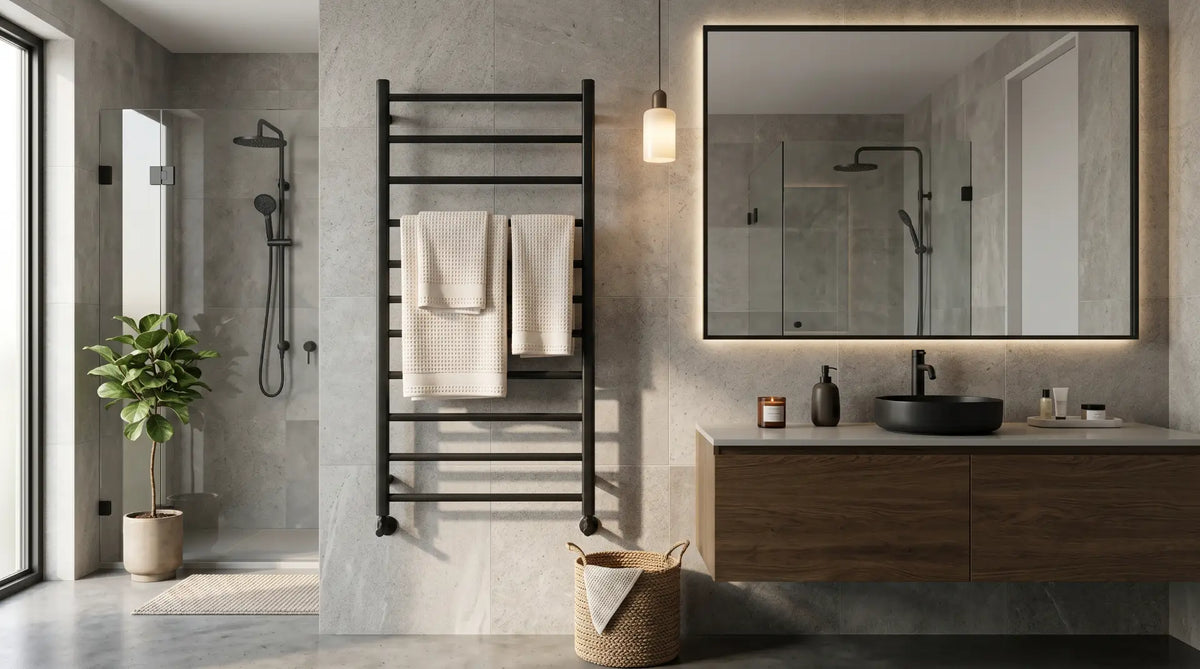
modern luxury bathroom with wall mounted ladder towel warmer glowing softly, warm folded towels on rail

Towel Warmers: Types, Benefits & What to Look For

Accessory Guide · Bathroom Fixtures Series

A towel warmer is one of the most functional luxury upgrades available in a Canadian bathroom - and one of the most frequently bought wrong. This guide covers every type, the electric vs. hydronic decision, wattage sizing, finish matching, running costs, and exactly what to specify before you buy.

Towel warmer buying guide Best towel warmer bathroom Electric vs hydronic · Wattage · CSA certified · Canadian market Ladder rail · Flat panel · Wall-mounted · 2026
B
Amon
A bathroom design expert and writer at Bathify, Amon specialises in creating content around smart layouts, premium fixtures, and modern aesthetics. His work bridges the gap between visual appeal and practical functionality, guiding homeowners toward beautifully designed and highly efficient bathroom spaces.
· bathify.ca
Part of the complete guide
Bathroom Fixtures Guide: Faucets, Finishes & What to Buy (2026)
→
$2-5
Monthly electricity cost of a towel warmer on a programmable timer - vs. $10-$20 running all day without one
60-80W
Correct wattage range for a single-bar electric towel warmer drying one towel - the most common under-specified purchase
#1
Reason towel warmers are returned in Canada - finish mismatch with existing bathroom hardware
CSA
Required certification for all electric towel warmers installed in Canadian bathrooms - CE marking alone does not qualify

In a country where bathroom temperatures drop in October and do not reliably recover until April, a warm towel after a shower is not a luxury in the way it might be in warmer climates - it is a genuinely functional comfort that changes the daily experience of a bathroom. Towel warmers accomplish this at a relatively modest cost, and in doing so they also serve as one of the most effective visual upgrades available in a bathroom renovation: a well-specified towel warmer in the right finish replaces the towel bar that every bathroom already has, adds a design detail that reads as premium, and provides a functional benefit that no standard towel bar offers.

The problem is that towel warmers are purchased wrong more often than almost any other bathroom fixture - wrong wattage that barely heats the towel, wrong finish that clashes with the faucet, wrong type (hydronic when the home cannot support it, or undersized electric that runs hot on one bar and cold on the next). This guide eliminates all of those mistakes.

Why towel warmers are particularly valuable in Canadian homes

Canadian winters mean bathrooms are cold spaces for five to seven months of the year. A damp towel hanging in a cold bathroom does not dry between uses - it stays damp, develops a musty odour within two or three days, and requires laundering more frequently. A towel warmer solves both the comfort problem (a warm towel after stepping out of a hot shower into cold air) and the hygiene problem (warm air circulation from the heated rail dries the towel fully between uses, reducing bacterial growth and extending the time between washes). In Canadian homes, a towel warmer is genuinely dual-purpose in a way that it is not in climates where bathroom temperatures are naturally mild year-round.

● ● ●
Type 01
Electric towel warmers - the right choice for most Canadian homes
01
Electric Towel Warmers - self-contained, no plumbing required
Plug-in or hardwired · Works in any bathroom · The standard Canadian renovation choice
Best for Most

Wall-mounted electric towel warmer with folded towel in a modern minimalist bathroom setting

An electric towel warmer contains a self-contained electric heating element - a resistance wire or fluid-filled sealed tube - that heats when current passes through it. It connects to the home's electrical system either through a plug into a nearby GFCI outlet (plug-in models) or through a hardwired junction box in the wall (hardwired models). No plumbing modification is required, which means an electric towel warmer can be installed in any bathroom that has a suitable electrical connection - including retrofits into existing bathrooms where opening walls for plumbing is not practical or desirable.

This is the format that accounts for the overwhelming majority of towel warmer installations in Canadian residential bathrooms. Electric models are available in every style (ladder rail, flat panel, and plug-in freestanding), every finish that matches current Canadian hardware preferences, and a wide wattage range to suit bathrooms of different sizes and towel loads. The installation is straightforward - mounting brackets into studs or wall anchors, connecting the electrical, and the unit is operational. The running cost is low, particularly with a programmable timer, and the unit operates independently of the home's heating system - it performs identically in summer and winter.

Installation: Plug-in to GFCI outlet, or hardwired - no plumbing change needed Heating element: Resistance wire (dry) or sealed fluid-filled tube (wet/oil-filled) Best for: All Canadian residential bathrooms - new build, full reno, or retrofit Wattage range: 40W-300W depending on rail count and size Required certification: CSA or UL listed - mandatory for Canadian bathroom installation
Dry vs. Wet

Within electric towel warmers, the two main heating technologies are dry element (resistance wire running inside the rail tubes) and wet/fluid-filled (sealed oil or glycol solution inside the rail tubes that is heated by an element and circulates through the rails). Fluid-filled models heat more evenly across all rails - every bar reaches a consistent temperature because the liquid circulates. Dry element models can have temperature variation between bars closer to and farther from the heating element, particularly on long multi-bar units. For a unit with four or more bars, specify fluid-filled for the most even towel-warming performance.

What to confirm before buying
  • Electrical situation confirmed - GFCI outlet nearby for plug-in, or hardwired junction box planned with a licensed electrician
  • CSA or UL certification confirmed on the product listing - CE marking alone does not meet Canadian code
  • Heating technology confirmed - fluid-filled for 4+ bars; dry element acceptable for 1-3 bar units
  • Wattage appropriate to rail count confirmed - see wattage guide below
  • Finish confirmed to match dominant fixture finish in the bathroom
02
Hydronic Towel Warmers - connected to the home's hot water system
Plumbing connection required · Operates on home heating schedule · Premium specification for new builds and full renovations
Renovation Only

Hydronic towel warmer mounted on a bathroom wall with neatly hung white towels in a modern, softly lit interior

A hydronic towel warmer connects to the home's central hot water heating system - typically a boiler-fed radiant system or a domestic hot water supply - and uses the circulating hot water to heat the rail tubes. When the home's heating system is running, the towel warmer operates passively as part of that system, with no separate electrical requirement for the heating function. The visual result is identical to an electric ladder rail, but the operating cost is integrated into the home heating bill rather than a separate electrical draw.

Hydronic towel warmers are a premium specification that makes strong practical sense in new builds or full bathroom renovations where the rough-in plumbing can be planned - supply and return pipes need to be run to the towel warmer location, which requires wall access and a licensed plumber. They are not a retrofit option in most existing Canadian bathrooms without significant wall work, and they depend on the home's heating system operating - in summer months or shoulder seasons when the heating is off, a hydronic warmer does not function unless a separate electric element is added (some dual-fuel models include this). For most Canadian homeowners retrofitting an existing bathroom, electric is the correct choice. For a new build or a renovation where walls are already open, hydronic is worth considering if the home has a radiant heating system.

Installation: Plumbing connection to hot water system - licensed plumber required Best for: New builds, full renovations with open walls, homes with hydronic radiant heating Limitation: Does not operate when home heating system is off - summer functionality requires dual-fuel model Cost: Higher installation cost due to plumbing rough-in - lower ongoing operating cost integrated into heating bill
⚠️ Do not attempt to connect a hydronic towel warmer to a domestic hot water supply (the same line that feeds your taps and shower) without a plumber's assessment. A direct open-loop connection to domestic hot water is not appropriate for most hydronic towel warmers - they require a closed-loop connection to a heating circuit, not the potable water supply. Connecting incorrectly can cause mineral buildup in the rails, corrosion, and pressure issues that damage both the warmer and the plumbing system. Always use a licensed plumber for hydronic towel warmer installation.
Side-by-side comparison
Electric vs. hydronic - the complete decision guide
⚡ Electric
The standard Canadian residential choice
  • Works in any bathroom with a GFCI outlet or wiring - no plumbing changes
  • Retrofit-friendly - can be added to any existing bathroom
  • Operates independently of home heating - works in summer and winter equally
  • Lower installation cost - mounting and electrical connection only
  • Programmable timer means minimal electricity cost ($2-$5/month on timer)
  • Wide availability at Canadian retailers across all price points
  • Fluid-filled models heat evenly across all bars - specify for 4+ bar units
🔥 Hydronic
Premium new-build and renovation specification
  • Operating cost integrated into home heating - no separate electricity draw for heating
  • Consistent heat output while home heating system is active
  • No electronic components to fail - mechanically simple once installed
  • Ideal when walls are already open during a full renovation
  • Requires licensed plumber for installation - higher upfront cost
  • Does not function when home heating is off - summer limitation unless dual-fuel
  • Not a retrofit option in most finished Canadian bathrooms
Decision Factor Electric Hydronic Better Choice
Existing bathroom retrofit Yes - plug-in or hardwired with minimal wall work No - requires opening walls for plumbing rough-in Electric
New build or walls-open renovation Yes - still simpler to install Yes - ideal scenario for hydronic planning Hydronic if radiant system present
Summer operation Full function year-round No heat when home heating is off - unless dual-fuel Electric
Operating cost (long term) Low with timer ($2-$5/month); moderate without ($10-$20/month) Integrated into heating bill - effectively near-zero incremental cost Hydronic (long-term)
Installation cost Low - electrical connection only; $100-$250 for electrician if hardwired High - plumbing rough-in and connection; $400-$900+ depending on access Electric
Home without radiant heating Works on any electrical circuit Not practical - requires a compatible hot water heating circuit Electric
Home with hydronic radiant heating Works - still the simpler installation Natural fit - ties into existing system with no extra operating cost Either - personal preference
● ● ●
Style formats
Ladder rail, flat panel, plug-in freestanding - which style suits your bathroom
🪜
Ladder Rail
Most Popular
Vertical frame with horizontal bars - the most common towel warmer format in Canadian renovations. Replaces a standard towel bar. Available in narrow (2-3 bars) to wide (5-7 bars) configurations. Reads as the cleanest and most design-neutral option.
▬
Flat Panel
Design-Forward
Solid flat heating panel mounted flush to the wall - minimalist, architectural, and increasingly specified in contemporary Canadian bathrooms. Heats the towel through contact rather than rail circulation. Best for a single folded bath towel against the panel surface.
🏠
Plug-In Freestanding
No Installation
Floor-standing unit that plugs directly into a standard outlet. No wall mounting required - portable and renter-friendly. Lower wattage than wall-mounted models and suitable for light use. Not a permanent fixture; does not replace a standard towel bar.
↔
Horizontal Bar
Space Saver
A single wide horizontal heated bar - essentially a heated version of a standard towel bar. Lower visual profile than a ladder rail. Best for small bathrooms where wall height is limited or a full ladder rail would be disproportionate.
↕
Vertical Column
Niche Use
A tall narrow unit mounted vertically - effective in narrow wall spaces between a door and a wall, or in a powder room where horizontal space is limited. Heats one folded towel per column effectively.
🔲
Towel Warmer Drawer
Premium Only
A concealed drawer that heats towels from inside - the towel is placed folded in the drawer before a shower and emerges warm. A luxury specification found in high-end Canadian bathroom renovations. Requires vanity integration during design phase.
● ● ●
Wattage guide
Getting the wattage right - the specification most buyers under-specify
⚡
Wattage sizing - why this matters and how to get it right
Bars vs. wattage · Room temperature · Towel load · The most common sizing mistake
Critical Spec

Wattage is the single most important specification in a towel warmer purchase and the one most frequently under-specified. The wattage determines how much heat the unit produces - insufficient wattage means the rails will be warm to the touch but not actually hot enough to dry a damp towel or warm a cold one within a reasonable time. The most common buyer disappointment with towel warmers is purchasing a visually appropriate ladder rail at an attractive price and finding that the towels are tepid rather than warm, and still damp after hanging overnight.

The general sizing rule for electric towel warmers in Canadian bathrooms: 60-80 watts per bar is the minimum for a bar that will actually warm a folded bath towel to a noticeable temperature in a standard Canadian bathroom (typically 18-22°C). A five-bar ladder rail at 60W per bar requires 300W total. Many entry-level and mid-range towel warmers are sold with total wattage significantly below this threshold - a 5-bar unit at 100W total, for example, is producing only 20W per bar, which will be barely perceptible on a towel.

60W
Per Bar Minimum
The minimum wattage per rail bar to noticeably warm a folded bath towel. Below this, rails feel warm but do not deliver functional heat.
80W
Per Bar Recommended
The recommended target for a Canadian bathroom - rails are comfortably warm after 15-20 minutes and effectively dry a damp towel between uses.
120W
Per Bar Premium
High-output specification for larger bathrooms, colder starting temperatures, or heavier towel loads (bathrobes, multiple towels per bar).
×bars
Total Wattage
Multiply per-bar wattage by the number of bars to get total unit wattage. Use this figure to compare products - not the bar count alone.
🔢 How to calculate what you need: count the number of bars on the unit you are considering, then divide the total wattage by the bar count. If the result is below 60W per bar, the unit is under-specified for functional towel warming in a Canadian bathroom. Example: a 5-bar unit at 250W = 50W per bar - inadequate. A 5-bar unit at 400W = 80W per bar - correct specification. Always calculate watts-per-bar, not just total wattage, when comparing units with different rail counts.
● ● ●
Running costs in Canada
What a towel warmer actually costs to run - with and without a timer

The electricity cost of running a towel warmer is the detail that concerns most Canadian buyers - and the detail that changes most dramatically based on whether a programmable timer is used. Here is an honest cost breakdown using the Canadian average electricity rate of approximately $0.16/kWh (Ontario average - rates vary by province).

Monthly electricity cost - 150W towel warmer at $0.16/kWh (Ontario average)
No timer - running 24 hours/day
$17/month
150W × 24hrs × 30 days = 108 kWh × $0.16. Significant and unnecessary - no one uses a towel warmer 24 hours a day.
Timer - 2 hrs morning + 1 hr evening daily
$2.16/month
150W × 3hrs × 30 days = 13.5 kWh × $0.16. The practical cost of a towel warmer used correctly with a timer - essentially negligible.
Timer - 1.5 hrs morning only
$1.08/month
150W × 1.5hrs × 30 days = 6.75 kWh × $0.16. For single-shower households - well under the cost of a coffee per month.
Smart plug - motion-activated or schedule
$1-3/month
A smart plug ($15-$30 CAD) paired with a schedule or motion trigger achieves comparable control to a built-in timer on plug-in models that lack one.
⚠️ A towel warmer without a programmable timer is the most expensive version of this fixture to operate - and the operating cost is entirely avoidable. Always specify a built-in programmable timer on hardwired models, or pair a plug-in model with a smart plug or mechanical outlet timer. The timer pays for itself within the first month of use compared to a unit running uncontrolled. The timer is not optional - it is the specification that determines whether the running cost is negligible ($2-$5/month) or meaningful ($15-$20/month).
● ● ●
Finish & sizing
Matching finish to your hardware - and sizing the unit to your wall space
🎨
Finish selection - the one-finish rule and why towel warmers are where it most often breaks
Match to faucet, towel bar, toilet paper holder · Why this is the most common return reason
Design Rule

Matte black towel warmer matching other bathroom fixtures in a modern cohesive bathroom design

The towel warmer finish must match the dominant fixture finish in the bathroom - the same finish as the faucet, existing towel bar, toilet paper holder, and robe hook. This is the rule that results in the most towel warmer returns in Canada: a homeowner selects a towel warmer based on style and wattage, orders it in polished chrome because it was the only finish in stock, and installs it in a bathroom where every other fixture is matte black. The visual inconsistency is immediately obvious and deeply undermining to an otherwise well-designed bathroom.

The finishes available in towel warmers at Canadian retailers closely track the main bathroom hardware finish categories: matte black (the most popular finish for new renovations since 2021), brushed nickel (the most widely installed finish in Canadian homes overall and the most broadly available across towel warmer products), brushed gold (growing availability at mid and premium price points), and polished chrome (still the most commonly stocked entry-level finish). If your bathroom hardware is in a less common finish - gunmetal, venetian bronze, unlacquered brass - confirm the towel warmer is available in that finish before finalising any other aspect of the purchase. Finish availability varies more in towel warmers than in faucets or towel bars.

Finish rule: Match exactly to dominant fixture finish - no exceptions Most available: Brushed nickel, matte black, polished chrome - widest selection at Canadian retailers Growing availability: Brushed gold - confirm stock before selecting a unit Top return reason: Finish mismatch - confirm finish against physical fixture sample, not screen colour If in doubt: Order from the same manufacturer collection as your existing towel bars - finish consistency is guaranteed within a single collection
📐
Sizing the unit - height, width, bar count, and wall space
Proportional to the wall · Bar count vs. towel load · Common sizing mistakes
Sizing

Properly sized towel warmer with multiple bars holding towels in a balanced modern bathroom setting

A ladder rail towel warmer should be proportional to the wall space it occupies and appropriate to the number of towels it will need to warm. The two most common sizing mistakes are opposite: buying a unit too narrow for the wall (a slim 3-bar unit on a wall that has room for a 5-bar, which reads as underdressed) and buying a unit with too many bars for the actual towel load (a 7-bar warmer that is never loaded beyond 2 bars, which wastes wattage and looks cluttered when in use).

A practical framework: match the towel warmer bar count to the number of towels in active use, then confirm the unit's overall height and width are proportional to the wall. For a primary bathroom used by two people, a 4-5 bar unit typically accommodates two full bath towels plus a hand towel simultaneously. For a single-person ensuite, a 3-bar unit is correct. For a shared family bathroom with three or more users, consider two separate units on different walls rather than one very large unit - distributing the towel storage reads better than a single oversized rail.

Bathroom / Household Type Recommended Bar Count Total Wattage (at 75W/bar) Notes
Single-person ensuite 2-3 bars 150-225W One bath towel plus one hand towel. A narrow 2-bar unit fits even the smallest ensuite wall.
Primary bath - couple 4-5 bars 300-375W Two full bath towels plus one hand towel comfortably. The most common residential specification.
Family bathroom - 3-4 users 5-6 bars, or two separate 3-bar units 375-450W per unit Consider two units on different walls rather than one large unit - better towel distribution and lower peak load on a single circuit.
Guest bathroom (occasional use) 2-3 bars 150-225W A guest bathroom towel warmer serves as much a visual/luxury signal as a functional one - 3 bars is visually appropriate and provides ample capacity for occasional use.
Powder room 1-2 bars (hand towel size) 60-120W Powder rooms require a hand-towel-scale warmer, not a full bath towel unit. A single heated horizontal bar is appropriate here.
● ● ●
Installation requirements
Electrical requirements, wall mounting, and what to confirm before buying
🔧
What you need in place before the towel warmer arrives
GFCI outlet · Stud locations · Hardwired vs. plug-in decision · Clearance from water sources
Pre-Install

For a plug-in electric towel warmer, the pre-installation requirement is a GFCI outlet within reach of the power cable - typically 1.5-2 metres. The outlet must be GFCI (Ground Fault Circuit Interrupter) - standard non-GFCI outlets do not meet the Canadian Electrical Code requirements for bathroom electrical fixtures. Confirm the outlet at the planned installation wall is GFCI before purchasing a plug-in model. If the nearest outlet is not GFCI, a licensed electrician must upgrade it before installation.

For a hardwired model, a licensed electrician must install a junction box at the towel warmer location before the unit is mounted. This is the cleaner installation - no visible power cord - and the preferred approach when aesthetics are a priority. The hardwiring work is straightforward but must meet CEC requirements for bathroom electrical work, including GFCI protection on the circuit. For wall mounting, the towel warmer must be anchored to wall studs or to hollow-wall anchors rated for the unit's weight. Most ladder rail towel warmers weigh 4-10 kg empty - confirm the anchor system is rated at a minimum of twice the unit weight, and more if towels will add significant load.

Plug-in: GFCI outlet within 1.5-2m of unit location - confirm before purchasing Hardwired: Licensed electrician required - junction box must be installed before mounting Wall anchoring: Stud preferred; hollow-wall anchors must be rated for unit weight + towel load CEC clearance: Electric towel warmers must maintain minimum clearance from water sources per the Canadian Electrical Code - confirm placement with electrician CSA/UL: Confirm on the unit's label before installation - CE marking alone does not meet Canadian code
Pre-installation checklist
  • GFCI outlet confirmed at installation wall - or hardwired junction box planned with electrician
  • Stud locations at installation wall marked - or hollow-wall anchors rated for unit weight selected
  • Unit weight from spec sheet confirmed - anchoring system rated at minimum 2× unit weight
  • CSA or UL certification confirmed on the unit - check the label, not just the listing
  • Power cable route confirmed (for plug-in) - cable can reach outlet without crossing open floor space
  • Finish confirmed against physical fixture in the bathroom - not screen colour
● ● ●
Budget guide
What to expect at each price point in the Canadian market
Price (CAD)
What You Get
Best For
Under $200
Entry-level units - typically under-wattaged (20-40W per bar), limited finish options (chrome only at this tier), no built-in timer, and frequently without CSA certification. May be adequate as a decorative accent but will not deliver meaningful towel warming in a Canadian bathroom.
Not recommended for primary or ensuite bathrooms. Acceptable only as a purely decorative installation in a powder room where functional warming is not the goal.
$200-$400
Transition zone - some products in this range begin to offer adequate wattage (6-75W per bar) and CSA certification. Finish options expand to include brushed nickel and matte black at the top of this range. Research specific product wattage and certification carefully - quality varies significantly.
Secondary bathrooms and guest baths where the towel warmer will see moderate use. Confirm wattage before buying - do not assume adequate output based on price alone.
$400-$700
The recommended range for most Canadian primary bathrooms. Proper wattage (75-100W per bar), full finish selection including matte black and brushed nickel, built-in programmable timer standard on most models, CSA listed, fluid-filled heating technology in multi-bar units. The sweet spot of quality and value for a fixture that will be used daily for 10+ years.
Primary baths, ensuites, any bathroom where the towel warmer will see daily heavy use. The investment range that eliminates buyer disappointment.
$700-$1,400
Premium and European-specification units - higher-grade stainless steel construction, more refined finish quality (particularly in brushed gold and speciality finishes), designer ladder rail proportions, dual-fuel capability (electric + hydronic). Some units in this range include integrated timers with Wi-Fi control.
Premium renovations, luxury listings, bathrooms where the towel warmer is a visible design focal point rather than a utility fixture tucked in a corner.
● ● ●
Towel warmer buying checklist
Complete before purchasing any towel warmer for a Canadian bathroom - plug-in or hardwired, electric or hydronic
Type & format
  • Electric confirmed as the correct type for the installation (existing finished bathroom, no plumbing access) - or hydronic confirmed with licensed plumber for new build / open-wall renovation
  • Style format selected - ladder rail, flat panel, horizontal bar, or plug-in freestanding - appropriate to wall space and design
  • Bar count appropriate to towel load - 2-3 bars for single user; 4-5 bars for couple; 5-6 bars or two units for family
Wattage
  • Total wattage divided by bar count calculated - result must be 60W minimum per bar; 75-80W recommended for Canadian bathroom conditions
  • Fluid-filled heating technology confirmed for units with 4+ bars - ensures even heat distribution across all rails
  • Wattage appropriate for room size - larger bathrooms and colder starting temperatures may require 100W+ per bar
Timer & controls
  • Built-in programmable timer confirmed - or smart plug / mechanical outlet timer purchased alongside unit
  • Timer schedule planned: heating window aligned with actual shower schedule (typically 30-60 min before shower time to 30 min after)
  • Wi-Fi or smart control feature assessed - useful if shower schedule is variable; unnecessary for fixed-schedule households
Finish & design
  • Finish confirmed against physical fixture in the bathroom - not screen colour match
  • Finish availability in selected unit confirmed - not all towel warmer models available in all finishes
  • Unit height and width proportional to installation wall - not under-sized for the space
Safety & installation
  • CSA or UL certification confirmed on product label - CE marking alone does not meet Canadian electrical code
  • GFCI outlet confirmed at installation wall (plug-in) - or electrician booked for hardwired installation
  • Wall mounting anchoring planned - studs identified or hollow-wall anchors rated for unit weight + towel load selected
  • For hydronic: licensed plumber consulted before purchase - connection type and compatibility with home heating system confirmed
● ● ●
Common questions answered
Frequently asked questions
Q
How long does it take for a towel warmer to heat up from cold?
A properly wattaged electric towel warmer (75-80W per bar) reaches operating temperature in approximately 15 to 30 minutes from a cold start in a standard Canadian bathroom. Fluid-filled models typically take slightly longer to reach full temperature than dry element models because the fluid requires more energy to heat, but they distribute that heat more evenly once at temperature. This warm-up time is the primary reason a programmable timer is so valuable - setting the warmer to activate 30 minutes before your typical shower time means the rails are already at full temperature when you step out, rather than asking you to wait after the fact. A towel placed on a cold warmer and left for 30 minutes will be warm throughout, but the experience of hanging a towel on an already-warm rail is significantly better and is the use pattern the fixture is designed for.
Q
Can I leave a towel warmer on all the time, or does it need to be turned off?
Quality electric towel warmers are designed to operate continuously and are safe to leave on - they reach a stable operating temperature and maintain it without risk of overheating. That said, running a towel warmer continuously is unnecessary and expensive. At 150W running 24 hours a day, the monthly electricity cost is approximately $17 CAD at Ontario rates - an avoidable cost given that the warming function is only needed for 30-60 minutes twice a day for most households. A programmable timer or smart plug reduces this to $2-$5 per month with no change to the functional benefit. The answer is: it is safe to leave on, but it is a poor use of electricity and money. Specify a timer - it is the correct way to operate this fixture.
Q
Does a towel warmer actually dry towels, or does it just warm them?
A properly wattaged towel warmer does both - it warms towels immediately before use and dries them between uses. A damp towel hanging on a heated rail for two to four hours (for example, between a morning shower and the next day) will be fully dry by the next use because the warm air rising from the heated rails circulates around the towel and evaporates moisture continuously. This is one of the most practically useful functions of a towel warmer in a Canadian winter context - a towel hanging in a cold bathroom in January may take 24-48 hours to dry fully between uses, which results in a musty smell and the need to launder more frequently. A towel on a heated rail dries within two to four hours and is ready for the next use without any hygiene concern. An under-wattaged warmer - below 60W per bar - may warm a dry towel slightly but will not generate enough continuous heat to dry a damp one reliably. This is the functional difference between a properly specified and an under-specified unit.
Q
Is a towel warmer worth it for a bathroom that also has in-floor heating?
Yes - in-floor heating and a towel warmer solve different problems. In-floor heating warms the room and the floor surface, which is a significant comfort improvement in a cold Canadian bathroom. But it does not warm a towel - a towel hanging on a standard towel bar in a room with in-floor heating is simply hanging in a somewhat warmer room. The towel still dries slowly in a damp post-shower environment, and it is not warm when you reach for it. A towel warmer addresses the towel directly - heating and drying it at the source rather than relying on ambient room temperature. In a bathroom with both in-floor heating and a towel warmer, the floor keeps your feet warm and the warmer keeps your towel warm - they are complementary, not substitutes.
Q
Can I install a towel warmer myself, or do I need an electrician?
For a plug-in towel warmer where a CSA-compliant GFCI outlet already exists at the installation wall, installation is fully DIY: mount the brackets to the wall (into studs or rated hollow-wall anchors), hang the unit, and plug it in. The physical installation requires basic hand tools and typically takes 30-60 minutes. For a hardwired towel warmer - where the unit connects directly to the home's electrical system through a junction box - a licensed electrician is required under the Canadian Electrical Code. The hardwiring itself is a simple connection, but it must be done to CEC specifications including GFCI protection on the circuit and the correct wire gauge for the unit's wattage. In most Canadian provinces, homeowners may do their own electrical work under a homeowner permit, but bathroom electrical work specifically involves GFCI and wet-area regulations where errors have safety consequences. For a hardwired installation, using a licensed electrician is the lower-risk choice and the cost - typically $100-$250 CAD for the connection - is a small fraction of the fixture cost.

Shop towel warmers at Bathify - shipped across Canada

Browse electric ladder rail and flat panel towel warmers in matte black, brushed nickel, brushed gold, and more - all CSA certified and shipped free on orders over $50.

Want more Canadian bathroom and kitchen guides like this? Add Bathify as a preferred source to see more of our Canadian bathroom renovation tips, kitchen design ideas, buying guides, and expert advice in Google Search, Top Stories, and AI Overviews.
Add to Preferred Sources
Previous Post Next Post