






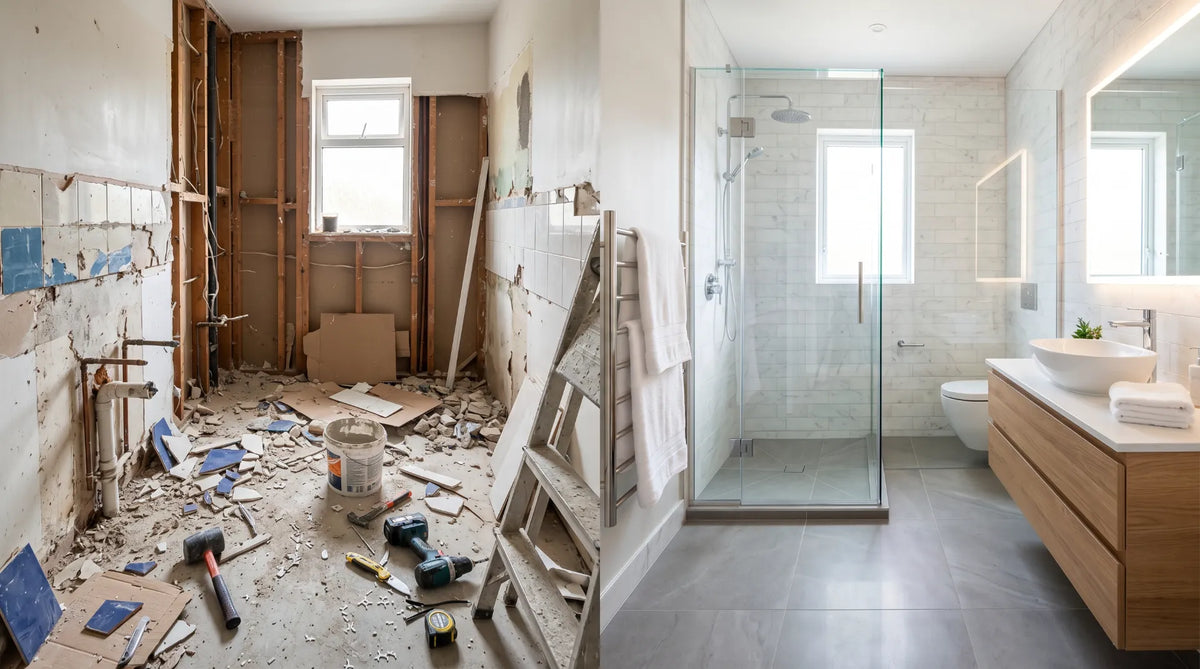
Most bathroom renovation regrets in Canada aren't caused by bad contractors or bad materials - they're caused by decisions made before the first tool was picked up. This guide covers the fifteen most common and most costly mistakes Canadian homeowners make, what each one actually costs, and the specific action that prevents each one.
Bathroom renovation regret in Canada follows consistent patterns. The specific tile, vanity, or fixture that a homeowner wishes they'd chosen differently accounts for a minority of cases. The majority of renovation regret traces back to decisions made in the planning phase - or decisions that should have been made but weren't - before the first wall was opened. Inadequate budgeting, skipped inspections, rushed curing times, and design decisions made mid-construction account for a disproportionate share of the projects that run over budget, over time, or produce results that disappoint on completion day.
This guide covers fifteen of the most common and most costly bathroom renovation mistakes in Canada. Each one has a clear cause, a quantifiable cost impact, and a specific prevention - not generalised advice, but the exact decision or action that eliminates the mistake before it becomes a problem. Work through this list before signing any contractor and before placing any order.
Almost every costly bathroom renovation mistake in Canada shares the same root: a decision that was deferred, assumed, or skipped because it seemed like a detail rather than a foundation. The waterproofing membrane skipped to save $300. The permit not pulled because it seemed like extra bureaucracy. The fixture ordered without confirming the rough-in measurement. The contractor selected because they were available immediately rather than because their work was verified. These are not random bad luck - they are predictable, preventable decisions. The value of this guide is not in the list of mistakes but in internalising the discipline of confirming specifics before committing, rather than assuming defaults and discovering gaps mid-project.

Every experienced Canadian contractor includes a contingency line in their mental budget - because hidden conditions discovered at demolition are not rare exceptions, they are a reliable statistical expectation. Subfloor rot from a slow toilet leak, mould in wall cavities behind old tile, asbestos-containing materials in pre-1985 homes, cast iron drain pipes requiring modification - these are discovered in a meaningful proportion of Canadian bathroom renovations and cannot be known until walls are opened. A homeowner who has budgeted to the quoted amount with no contingency is forced into one of three bad outcomes when a hidden condition is discovered: delay the project while finding additional funds, cut scope elsewhere to compensate, or accept shoddy workmanship from a contractor asked to do the same work for less money.
- Budgeting exactly to the contractor's quote with nothing held back
- Treating "no surprises" as the expected outcome rather than the best case
- Cutting contingency to fund a more expensive fixture or finish
- Build 15-20% contingency into the budget from day one, before getting any quotes
- Keep contingency funds liquid and accessible - not in a fixed savings product
- If no hidden conditions are discovered, apply contingency to the post-renovation punch list

Tile is not waterproof. Grout is not waterproof. The only waterproof layer in a tiled shower is the continuous membrane installed behind the tile on all shower surfaces - walls, floor, and the inside of any niche. When this membrane is omitted (to save money, because of an inexperienced installer, or because the homeowner didn't know to ask), water migrates through grout joints and tile into the wall cavity and subfloor. The damage accumulates invisibly for months or years before becoming detectable as mould, subfloor rot, or structural deterioration - at which point the remediation cost is three to ten times what the waterproofing membrane would have cost.
This is the most reliably preventable expensive mistake in Canadian bathroom renovations. The waterproofing membrane (Schluter Kerdi, Laticrete Hydro Ban, or equivalent) adds $200-$500 CAD to the material cost of a shower installation. Remediating a waterproofing failure - opening the shower, removing tile, treating mould or rot, replacing substrate, and retiling - costs $3,000-$8,000 CAD minimum. Ask every tile setter candidate directly: "What waterproofing system do you use in shower installations?" A correct answer names a specific product and installation method. An answer of "we use cement board" or "the tile is waterproof" is a disqualifying response.
- Assuming cement board is sufficient waterproofing (it is not - it is moisture-resistant substrate, not a waterproof barrier)
- Hiring a tile setter who doesn't mention waterproofing without being asked
- Accepting "we've always done it this way" as justification for omitting membrane
- Skipping niche interior waterproofing to save installation time
- Specify waterproofing membrane in writing in the scope of work - Schluter Kerdi, Laticrete Hydro Ban, or equivalent named product
- Ask tile setter to confirm membrane is applied to all shower surfaces including niche interiors before tile begins
- If possible, visually inspect membrane installation before tile substrate is covered

Rough-in measurements determine which fixtures can be installed in a specific bathroom without modifying the existing plumbing. The toilet rough-in distance (from the finished wall to the centre of the drain) is the most critical and the most commonly overlooked measurement - Canadian homes have 10-inch, 12-inch, and 14-inch rough-in configurations, and most standard toilets are designed for 12 inches. Installing a 12-inch rough-in toilet in a 10-inch rough-in space requires either moving the drain or purchasing a toilet with an adjustable rough-in adapter - both of which add $300-$1,200 CAD to the project cost. Vanity depth is the second critical measurement: a vanity specified at 21 inches of depth in a bathroom where the existing rough-in for the sink drain is set for a 16-inch-depth cabinet will either not reach the drain or will require plumbing modification.
- Ordering a toilet without measuring the rough-in from wall to drain centre
- Ordering a vanity based on dimensions listed online without confirming existing sink drain position
- Assuming all Canadian homes have the same standard rough-in dimensions
- Measure toilet rough-in before ordering: from finished wall (not baseboard) to centre of drain
- Measure existing vanity drain and supply positions before ordering new vanity
- Confirm fixture specifications against rough-in measurements before placing any order
- When in doubt, have your plumber take all measurements before any fixture is ordered

In a competitive bathroom renovation market, the contractor offering the lowest quote is statistically the most likely to achieve that price by underestimating the scope, omitting items that should be included (waterproofing membrane, permit, self-levelling compound), or planning to use the lowest-quality materials and labour that will pass visual inspection at completion. A quote that is 25% below the other two quotes is almost never a contractor who is more efficient - it is a contractor who has costed the project differently, and the difference will manifest either as scope omissions or as a mid-project price increase once the work has started and leverage has shifted.
The selection criterion for a Canadian bathroom contractor should be: verified portfolio of comparable completed work, references who can be called (not just read online), current licence and insurance documentation, and a detailed written quote that itemises scope rather than providing a single number. Price comparison is valid between contractors who have quoted the same itemised scope - it is not valid between a detailed quote and a summary quote that may be excluding critical line items.
- Selecting contractor based on price alone without verifying what was included in the quote
- Not calling references - reading online reviews is not equivalent
- Not asking for licence and insurance documentation before signing
- Accepting a quote that is a single number rather than an itemised scope
- Get minimum 3 quotes - all against the same itemised written scope
- Call two references for each contractor who makes the shortlist
- Request licence number and confirm active liability insurance in writing
- Select on value (verified quality at a competitive price) - not on lowest number

Bathroom renovations that involve plumbing, electrical, or structural changes require a building permit in most Canadian municipalities. Skipping the permit is the decision that feels like a shortcut and functions as a time bomb. The immediate saving is $100-$600 CAD in permit fees and 1-3 weeks of wait time. The consequences: an obligation to disclose unpermitted work when the home is sold (failure to disclose is a legal liability), potential difficulty obtaining home insurance if a claim arises related to the unpermitted work, and the possibility of a municipal order to open completed walls for inspection - at the homeowner's cost.
In competitive Canadian real estate markets, buyers' home inspectors increasingly check municipal permit records as part of their due diligence. An unpermitted bathroom renovation flagged in an inspection report gives buyers significant negotiating leverage or a reason to walk away entirely. The permit also provides a protection for the homeowner: it guarantees that the work is inspected by a qualified municipal inspector before walls close, which catches errors that become expensive if discovered later.
- Assuming "it's just a bathroom renovation" doesn't require a permit
- Accepting a contractor's suggestion to skip the permit "to save time"
- Not disclosing unpermitted work to buyers - a legal liability
- Confirm permit requirement with your municipal building department before signing any contractor
- Include permit application as a specific line item in the contractor's scope of work
- Confirm the permit number and inspection schedule before construction begins

Changing a design decision after demolition has begun - moving the shower from one wall to another, switching from a tub to a walk-in shower, upgrading the tile after the tile was already ordered, changing the vanity location - is the single most controllable source of renovation cost overruns and timeline extensions in Canada. Each mid-renovation change cascades: the plumber must reroute, the tile setter must re-layout, the order must be cancelled and reordered (potentially losing lead time on a backordered item), and the contractor must re-sequence the trade schedule. A change that costs $200 if decided before demolition costs $1,500-$4,000 when decided after walls are open and trades are scheduled.
The prevention is complete decision-making before signing the contract - not before beginning construction, but before signing the contract. Every design decision - tile, vanity, fixtures, hardware, shower configuration, lighting positions, paint colour - should be finalised before a contract is signed and a start date is set. Decisions left as "we'll figure it out" when construction begins will be made under time pressure with limited options, and the results are almost always more expensive and less satisfying than decisions made with adequate time for research and reflection.
- Signing a contractor without all design decisions finalised
- "We'll decide the tile once we see the vanity installed"
- Changing a key element (shower location, vanity size) after rough-in has begun
- Ordering a replacement item after discovering the original doesn't work on site
- Create a complete design decision list and mark every item as CONFIRMED before signing contractor
- Order all materials with confirmed lead times before setting a start date
- Do not sign the contract until every fixture, tile, vanity, and hardware piece has been selected
- Build a "change freeze" into the project: no design changes after contract is signed

The two most commonly rushed steps in Canadian bathroom tile installations - thinset adhesive cure before grouting, and grout cure before water exposure - cause the two most commonly encountered early-stage tile failures. Thinset adhesive needs 24-48 hours to cure before grout is applied; grout needs 72 hours before the shower is used with water. Both timeframes are chemistry-driven: the adhesive and grout are undergoing chemical hardening reactions that produce their final strength and density on a timeline that no amount of scheduling pressure can accelerate. Using a shower before grout has fully cured produces grout that is permanently porous, discolours unevenly, cracks at joints, and in some cases separates from the tile face - a failure that requires full grout removal and reapplication at a cost of $800-$2,500 CAD.
- Grouting over thinset that has been setting for less than 24 hours
- Using the shower within 24-48 hours of grouting because "it looks dry"
- Accepting a contractor's suggestion to "let it go a bit early this time"
- Sealing grout before the full cure - sealing locks in moisture that prevents complete curing
- Confirm cure times with tile setter in writing at project start: thinset 24-48hr, grout 72hr
- Do not negotiate cure times regardless of scheduling pressure
- If the contractor suggests shortened cure times, document it and hold the line
- Seal grout only after full cure - minimum 72 hours for cement grout, longer for darker colours

Two material ordering mistakes cause a disproportionate share of Canadian bathroom renovation delays and disappointments. The first: ordering materials without confirming in-stock availability or lead times, then discovering mid-renovation that a key item (a specific vanity, a frameless glass panel, a specialty tile) is backordered for eight weeks. The second: ordering tile in multiple rounds from the same product but different dye lots, then discovering after installation that the second delivery has a noticeably different tone from the first. Both are preventable with a single confirmation before ordering.
The dye lot issue is particularly insidious because the difference is often not visible in a single tile held in isolation - it becomes visible only when the tiles are installed side by side on a wall or floor. Always order all tile for a room from the same dye lot, with a 10-15% overage built in. When placing the order, ask the supplier to pull all tiles from the same production lot number and set aside the full quantity before you collect or arrange delivery. Keep 5-10 spare tiles from the same lot in storage after installation - if a tile needs replacing years later, the dye lot match will matter.
- Ordering fixtures and starting construction before confirming material availability
- Placing a tile order without specifying a single dye lot for the full quantity
- Ordering tile in multiple deliveries from different stock batches
- Not ordering 10-15% overage, then reordering a small top-up from a different lot
- Confirm in-stock status or lead time for every material before setting the contractor start date
- Request single dye lot fulfilment for all tile orders - confirm lot number on delivery receipt
- Order all tile with 10-15% overage in a single order from the same batch
- Retain 5-10 spare tiles in storage after installation

The exhaust fan is the element most commonly overlooked or underspecified in Canadian bathroom renovations - and the one whose absence or inadequacy produces the most visible long-term damage. A bathroom without adequate ventilation accumulates moisture that causes paint to blister and peel, grout to discolour and grow mould, MDF cabinetry to swell, and - in Canadian homes where exterior walls contain significant insulation - condensation in wall cavities that leads to structural timber moisture damage. Canadian building code requires a minimum of 50 CFM for a standard bathroom and 100 CFM for a combined bath-toilet room. Many existing fans in Canadian homes built before 2000 do not meet this minimum.
The ducting configuration is as important as the fan rating. A fan ducted into the attic rather than through the exterior - common in improperly installed Canadian renovations - deposits warm, humid air into an attic space where it condenses and causes mould on sheathing and roof structure. All bathroom exhaust fans must be ducted to the exterior through the soffit, roof, or wall - not into any interior space. Confirm this in writing in the contractor's scope.
- Keeping the existing undersized exhaust fan during a renovation "to save money"
- Installing a fan-light combo unit without confirming the fan CFM rating meets code
- Accepting ducting into the attic rather than to the exterior
- Not running the exhaust fan during and after every shower - a correctly sized fan that's never turned on achieves nothing
- Specify minimum 50 CFM fan (100 CFM for combined bath-toilet room) in the contractor's scope
- Confirm ducting runs to exterior - soffit, wall, or roof vent - not attic termination
- Choose fan on CFM performance, not appearance or whether it includes a light kit
- Consider a humidity-sensing fan that activates automatically after showers

Certain finish choices that look exceptional in a showroom create disproportionate maintenance demands in a Canadian home used daily under typical municipal water hardness conditions. Polished chrome fixtures show every water drop and require daily wiping to maintain the showroom appearance. Unlacquered brass develops a patina rapidly - beautiful by design for some, distressing for others who expected it to stay bright. Polished marble tile in a shower etches, stains, and dulls quickly without strict pH-neutral cleaning and frequent resealing. Dark grout in a light-use secondary bathroom looks striking; dark grout in a high-use primary bathroom with hard water requires aggressive cleaning to prevent mineral deposit build-up in the joint texture.
The maintenance reality test before any finish decision: ask yourself honestly whether the household will perform the specific maintenance this finish requires, every day or every week, for the next ten years. If the answer is "probably not reliably," select a finish with lower maintenance requirements - matte black over polished chrome, sealed porcelain over honed marble, mid-tone grout over white or very dark grout. The finish that looks 90% as good but requires 20% of the maintenance will produce more satisfaction over a decade than the finish that looks 100% as good on day one and 60% as good after six months of normal use.
- Selecting polished stone or highly textured grout without understanding daily cleaning requirements
- Choosing white grout in a shower without planning for weekly scrubbing or epoxy specification
- Installing unlacquered brass in a hard-water municipal zone without understanding patina development
- Research maintenance requirements of every finish before selecting - ask the supplier explicitly
- Specify epoxy grout in shower zones - substantially lower ongoing maintenance than cement grout
- If selecting natural stone: confirm household will seal annually and use only pH-neutral cleaners

An in-shower ceiling fixture - a single IP65-rated recessed LED - transforms the daily shower experience from a functional to a genuinely pleasant one, and costs $200-$500 CAD incremental when planned during a renovation. The electrical box must be positioned in the shower ceiling during rough-in, before tile substrate and waterproofing are installed. Once the shower is tiled and complete, adding a ceiling fixture requires opening the shower ceiling for access, which in most cases means removing tile from the affected area and retiling - a cost of $800-$2,000 CAD for what would have been a $200 addition during the renovation. This is one of the clearest examples in bathroom renovation of a decision that is inexpensive when made at the right moment and expensive when deferred to the wrong moment.
- Assuming the bathroom ceiling fixture provides adequate light inside a glass-enclosed shower
- Deciding against in-shower lighting during rough-in to save $200 - then regretting it after tile is complete
- Not including in-shower lighting in the electrical rough-in scope
- Include IP65-rated recessed LED in shower ceiling in the electrical rough-in scope - always
- Confirm electrical box is positioned before tile substrate and waterproofing are installed
- The decision to not use it later costs nothing; the decision to add it later costs $800-$2,000

In a small bathroom - which describes the majority of Canadian bathrooms - every metal surface is in direct visual proximity to every other. A matte black faucet, a chrome towel bar, a brushed nickel toilet paper holder, and a polished brass mirror frame are not separate design decisions when the room is 5×8 feet: they are all visible simultaneously and they read as a collection of unrelated purchases rather than a coordinated design. This is the most common finish mistake in Canadian bathroom renovations and one of the easiest to prevent - it requires only purchasing all hardware from the same finish family before any item is installed, ideally from the same manufacturer to ensure consistent finish tone and sheen.
- Purchasing faucet, towel bar, toilet paper holder, and mirror frame from different manufacturers in "similar" finishes that don't match
- Keeping old mismatched accessories when installing a new faucet and vanity
- Mixing warm and cool metal finishes (gold and chrome) without a deliberate rationale
- Select one dominant finish family for the entire bathroom before purchasing any hardware
- Purchase all plumbing hardware from one manufacturer's product line when possible
- Replace ALL hardware in the room when changing the dominant finish - partial replacements leave visible mismatches

Large-format tile (12×24 inches or larger) requires a subfloor that is flat to within 3mm over a 3-metre span - a tolerance that the wood subfloors in most Canadian homes built before 2000 do not naturally meet. Setting large tiles directly over an unflat subfloor produces lippage: the edge of one tile sits higher than the adjacent tile, creating a visible and tactile step at the joint that cannot be corrected after installation. The fix at that point is removing and relaying the affected tiles after levelling the substrate - a costly and disruptive correction that takes a day or more and requires retiling the affected area.
- Tiling over an existing floor without a flatness assessment
- Omitting self-levelling compound to save $200-$400 CAD on a $15,000 renovation
- Assuming the tile setter will work around the unevenness - they cannot, with large format tile
- Have the tile setter assess subfloor flatness before tile is ordered
- Include self-levelling compound as a line item in the tile setter's scope for any large-format tile application
- Allow self-levelling compound to cure fully (24 hours minimum) before tile is set

Converting the only bathtub in a Canadian home to a walk-in shower is one of the most commonly regretted bathroom renovation decisions - not because the walk-in shower is wrong, but because the absence of any bathtub in a home is a significant negative for a material segment of Canadian buyers. Real estate agents across Ontario, BC, and Alberta consistently report that homes with no bathtub in any bathroom sell to a smaller buyer pool and sometimes require a price adjustment to close - particularly in family-home markets where buyers with young children view a tub as a non-negotiable.
The correct approach if you want a walk-in shower: convert the primary ensuite to a walk-in shower while retaining the tub in the main bathroom. Both segments of the buyer market - those who want a walk-in shower in the ensuite and those who require a tub somewhere in the home - are satisfied. Converting the only tub in the home to a walk-in shower satisfies the first segment at the expense of the second, and the second segment is larger in most Canadian family home markets.
- Removing the only bathtub in the home without considering the buyer pool impact
- Assuming all buyers share the preference for walk-in showers over tubs
- Not consulting a real estate agent about the specific impact in your market before converting
- If a walk-in shower is the goal, convert the ensuite - retain the tub in the main bathroom
- If the home has only one full bathroom, retain the tub regardless of personal preference
- Consult your local real estate agent before removing the only tub - they know the buyer pool in your specific market

A single pot light or dome fixture centred in the bathroom ceiling is the default lighting configuration in most Canadian new construction and the most reliably unsatisfying one. Downward-only light from a ceiling centre creates shadows under the brow, nose, and chin at the mirror - making grooming, makeup, and shaving less accurate and making the face look older than in natural light. It also leaves the room's corners and lower areas dim, which makes a small bathroom feel smaller. This is the most common lighting mistake in Canadian bathrooms and the one that requires the least renovation investment to correct: adding two sconces at 60-65 inches on either side of the mirror, on their own switch or dimmer, transforms the lighting quality of any bathroom for $160-$600 CAD in fixtures installed.
- Finishing a bathroom renovation with only one ceiling light source
- Positioning the sole ceiling fixture directly over the mirror - the worst possible position for facial illumination
- Installing cool-white (4000K+) bulbs that make skin tones appear flat and grey
- Not including a dimmer - forcing a choice between bright task lighting and comfortable ambient lighting
- Always plan two light sources: vanity task light + ambient ceiling fixture on separate switches or dimmers
- Position vanity light - sconces at 60-65", bar at 75-80", or LED backlit mirror - before closing walls
- Specify 2700K warm white, CRI 90+ for all bathroom fixtures
- Install a dimmer on the ambient ceiling fixture as a minimum
| Mistake | Likelihood | Cost if made (CAD) | Prevention moment |
|---|---|---|---|
| 01 - No contingency budget | Very High | $1,500-$8,000 unplanned | Before getting any quote |
| 02 - Skipping waterproofing membrane | Medium (with unvetted trades) | $3,000-$8,000 remediation | Written scope before contract |
| 03 - Ordering fixtures without measuring rough-in | High | $300-$1,200 plumbing modification | Before ordering - 10-minute measurement |
| 04 - Choosing contractor on price alone | High | $1,500-$15,000+ rework | During contractor selection - verify before signing |
| 05 - Not pulling a permit | Medium | $2,000-$20,000+ legal/resale exposure | Before contractor is signed |
| 06 - Design changes mid-renovation | Very High | $500-$4,000 per change | Finalise all decisions before signing contractor |
| 07 - Rushing tile cure times | Medium | $800-$2,500 regrout | Confirmed in writing at project start |
| 08 - Material ordering without stock confirmation | High | 2-8 week delay or $1,000-$3,500 retile | Before setting contractor start date |
| 09 - Ignoring exhaust fan spec and ducting | High in pre-2000 homes | $500-$3,500 mould remediation | In contractor scope before construction |
| 10 - Choosing finishes without maintenance realism | Medium | $500-$2,500 regrouting/refinishing | Before selecting any finish |
| 11 - Skipping in-shower lighting at rough-in | High | $800-$2,000 to retrofit | During electrical rough-in scope discussion |
| 12 - Mismatching hardware finishes | Very High | Aesthetic only - room reads as undesigned | Before purchasing any hardware |
| 13 - Installing large tile over unflat subfloor | Medium | $500-$2,000 relay cost | Tile setter assessment before ordering tile |
| 14 - Removing the only tub in the home | Low frequency - high impact | $10,000-$30,000 reduced resale value | Before planning shower conversion - consult realtor |
| 15 - Under-lighting - single ceiling fixture only | Very High | Functional + aesthetic dissatisfaction - $200-$600 retrofit | In electrical rough-in scope before walls close |
- 15-20% contingency built into total budget - held in liquid funds, not earmarked for fixtures
- If pre-1985 home: asbestos survey budgeted or commissioned before demolition
- All design decisions finalised - every tile, fixture, vanity, hardware, and finish confirmed before contractor is signed
- Rough-in measurements taken: toilet drain-to-wall distance, sink drain position, vanity depth compatibility
- Minimum 3 quotes obtained against the same itemised written scope
- Two references called for each shortlisted contractor - portfolio of comparable bathroom work reviewed
- Active licence and $2M+ liability insurance confirmed in writing before signing
- Permit requirement confirmed with municipal building department - permit as line item in contractor scope
- Waterproofing membrane specified by product name (Schluter Kerdi, Laticrete Hydro Ban, or equivalent) in written scope
- Exhaust fan CFM confirmed: 50 minimum for standard bath; 100 for combined bath-toilet room - ducting to exterior confirmed
- All materials ordered before contractor start date - stock availability or lead times confirmed for every item
- Tile ordered from single dye lot with 10-15% overage - lot number confirmed on delivery receipt
- 5-10 spare tiles retained in storage after installation for future repairs
- All hardware ordered from same finish family - ideally same manufacturer for consistent finish tone
- All deliveries inspected on arrival - damaged or incorrect items flagged before installation date
- Subfloor flatness assessed before large-format tile is set - self-levelling compound in scope if required
- In-shower ceiling fixture electrical box confirmed in rough-in scope - IP65 rated, positioned before waterproofing
- Vanity task light positions confirmed in rough-in - sconces at 60-65" from floor, 24-28" apart
- Rough inspection booked as soon as rough-in is substantially complete
- Tile cure times confirmed with setter: thinset 24-48hr before grouting; grout 72hr before water exposure
- No design changes after contract is signed - "change freeze" in effect from contract date
Plan your renovation right - shop Bathify for quality fixtures that last
Vanities, LED mirrors, faucets, shower fixtures, and hardware - all curated for Canadian homes and shipped across Canada. Free shipping on orders over $50.


