






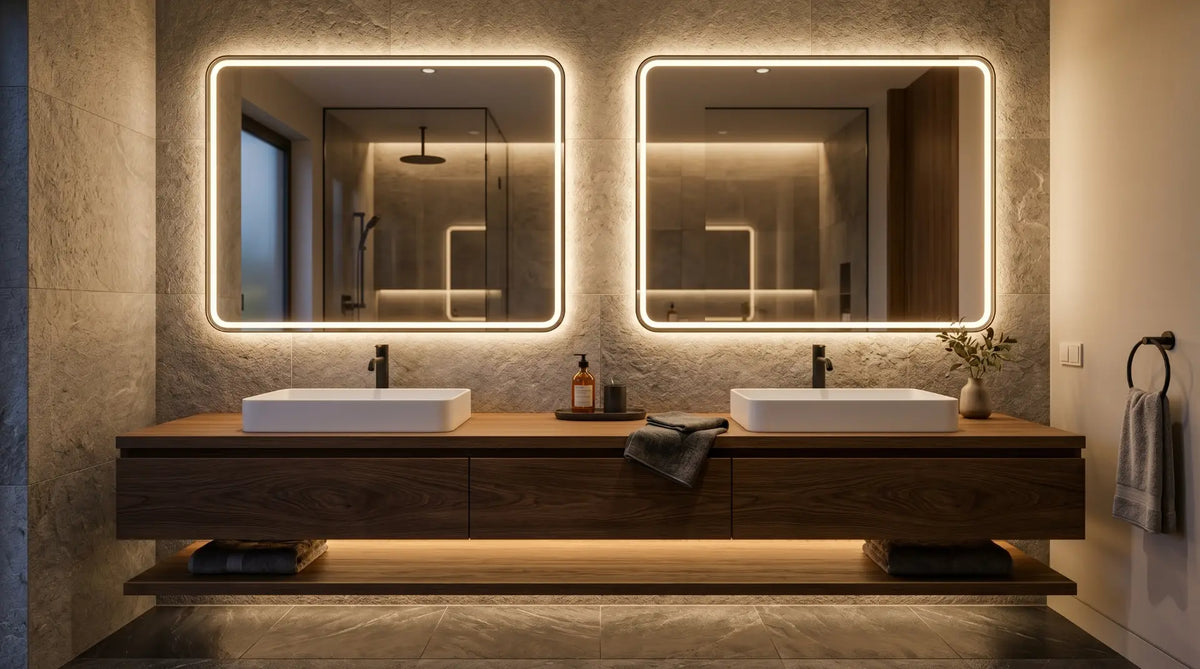
LED bathroom mirrors have gone from a luxury add-on to a mainstream renovation choice in Canada - but not all of them are equal, and not evoery bathroom actually needs one. This guide covers what LED mirrors genuinely do better, the features worth paying for, the ones to skip, and exactly what to look for before you buy.
The standard bathroom lighting setup in most Canadian homes - a single overhead fixture or a ceiling pot light - creates a predictable problem: light falls from above, casting downward shadows across the face, making the mirror unusable for anything that requires detail. Applying makeup, shaving, checking your complexion - all of these tasks require even, face-level light, which is exactly what a ceiling fixture cannot provide from above the head.
An LED mirror solves this problem at the source by integrating the light into the mirror itself, at face height, with even diffusion across the reflective surface. That is the core functional case for an LED mirror - and it is a strong one. But the question of whether a specific LED mirror is worth buying for your bathroom depends on features, specifications, and sizing decisions that the majority of buyers do not check before purchasing. This guide covers all of it.
Canadian homes are used heavily in winter mornings and evenings, when natural light from a window is minimal or absent. Unlike bathrooms in warmer climates where large windows provide natural face-level light for much of the year, most Canadian primary bathrooms rely almost entirely on artificial lighting for daily grooming tasks from October through April. This makes the quality and direction of bathroom lighting more consequential in Canada than in many other markets - and it is why LED mirrors have gained adoption here faster than in sunnier climates.
- Eliminates downward shadow from overhead lighting - the single biggest functional improvement in most Canadian bathrooms
- Face-level illumination makes grooming tasks (makeup, skincare, shaving) significantly more accurate
- Demister pad keeps the mirror clear immediately after a shower - no waiting, no wiping
- Colour temperature control allows warm light for evenings and daylight-equivalent light for colour-accurate tasks
- Replaces the need for separate vanity sconce installation - one purchase solves both mirror and lighting
- Reads as a premium fixture in listing photography - improves the visual quality of the vanity wall significantly
- LED strips last decades under normal use - not a recurring replacement cost
- Requires a wired electrical connection - not a simple swap if there is no outlet or wired circuit at the vanity wall
- Quality varies dramatically by price - budget LED mirrors often have poor colour rendering, dim output, and short-lived touch sensors
- Gimmick features (Bluetooth speakers, clocks, digital displays) add failure points without meaningful functional benefit
- Heavier than a standard mirror - wall anchoring must be confirmed for weight before installation
- Cannot be repositioned easily once wired - placement decisions are more consequential than with a standard mirror
- Higher upfront cost than a standard frameless mirror - $400+ vs. $80-$200 for a comparable standard mirror
| Criterion | LED Mirror | Standard Mirror | Winner |
|---|---|---|---|
| Grooming lighting quality | Face-level even illumination - eliminates shadow from above. The primary functional advantage. | Dependent entirely on the bathroom's existing light fixtures - usually inadequate for detail grooming | LED Mirror |
| Fog / steam clearance | Built-in demister pad (on quality models) clears the mirror within seconds of activation - no waiting after a shower | Fogs completely after a shower - must wait for ventilation to clear or wipe repeatedly | LED Mirror |
| Installation complexity | Requires a wired electrical connection - hardwired or GFCI outlet nearby; more planning required | Hang on wall - two screws and a level; no electrical work needed | Standard Mirror |
| Upfront cost | $400-$900 CAD for a quality single-vanity size | $80-$350 CAD for a frameless or basic framed mirror of comparable size | Standard Mirror |
| Listing photography impact | A lit LED mirror in a listing photo reads as a premium renovation detail - significantly elevates the vanity wall appearance | A standard mirror is visually neutral in listing photography - neither adds nor subtracts | LED Mirror |
| Long-term maintenance | LED strip lasts 50,000+ hours - essentially zero maintenance; touch sensor or dimmer may fail before LEDs | No maintenance beyond cleaning - zero failure points | Draw |
| Design versatility | Fixed form factor - rectangular with integrated light. Less design flexibility than a framed mirror. | Available in any shape, size, and frame style - maximum design flexibility | Standard Mirror |
| Energy use | LED lighting is highly efficient - a typical 30W LED mirror uses less electricity per hour than a 60W incandescent bulb | No electricity use - but also no lighting benefit | Contextual |
| Resale value signal | Strong positive signal - buyers associate LED mirrors with quality renovation and move-in readiness | Neutral - expected in any bathroom, adds no specific premium signal | LED Mirror |

A demister pad is a thin heating element bonded to the back of the mirror glass that warms the mirror surface to just above the dew point - preventing condensation from forming when steam fills the bathroom after a shower. In a well-ventilated bathroom it activates when the mirror is powered on and keeps the reflective surface clear within 30 to 60 seconds, without waiting for the room to ventilate or manually wiping the glass.
This is the single most practically useful feature in an LED mirror for the Canadian market. Canadian bathrooms - particularly those with smaller ventilation fans or older homes where bathroom ventilation is inadequate - fog heavily after a shower, and a mirror that cannot be used for five to ten minutes after bathing is a genuine daily inconvenience. A demister changes that entirely. Specify this feature explicitly when buying - it is present on most quality LED mirrors but absent from many budget models, and the product listing may describe it as "anti-fog pad," "heated mirror pad," or "demister function." Confirm it is listed as a feature before purchasing.
- Listing explicitly states "demister pad," "anti-fog," or "heated backing" - not implied or described as a side effect of the LED heat
- Demister pad coverage stated - full coverage or zone coverage; full-surface pads perform better in high-humidity bathrooms
- Demister activates on main power switch - not a separate switch requirement (separate switches are a nuisance in daily use)

Colour temperature - measured in Kelvin (K) - determines the warmth or coolness of the light produced by the LED strip. This is one of the most consequential specifications in an LED mirror because different tasks require different light qualities: a warm light (2700K-3000K) is flattering and relaxing for evening use, while a cool daylight-equivalent light (5000K-6000K) is necessary for accurate colour judgements - applying foundation that actually matches your skin tone, checking whether a fabric is navy or black, or shaving without missing patches. A mirror locked to a single colour temperature performs one of these tasks well and the other poorly.
Quality LED mirrors offer either a fixed neutral temperature (4000K - the best single-temperature compromise) or a selectable range, typically toggling between 3000K (warm), 4000K (neutral), and 6000K (daylight). Some models offer a CCT (Correlated Colour Temperature) slider for continuous adjustment. For a primary bathroom where the mirror is used both in the morning for task grooming and in the evening for general use, a three-setting or continuous colour temperature control is worth the additional cost.

CRI (Colour Rendering Index) measures how accurately a light source renders colour compared to natural sunlight, on a scale of 0 to 100. A CRI of 100 means colours appear identical to how they look in natural daylight. A CRI of 80 means some colours - particularly reds, skin tones, and subtle hue differences - are rendered inaccurately. Most standard LED strips used in budget bathroom mirrors have a CRI of 70-80: adequate for general room lighting but not for the close-up colour-accurate tasks that a bathroom mirror is used for.
Specify CRI 90 or higher for any LED mirror used for grooming tasks. At CRI 90+, skin tones render accurately, makeup colours match what they look like outdoors, and subtle colour differences in clothing or products are distinguishable. The CRI specification is listed in the product specs - look for it explicitly. If a product listing does not state CRI, assume it is below 90. Premium LED mirrors from reputable brands state CRI prominently because it is a differentiator; budget products omit it because it is not a selling point at their spec level.

An LED mirror used as the primary light source in a bathroom without supplementary fixtures needs to produce enough lumens to adequately illuminate the face - not just glow decoratively around the mirror edge. The minimum brightness for a LED mirror serving as the sole vanity light in a Canadian bathroom is approximately 800 lumens for a small single-vanity mirror (600mm wide) and 1,200-1,500 lumens for a mirror spanning a 900-1,200mm double vanity. Backlit-only mirrors (where the light source is behind the glass and projects a halo effect) often produce lower delivered lumens at the face than front-lit or edge-lit mirrors - the light is diffused through the glass rather than projected forward.
Dimmability is a feature worth specifying if the bathroom is used for multiple purposes - task grooming in the morning at full brightness, and a relaxed bath environment in the evening at lower brightness. Most quality LED mirrors offer a touch-dimmer or dial dimmer built into the switch panel. Confirm that the dimmer operates smoothly across the full range rather than stepping in a few fixed increments - stepped dimmers feel dated and are common in lower-quality mirrors.

Any electrical fixture installed in a Canadian bathroom must carry both CSA (Canadian Standards Association) or UL (Underwriters Laboratories) certification and a minimum IP44 ingress protection rating. CSA/UL certification confirms the fixture has been tested to Canadian electrical safety standards - this is a legal requirement, not an optional quality indicator. A mirror without this certification cannot be legally installed in a Canadian home and may void your home insurance if there is an electrical incident. IP44 confirms the fixture is protected against solid objects larger than 1mm and against water splashing from any direction - the minimum standard for bathroom environments where steam and splash are routine.
For mirrors installed in close proximity to a shower or bath - within the "zone 2" area defined by the Canadian Electrical Code, which extends 0.6 metres horizontally from the edge of the bathtub or shower tray - a minimum IP44 rating is required. For mirrors directly above a shower (rare in bathroom design but occasionally specified in wet-room layouts), IP65 or higher is required. For standard vanity wall placement, IP44 is the correct minimum.

The LED mirror market has accumulated a collection of add-on features that are marketed as premium upgrades but in practice reduce the product's reliability without adding meaningful daily value. The three most common to avoid:
Bluetooth speakers: Speaker quality in a bathroom mirror is constrained by the thin enclosure behind the glass - audio output is typically low-fidelity and directionally inconsistent. The Bluetooth module adds an electronic component that can fail independently of the mirror and LED functions, and the battery or circuit board may not be rated for the humidity conditions inside a bathroom enclosure long-term. A dedicated Bluetooth shower speaker costs $40-$80 CAD and performs significantly better.
Digital clocks and temperature displays: These read as gadget-oriented rather than design-oriented, and the LED or LCD display behind the mirror glass is among the first components to fail in a bathroom environment. A mirror that otherwise continues to function well but has a dead or dim clock display looks broken even when it is not - an avoidable aesthetic issue in a room designed to look clean and deliberate.
Motion-activated lighting: While the concept is convenient, motion sensors in bathroom mirrors are frequently triggered by passing shadows, steam movement, or minor vibration - resulting in the mirror turning on and off unexpectedly during use. A manual touch switch is more reliable and more precise for the actual use pattern of a bathroom mirror.
The simpler the control panel, the more reliable the mirror over time. The ideal LED mirror control set: one touch switch for on/off, one touch dimmer for brightness, and one toggle for colour temperature. Any additional controls - mode buttons, scene presets, app connectivity - increase the number of electronic components that can fail in a high-humidity environment. Specify the features you will actually use every day and ignore everything else.
LED mirrors use three main illumination approaches, each producing a different visual effect and different functional lighting quality. Understanding the difference prevents the common disappointment of buying a mirror that looks beautiful in a showroom but does not adequately light the face in actual use.
| Illumination Style | How It Works | Face Lighting Quality | Visual Effect | Best For |
|---|---|---|---|---|
| Backlit (halo) | LEDs sit behind the mirror glass and project light outward from all edges, creating a floating glow effect on the wall behind the mirror | Low - the light is directed away from the face rather than toward it. Provides minimal face illumination and relies on ambient room light for grooming tasks. | The most dramatic and design-forward look. Creates a halo of light around the mirror that reads as premium in listing photography. Excellent ambience lighting. | Powder rooms, guest baths with adequate supplementary lighting, premium bathrooms where ambience is prioritised over task lighting |
| Front-lit (face-lit) | LEDs are positioned at the front of the mirror frame - behind a frosted diffuser panel along the top, bottom, or sides - projecting light toward the user's face | High - light is directed toward the face, reducing shadow from above and providing even illumination across facial features. The most functionally effective design for grooming tasks. | Cleaner, less dramatic than backlit. Reads as functional and well-considered rather than decorative. Similar to traditional Hollywood-style vanity lighting. | Primary baths, ensuites, any bathroom where the mirror is used for detailed grooming tasks - the recommended choice for functional daily use |
| Edge-lit | LEDs run along one or more edges of the mirror (typically all four sides) behind a translucent edge seal, producing a strip of light visible along the mirror perimeter | Moderate - better than backlit for face illumination but less even than a full front-lit panel. Side-edge lighting helps reduce lateral shadow; top-edge lighting alone does not solve the downward shadow problem. | Contemporary and refined. Less dramatic than backlit, cleaner than front-lit. A popular middle-ground in current Canadian bathroom design. | Good for primary bath use when the edge lighting covers all four sides; avoid mirrors with top-edge-only lighting if functional grooming illumination is the primary goal |
| Combined backlit + front-lit | Both illumination systems present - halo on the wall and face illumination simultaneously, typically on separate controls | High - the front-lit component handles grooming illumination while the backlit halo provides ambience and visual depth | The most premium and versatile configuration. Allows the mirror to function as task lighting during grooming and ambient lighting for relaxed bathing. | Primary baths and ensuites in premium and luxury renovations where both functional and design performance are priorities |
The most common LED mirror sizing mistake in Canadian renovations is selecting a mirror that is too small for the vanity - a mirror that leaves significant wall space exposed on each side of the vanity reads as an afterthought rather than an intentional design decision. The correct sizing rule: the mirror width should be 80 to 90 per cent of the vanity cabinet width. For a 900mm single vanity, the mirror should be 720-810mm wide. For a 1,500mm double vanity, a single mirror of 1,200-1,350mm or two individual 600-700mm mirrors are the appropriate choices.
Never exceed the vanity width with the mirror - a mirror wider than the cabinet below it creates a visual imbalance that draws attention to the proportion mismatch. For height: a bathroom mirror should be tall enough to show the head and shoulders of the tallest person in the household, with the mirror top positioned approximately 200-250mm above the tallest user's eye level. A practical default for most Canadian homes: position the mirror bottom 150-200mm above the backsplash and extend to a height that gives a minimum 900mm of reflective surface.
| Vanity Width | Recommended Mirror Width | Mirror Configuration | Notes |
|---|---|---|---|
| 600mm (small single) | 480-540mm | Single mirror | A 500mm mirror is the practical minimum for a single vanity - smaller reads as underdressed for the wall space |
| 750mm (standard single) | 600-680mm | Single mirror | 600mm is the most common single-vanity LED mirror size stocked at Canadian retailers |
| 900mm (large single) | 720-810mm | Single mirror | 800mm mirrors are widely available and the right fit for most 900mm single vanities |
| 1,200mm (small double) | One 960-1,080mm, or two 500-550mm | Single wide or two individual | A single wide mirror reads as more premium; two individual mirrors work when a defined separation between sinks is desired |
| 1,500mm (standard double) | One 1,200-1,350mm, or two 600-650mm | Single wide or two individual | Single wide mirror spanning the full double vanity is the strongest design choice - creates continuity and makes the wall appear wider |
For a double vanity, a single continuous LED mirror spanning the full width is almost always the stronger design choice over two separate mirrors. The continuous reflective surface reads as intentional and architecturally integrated - it makes the vanity wall appear wider and the bathroom feel larger. Two individual mirrors create a visual break that emphasises the gap between sinks rather than the continuity of the vanity. The exception: when two users have significantly different height requirements and individual mirror positioning is genuinely more practical than a shared mirror at a fixed height.
The electrical requirement is the aspect of LED mirror installation that catches the most Canadian buyers off guard. Unlike a standard mirror - which requires only two wall anchors and a level - an LED mirror requires a reliable electrical connection, and the type of connection available in your bathroom determines what installation approach is possible.
| Electrical Situation | Installation Approach | DIY or Licensed Electrician? | Approximate Cost (CAD) |
|---|---|---|---|
| GFCI outlet already present at vanity wall | Plug-in LED mirror - power cable runs to the outlet. Simplest installation, fully reversible. | DIY - no electrical work required. Hang the mirror and plug in. | $0 beyond the mirror cost |
| No outlet at vanity but existing wiring in the wall | Add a GFCI outlet to the existing circuit, then plug in or hardwire the mirror | Licensed electrician required to add the outlet - a straightforward job but must meet CEC requirements for bathroom GFCI placement | $150-$300 for electrician to add GFCI outlet |
| No outlet and no existing wiring at vanity wall | Run a new circuit from the electrical panel to the vanity wall, then install a GFCI outlet or hardwire junction box | Licensed electrician required - a more involved job, particularly in a finished bathroom where walls must be opened | $400-$900+ depending on distance from panel and wall construction |
| Hardwired junction box already at vanity (existing vanity sconce wiring) | Hardwire the LED mirror directly to the junction box - the cleanest installation with no visible cord | Licensed electrician strongly recommended - hardwiring involves connecting to the home's electrical system and must meet CEC code | $100-$200 for electrician to make the hardwired connection |
Typically zinc or aluminium frame, low-CRI LED strips (70-80), no demister pad, limited or no dimming, and questionable CSA certification. May function adequately as an ambient light source but will not perform well for grooming tasks.
Avoid for primary or ensuite bathrooms. Acceptable only as a temporary installation or in a low-use secondary bathroom.
The sweet spot for most Canadian renovations. Demister pad standard, CRI 90+ available (confirm before buying), colour temperature control on quality models, smooth dimmer, CSA/UL certified, IP44 rated.
Right for most primary baths and ensuites. Research specific models at this tier - quality varies more than at the premium level.
European or designer-brand mirrors with CRI 95+, combined backlit + front-lit illumination, full-surface demister pads, continuous colour temperature control, and refined touch panel design. Some include integrated storage (LED mirror cabinets).
Right for premium and luxury renovations where the mirror is a design focal point and fixture quality is a buyer expectation.
- Vanity width measured - mirror width calculated at 80-90% of vanity width
- Mirror height confirmed - minimum 900mm of reflective surface; top of mirror positioned 200-250mm above tallest user's eye level
- For double vanity: decision made between one wide mirror or two individual mirrors - single wide mirror is the stronger design choice in most cases
- Wall space behind vanity measured to confirm no obstruction (plumbing, ventilation, structural elements) at the mirror mounting zone
- Demister / anti-fog pad confirmed - stated explicitly in the product listing or spec sheet
- CRI 90+ confirmed - look for "CRI," "Ra," or "Colour Rendering Index" in the product specs
- IP44 rating minimum confirmed - required for all bathroom electrical fixtures in Canada
- CSA or UL certification confirmed - CE marking alone does not meet Canadian electrical code
- Illumination type confirmed as front-lit or combined backlit + front-lit for grooming use (backlit-only for ambience-focused applications)
- Brightness confirmed - minimum 800 lm for a sole-light-source application; 500 lm acceptable if supplementary lighting present
- Electrical situation at vanity wall confirmed - GFCI outlet present, existing wiring, or new circuit required
- If no existing outlet: electrician contacted and quoted before purchasing the mirror
- Mirror weight checked against wall construction - drywall anchors rated for the mirror weight confirmed, or stud locations identified
- If hardwiring: licensed electrician booked - hardwiring must meet Canadian Electrical Code requirements
- Colour temperature control confirmed if needed - at minimum, a 4000K fixed neutral; ideally 3000K / 4000K / 6000K selectable
- Smooth continuous dimmer confirmed - not stepped or on/off only
- Bluetooth speaker, digital clock, and motion sensor absent or confirmed as non-essential - these features are skipped in most quality-focused purchases
Shop LED bathroom mirrors at Bathify - shipped across Canada
Browse our curated selection of front-lit, backlit, and combined LED mirrors with demister pads, colour temperature control, and CSA certification. Free shipping on orders over $50.


