






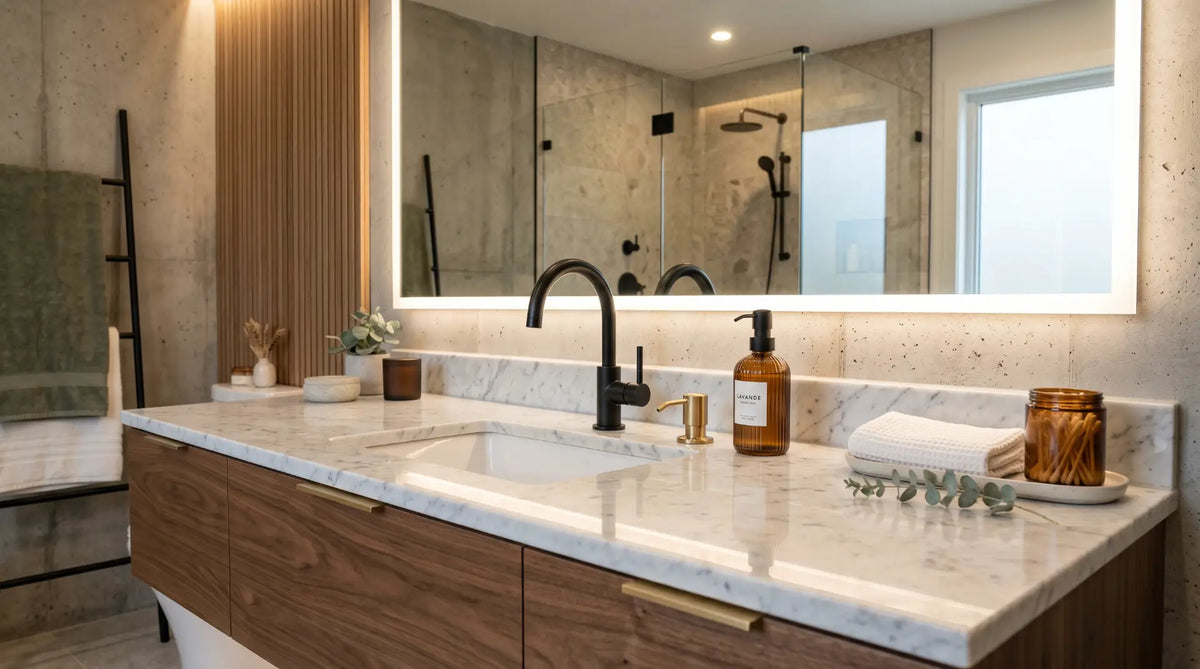
The soap dispenser is the smallest hardware decision in a bathroom renovation and the one most often left to chance - a plastic bottle sits on the counter because no one got around to choosing something better. This guide covers every dispenser format, the finish-matching rules, the countertop hole requirements for built-in models, refill mechanics, and exactly which option suits each Canadian bathroom context.
A soap dispenser is rarely discussed in bathroom renovation planning - it is not in the same category as a faucet or a vanity - but it is present in every bathroom, every day, and its presence (or absence) is one of the clearest signals of whether a bathroom was finished intentionally or assembled and left. A plastic pump bottle of hand soap on an otherwise immaculate stone countertop undermines the whole renovation in a way that is disproportionate to the price of the solution.
The decision between a built-in (deck-mount) dispenser and a countertop dispenser is not just aesthetic - it involves practical questions about counter drilling, refill access, soap viscosity compatibility, and the relationship between the dispenser finish and the rest of the hardware. None of these questions are difficult to answer, but they must be answered before purchase, not after the dispenser arrives and turns out to require a hole in the counter that does not exist.
This guide covers all four dispenser formats - deck-mount built-in, countertop pump, wall-mount, and touchless - in full detail, including the installation requirements for each, the finish-matching rules that integrate the dispenser into the broader bathroom hardware palette, the refill mechanics that determine how practical each option is for different household sizes, and the specific product features worth paying for and the ones that are not.
The soap dispenser and the faucet are the two fixtures that share the counter surface above the vanity basin - they are the closest visual neighbours in the bathroom, and their finishes are seen together every time someone washes their hands. Deciding on the faucet finish without simultaneously deciding on the dispenser type and finish means the dispenser is almost always specified as an afterthought in a finish that may not match, or placed as a plastic bottle that negates the visual investment in the faucet. Specify both together. A built-in deck-mount dispenser also requires a counter hole - this decision must be made before the counter is fabricated or before a pre-drilled counter is ordered.

A deck-mount built-in soap dispenser installs through a hole in the counter - the pump head and neck are visible on the counter surface, and the reservoir bottle sits underneath in the vanity cabinet. This format eliminates any visible bottle from the counter, leaving only the pump head - which, in a matching metal finish, reads as part of the faucet family rather than as a separate object. For a bathroom where the counter surface has been carefully specified in stone, solid surface, or a high-quality laminate, this is the format that keeps that surface visually uncluttered.
The counter hole requirement is the critical installation consideration. A standard deck-mount dispenser requires a 35mm (1-3⁄8") hole through the counter - the same diameter as a standard faucet hole. In a pre-drilled counter or vanity top with an extra unused hole (a three-hole faucet cutout where a single-hole faucet was installed, for example), the dispenser can use one of those holes without additional drilling. In a counter where no extra hole exists, a licensed countertop fabricator must drill the hole in the correct location - attempting to drill a 35mm hole in a stone or engineered stone counter without the right diamond-core bit and drilling technique risks cracking the slab.
The reservoir is typically accessed from below the counter for refilling - the bottle is unscrewed from the pump tube inside the cabinet, refilled with liquid hand soap, and reinstalled. Some models allow top-fill refilling from above the counter without removing the bottle. The reservoir capacity is a practical specification: a built-in reservoir of less than 300mL will require refilling every few days in a household of three or more - choose a unit with 400-600mL capacity for a primary bathroom, or a 250-350mL unit for a guest or powder room with lower use.
Soap viscosity is the specification most commonly overlooked with built-in dispensers, and the cause of the most common operational complaints. A standard pump-tube dispenser works correctly with thin to medium-viscosity liquid hand soaps - the type that pours easily from a bottle. Thick gel soaps, heavy lotion soaps, and foaming soap concentrates do not pump reliably through the long tube of an under-counter reservoir. If the household prefers a thick or foaming soap, confirm the dispenser model is rated for that viscosity, or specify a countertop dispenser with a shorter pump path instead. Most major Canadian bathroom fixture suppliers list the soap type compatibility on the product spec sheet - check before purchasing.
- Counter hole confirmed present (35mm) - or fabricator booked to drill before dispenser installation
- Hole location confirmed - positioned to the right or left of the faucet with adequate clearance for pump operation
- Reservoir capacity confirmed at minimum 400mL for primary bathroom use
- Soap compatibility confirmed - liquid hand soap vs thick gel vs foam, matched to product spec
- Finish confirmed to match faucet, towel bar, and dominant bathroom hardware finish
- Refill access method confirmed - below-counter bottle or top-fill - appropriate for the household's maintenance preference

A countertop soap dispenser sits on the vanity counter surface - no drilling, no under-counter reservoir, no installation at all beyond placing it on the counter. The soap is visible in the reservoir (for glass or clear models) or contained in an opaque body, and the pump delivers soap from the top. This is the most widely purchased format in Canadian bathrooms and the correct choice for any bathroom where counter drilling is not possible, not practical, or not desired.
The design quality range in countertop dispensers is exceptionally wide - from the generic plastic bottle that nobody would describe as a renovation decision, to solid brass, stainless steel, matte ceramic, hand-blown glass, and stone dispensers that read as deliberate accessories coordinated with the rest of the bathroom. A quality countertop dispenser in a matching finish, placed intentionally on the counter, achieves much of the visual cohesion of a built-in model without the installation commitment. The difference is the visual weight of the bottle below the pump - a countertop dispenser is always a visible object on the counter, whereas a built-in model is only a pump head.
Countertop dispensers are also the practical choice for households that use multiple soap types (hand soap and lotion, for example), for rentals where modifications are not appropriate, and for bathrooms where the counter is too small to accommodate a built-in dispenser and its required clearances. They can be moved, replaced, and upgraded at any time without any counter modification.
- Only pump head visible on counter - reservoir hidden entirely below the counter surface
- Integrates with the faucet as a matched hardware set - reads as part of the fixture family
- Counter hole required - 35mm; must be planned before counter fabrication or existing hole used
- Refilling requires access to under-counter cabinet - less convenient than a countertop bottle top-fill
- Limited to soap viscosities the pump tube can draw - thin liquid soaps only for most models
- More expensive than a comparable countertop dispenser - the premium is for integration, not soap delivery
- Cannot be moved or replaced without patching the counter hole - a more permanent commitment
- Entire dispenser visible on counter - body material and design quality are part of the specification
- No drilling, no counter modification - place on counter and use immediately
- Widest range of materials, finishes, and designs - glass, ceramic, brass, stone all available
- Easy top-fill refilling - unscrew pump, fill, replace. No under-counter access needed
- Compatible with any soap viscosity - short pump tube works with thick gels and foaming soaps
- Portable - move, replace, or upgrade at any time without any residual counter change
- Correct for rentals, existing finished counters, and households that change soap types
| Decision Factor | Built-In Deck-Mount | Countertop Pump | Better Choice |
|---|---|---|---|
| New renovation, counter being fabricated | Ideal - specify hole during fabrication at no extra drilling cost | Works, but misses the opportunity to integrate at the fabrication stage | Built-In - plan it during fabrication |
| Existing finished counter, no spare hole | Requires professional counter drilling - cost and risk of cracking | No modification needed - place immediately | Countertop |
| Existing counter with spare unused hole | Uses the spare hole - ideal outcome, no drilling cost | Also works but leaves the unused hole visible or plugged | Built-In - uses the hole cleanly |
| Counter is small - limited surface space | Removes the dispenser body from counter entirely | Occupies counter space - adds to counter clutter on a small vanity | Built-In |
| Rental property or no counter modification allowed | Not appropriate - permanent counter modification | The correct choice - no modification, portable, easily replaced | Countertop |
| Household uses thick gel or foaming soap | May not work - long pump tube cannot draw thick viscosity reliably | Works with any soap type | Countertop |
| Hygiene is a priority (children, guests) | Standard pump - contact required | Standard pump or upgrade to touchless countertop model | Touchless countertop - both formats available |
| Design cohesion is the priority | Maximum integration - pump head matches faucet finish exactly | Can match finish closely but counter body adds a visible design element | Built-In for maximum cohesion |

A soap dispenser with a metallic finish - whether a countertop pump in brushed brass or a built-in deck-mount in matte black - is hardware, and hardware must follow the one-finish rule: match the dominant fixture finish in the bathroom. A matte black dispenser in a bathroom with brushed nickel fixtures creates the same visual inconsistency as a chrome towel bar next to a matte black faucet. The dispenser is small, but it sits on the counter beside the faucet at close range - the finish difference is immediately visible.
The exceptions to the matching rule are natural and finish-neutral materials: clear or frosted glass, natural stone (marble, travertine), unglazed ceramic in a neutral tone, and raw brass (unlacquered, which develops its own patina independent of other finishes). These materials do not carry a metallic finish tone that competes with the hardware - a clear glass pump dispenser next to a brushed gold faucet reads as a deliberate material contrast rather than a finish mismatch. This is a legitimate design choice, particularly in bathrooms where the soap is itself a decorative element - a glass dispenser filled with amber-coloured soap beside a warm-toned stone counter is a styled detail, not an oversight.
The installation of a deck-mount built-in soap dispenser is straightforward once the counter hole exists - thread the pump tube through the hole from above, secure the mounting nut from below, connect the reservoir bottle, and the dispenser is operational. The complexity is entirely in the counter hole, and the counter material determines whether this is a DIY step or a professional step.
| Counter Material | Can I Drill It Myself? | Tool Required | Risk |
|---|---|---|---|
| Laminate (Formica-type) | Yes - DIY feasible | 35mm hole saw or spade bit - standard drill speed | Low - laminate drills cleanly from above; tape the surface to prevent chipping at entry point |
| Solid surface (Corian, etc.) | Yes - DIY feasible | 35mm hole saw - moderate drill speed, water lubrication recommended | Low-moderate - solid surface is forgiving; avoid forcing the bit through the material |
| Porcelain tile counter | Experienced DIY only | 35mm diamond-core tile bit - slow speed, constant water cooling | Moderate - tile cracks without constant cooling and slow consistent pressure; work from the face side |
| Natural stone (granite, marble, quartz) | Professional required | Diamond-core wet drill - professional stone fabrication equipment | High - attempting to drill natural or engineered stone without a wet diamond core drill will crack the slab. A stone fabricator drills this cleanly and typically offers it as a service for $50-$120 CAD per hole |
| Pre-drilled countertop (unused hole) | Yes - no drilling needed | None - dispenser mounts directly into existing hole | None - confirm hole diameter is 35mm and position suits dispenser clearances |
- Built-in or countertop format decided based on: counter hole availability, counter material, renovation stage, and rental vs. owned home
- If built-in: counter hole confirmed present (35mm) or stone fabricator booked to drill before dispenser delivery
- If countertop: material and design confirmed as appropriate to the bathroom's hardware and palette - not a placeholder plastic bottle
- Touchless format assessed for family bathrooms and powder rooms where multiple users is the norm
- Dispenser finish confirmed to match dominant hardware finish - faucet, towel bar, toilet paper holder
- For glass or stone countertop dispensers: finish-neutral material confirmed as a deliberate contrast choice, not a mismatch
- Metal pump finish (for glass body dispensers) confirmed to match faucet finish
- Tone confirmed where brushed gold is involved - champagne, satin brass, and true brushed gold are distinct and must match existing hardware tone
- Reservoir capacity confirmed - minimum 400mL for a primary bathroom, 250mL acceptable for powder room or guest bath
- Soap viscosity compatibility confirmed - liquid soap, thick gel, or foam; matched to pump mechanism type
- Refill method assessed - below-counter bottle removal vs top-fill vs countertop open-top; appropriate for household maintenance habits
- For built-in: pump tube length confirmed to reach reservoir bottom at the installed counter height
- For built-in: reservoir bottle height confirmed to fit inside vanity cabinet with door closed
- For touchless: battery type noted (AA, AAA, or USB rechargeable) - spare batteries or charger sourced
- Counter material identified - laminate/solid surface (DIY possible) vs natural stone (professional required)
- Hole position planned - minimum 10cm from faucet centre, minimum 5cm from sink rim edge
- If stone counter: fabricator contacted and hole drilling scheduled before dispenser is delivered
- Mounting hardware confirmed included with dispenser - mounting nut and rubber gasket for counter seal
Shop soap dispensers & bathroom accessories at Bathify
Browse built-in deck-mount and countertop soap dispensers in matte black, brushed nickel, brushed gold, and chrome - matched to the rest of your bathroom hardware. Free shipping across Canada on orders over $50.


