






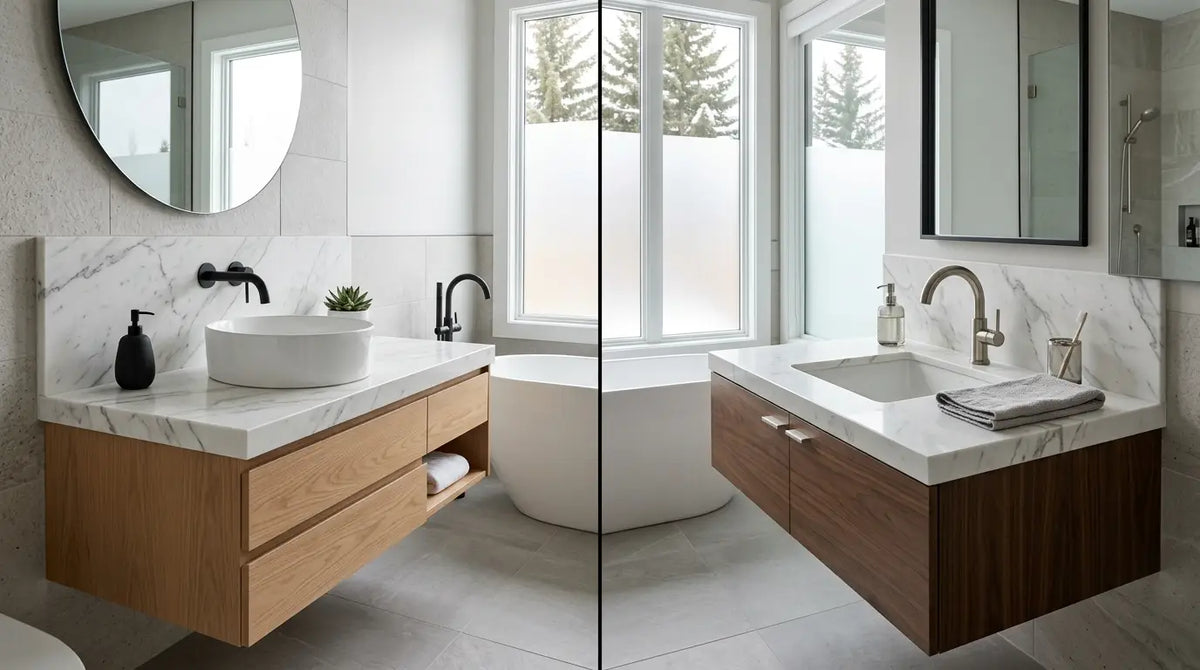
These two sink formats look very different but are evaluated on the same criteria by most Canadian buyers - and most buyers get those criteria wrong. This guide covers installation requirements, vanity height implications, faucet compatibility, counter clearance, daily maintenance, material options, and the design contexts where each one genuinely excels.
The vessel sink versus drop-in decision is one that looks straightforward on a showroom floor - the vessel sits dramatically above the counter and commands attention, the drop-in sits flush and functional - but it involves a cascade of technical decisions that most buyers don't encounter until after the sink has been delivered. Vanity cabinet height must be adjusted for a vessel installation. The faucet must be tall enough to clear the vessel rim and reach the basin centre. Most vessels have no overflow, which affects drain selection and insurance considerations in some Canadian provinces. The counter opening for a drop-in must match the sink's rim dimensions exactly. None of these details are difficult to manage, but all of them must be accounted for before anything is purchased.
This guide untangles both formats completely - what each sink type actually is, what it requires from the surrounding installation, what it delivers in daily use, where each one belongs by design context, and how to make the decision correctly the first time without returning a sink that won't work with the vanity you already have.
The correct sequence for a sink purchase is: (1) decide on sink type (vessel or drop-in), (2) determine the vanity cabinet height required for the chosen sink type, (3) select the sink and confirm its counter cutout or placement requirements, (4) select the faucet with a spout height appropriate to the chosen sink, and (5) confirm the drain assembly is compatible with both the sink and the faucet. Buyers who choose the sink and faucet simultaneously without working through this sequence frequently discover mid-installation that their faucet spout is too short to clear the vessel rim, or that the vanity counter height results in a total working height that is ergonomically incorrect for the household.

A vessel sink sits entirely above the counter surface rather than dropping through it. The counter is cut with a single drain hole (and in some configurations a small faucet hole if the faucet mounts through the counter rather than on the wall), and the sink bowl rests on the counter surface - held in place by its own weight, a ring mount, or a silicone seal, depending on the product and installation specification. The entire bowl is visible above the counter plane, which gives a vessel sink its defining sculptural quality and makes it the most visually prominent fixture in most bathrooms where it is installed.
The above-counter position creates a set of technical requirements that a drop-in sink does not have. The total working height of the vanity - the distance from finished floor to the top rim of the vessel bowl - must land in the ergonomically correct range for the household. Standard ergonomic bathroom sink height is 85-92cm from finished floor. A typical vessel bowl is 12-17cm tall. This means the vanity cabinet plus counter must reach only 70-78cm total before the vessel is placed - significantly lower than a standard bathroom vanity (typically 80-85cm plus counter). Purchasing a vessel sink for an existing standard-height vanity frequently results in a total working height of 95-100cm or more, which is uncomfortably tall for most Canadian adults.
The faucet for a vessel sink must be a tall vessel faucet - the spout must clear the vessel rim (typically 12-15cm above the counter) and reach the centre of the basin. A standard deck-mount faucet with a short spout will not reach the basin interior from outside the vessel rim. Most vessel faucets have spout heights of 20-28cm and are available in wall-mount (the cleanest installation - counter is clear of holes) or single-hole deck-mount configurations.
The absence of an overflow drain in most vessel sinks is a functional and sometimes insurance-relevant consideration that most buyers don't register until after purchase. An overflow is the secondary drain opening near the top of a sink basin that prevents the sink from flooding if the drain is closed and the tap is left running. Drop-in sinks include an overflow as standard. Most vessel sinks do not - the open bowl design means water simply spills over the rim if the basin overfills. In a Canadian home, some property insurance policies distinguish between sinks with and without overflow protection when assessing water damage claims. Confirm your sink has an overflow if this is a concern, or select a vessel model that specifically includes one - they exist but are less common than overflow-free designs.
- Vanity cabinet height confirmed - cabinet plus counter must total 70-78cm for correct finished height with vessel
- Vessel faucet selected and spout height confirmed - clears vessel rim with minimum 5cm clearance
- Drain assembly confirmed as vessel drain (open, no overflow port) - matches sink's drain opening diameter
- Counter material confirmed as suitable for vessel placement - vessel ring or silicone seal method per manufacturer
- Wall-mount faucet option assessed - eliminates counter holes and simplifies daily cleaning
- Overflow presence or absence confirmed - relevant for insurance and family contexts where taps may be left running

A drop-in sink (also called a self-rimming or top-mount sink) is installed by cutting a hole in the counter surface and dropping the sink into it from above. The sink's rim rests on the counter surface and is sealed with silicone - the weight of the sink and the seal hold it in place. The counter cutout must match the sink's template exactly; most drop-in sinks include a paper or cardboard template for tracing the cutout. The visible rim is the defining visual characteristic of a drop-in sink - it creates a clear boundary between the sink and the counter at counter level.
Drop-in sinks are the dominant sink format in Canadian residential bathrooms for practical reasons: they are compatible with standard vanity heights (the sink basin drops below the counter plane, so no height adjustment is needed), they include an overflow drain as standard on virtually all models, they work with any standard faucet configuration (the three pre-drilled holes in most drop-in sinks accommodate a centerset or widespread faucet, and the holes can be covered with a deck plate if a single-hole or wall-mount faucet is preferred), and the rim edge provides a defined cleaning perimeter that most homeowners find easier to maintain than the counter-level silicone seal of a vessel sink.
The visual limitation of a drop-in sink is that the rim is always visible and the counter-to-sink transition is always a raised edge rather than a flush or invisible joint. For countertops where the aesthetic goal is an uninterrupted surface flowing from counter to basin - an integrated look or a high-end finish material - the visible rim of a drop-in sink is a design constraint. This is where undermount sinks (a third format, installed from below the counter) address a limitation that both vessel and drop-in formats share in different ways - but that is a separate guide.
- Sits fully above the counter - maximum visual impact, the most distinctive sink format
- Widest material and shape range - stone, glass, copper, ceramic, concrete available
- Counter surface below the vessel is largely uninterrupted - no three-hole faucet deck visible
- Requires a lowered vanity cabinet to achieve correct total working height
- Requires a tall vessel faucet - standard faucets cannot reach the basin interior
- No overflow on most models - water spills over rim if basin overfills
- Water splashing over the rim is a daily reality with shallow bowls or high-flow faucets
- Cleaning the counter-to-vessel base seal requires consistent attention
- Works with standard vanity heights - no height adjustment required
- Overflow drain included - prevents flooding if tap is left running with drain closed
- Compatible with any standard faucet configuration - three-hole, single-hole, or wall-mount
- Basin drops below counter plane - functional depth without adding height above counter
- Visible rim at counter level - raised edge is a cleaning requirement and a design constraint
- Silicone rim seal requires annual inspection and periodic replacement
- Wide availability across all Canadian retailers at every price point
- Ceramic and porcelain options are the most durable and lowest maintenance of any sink format
| Decision Factor | Vessel Sink | Drop-In Sink | Better Choice |
|---|---|---|---|
| Existing standard-height vanity (80-85cm) | Will result in total height of 95-100cm - uncomfortably tall for most users | Compatible - standard height works correctly with a drop-in basin | Drop-In |
| New custom vanity build or full reno | Ideal - cabinet height can be specified to achieve correct total working height | Also ideal - standard height vanity with no adjustment needed | Either - choose on design preference |
| Household with children under 12 | Higher total height makes access harder for children; no overflow is a concern | Standard height is more accessible; overflow drain provides safety margin | Drop-In |
| Primary bathroom - design is the priority | The stronger design statement - sculptural, material variety, visual focal point | Clean and capable but visually lower impact than a distinctive vessel | Vessel |
| Guest bathroom or powder room | Ideal - lower daily use reduces splashing frustration; high visual impact for guests | Practical but less memorable - a guest bathroom is where a vessel's theatrics suit the context | Vessel |
| Long-term maintenance preference | Base seal and counter surface need consistent attention; splashing creates additional cleaning | Rim seal needs annual inspection; otherwise straightforward maintenance | Drop-In |
| Wall-mount faucet planned | Natural pairing - no deck holes needed, clean counter surface below vessel | Works with wall-mount but counter holes typically need covering with a deck plate | Vessel |
| Budget under $300 CAD for sink only | Quality ceramic vessel sinks available from $150 - wide selection at this budget | Wide selection - quality ceramic drop-in sinks from $120 at Canadian retailers | Either - comparable pricing at entry level |
| Stone, glass, or specialty material desired | Strongest format for premium materials - stone and glass vessels are widely available | Less range in specialty materials - stone drop-in exists but is less common | Vessel |
| Rental property or high-turnover use | Vessel base seal requires more maintenance discipline - higher failure risk in rental context | More durable in high-use contexts; overflow protection reduces flood risk | Drop-In |
The ergonomic target for a bathroom sink rim height is 85-92cm from the finished floor. For an average Canadian adult, this range places the sink rim at approximately hip-to-waist height - the correct position for comfortable hand washing and face care without hunching or stretching. Below 82cm feels too low; above 95cm causes shoulder fatigue during extended use. The total working height is calculated as: vanity cabinet height + counter thickness + any above-counter sink height.
| Sink Type | Typical Bowl Height Above Counter | Cabinet + Counter Required | Standard Vanity Compatible? |
|---|---|---|---|
| Vessel sink (shallow bowl, 10-12cm) | 10-12cm above counter | 75-80cm cabinet + counter | Partial - lower vanity or shorter counter needed |
| Vessel sink (standard bowl, 13-15cm) | 13-15cm above counter | 72-77cm cabinet + counter | No - custom or lowered vanity required |
| Vessel sink (tall bowl, 16-18cm) | 16-18cm above counter | 68-74cm cabinet + counter | No - significantly lowered vanity required |
| Drop-in sink (standard) | 1-2cm rim above counter only | 83-89cm cabinet + counter | Yes - standard vanity heights are designed for this |
Faucet compatibility is where most vessel sink purchasing errors occur - and where drop-in sink installation is largely predictable and safe. A vessel sink requires a faucet whose spout rises high enough to clear the vessel rim and reach the basin interior. The minimum spout height for a vessel faucet is the vessel bowl height plus approximately 5cm for comfortable use - so a 14cm vessel requires a faucet with a minimum 19cm spout height. Most purpose-designed vessel faucets have spout heights of 20-28cm. A standard centerset or widespread bathroom faucet has a spout height of 8-13cm and cannot reach inside a vessel bowl - this is the combination that results in water flowing onto the rim rather than into the basin.
| Faucet Type | Works with Vessel? | Works with Drop-In? | Notes |
|---|---|---|---|
| Tall vessel deck-mount faucet (single-hole, 20-28cm spout) | Yes - designed for this | Technically yes, but disproportionate | The correct pairing for a vessel sink. Single-hole mount through counter. Confirm spout height clears vessel rim with minimum 5cm clearance |
| Wall-mount faucet | Yes - ideal pairing | Yes - works but less commonly specified | Wall-mount is the cleanest vessel sink installation - no counter holes, clear counter surface. Requires in-wall rough-in at correct height; a plumber is required for the rough-in if not already present |
| Standard centerset faucet (8-13cm spout, 3-hole) | No - spout too short for most vessels | Yes - the standard pairing | The most common drop-in faucet format. Three pre-drilled holes in the sink accept the faucet body and two handle valves directly |
| Standard widespread faucet (3-hole, 6"-16" spread) | No - vessel has no three-hole configuration | Yes - fits three-hole drop-in directly | Requires three holes at correct spread distance. Most Canadian drop-in sinks have 4" centerset holes as standard; widespread requires wider hole spacing - confirm before purchasing |
| Single-hole deck-mount faucet (standard height) | No - spout too short | Yes - with deck plate covering extra holes | A standard single-hole faucet on a three-hole drop-in sink requires a matching deck plate to cover the two unused outer holes. Confirm deck plate is available in matching finish |
For a vessel sink, the bowl diameter or width should be no more than 60% of the total counter width - allowing at least 20% of the counter on each side of the vessel for context and visual balance, and for practical use (setting items down beside the sink). A 40cm round vessel on a 60cm vanity counter fills the space correctly; the same vessel on a 45cm counter reads as cramped and risks instability. The vessel should also be positioned so that the drain hole in the counter and the drain opening in the vessel bowl align - this sounds obvious but becomes a mistake when the drain hole is pre-drilled off-centre on the counter, or when the vessel has its drain opening away from the geometrical centre.
For a drop-in sink, the rim width must be smaller than the counter opening by the exact overlap dimension specified in the installation template - typically the sink's outer rim is 3-5cm wider than the counter cutout on all sides. The basin depth must also be considered in relation to the vanity cabinet interior clearance - a deep drop-in basin installed in a shallow cabinet can contact the plumbing rough-in or the cabinet bottom, preventing a full drop installation.
- Total working height calculated - cabinet height + counter thickness + sink-above-counter height = target 85-92cm from finished floor
- For vessel: vanity cabinet height confirmed as low enough (typically 70-78cm with counter) for the chosen vessel bowl height
- For drop-in: standard vanity height confirmed as compatible - typically no adjustment needed
- Vessel bowl height (external, from spec sheet) confirmed - used for working height calculation
- Vessel faucet selected - spout height clears vessel rim by minimum 5cm and reaches basin centre
- Wall-mount faucet option assessed - requires in-wall rough-in; plumber needed if not already present
- Drain assembly confirmed as vessel type (no overflow port) - matches vessel drain opening diameter
- Overflow presence or absence noted - confirmed acceptable for household context and insurance policy
- Counter material confirmed as suitable for vessel placement - ring mount or silicone seal per manufacturer
- Vessel diameter confirmed as maximum 60% of counter width - minimum 15cm clear on each side
- Material maintenance requirements understood - stone sealed, glass wiped daily in hard-water regions
- Counter cutout template confirmed - template provided by manufacturer or dimensions confirmed for fabricator
- Rim overlap confirmed - outer rim 3-5cm larger than cutout on all sides; counter material supports this overlap
- Basin depth confirmed vs cabinet interior height - sufficient clearance for basin below counter without contacting cabinet bottom or plumbing
- Faucet hole configuration confirmed - three-hole centerset, three-hole widespread, or single-hole with deck plate
- Overflow confirmed present - standard on virtually all drop-in models; verify on the specific product
- Rim seal maintenance plan noted - silicone to be inspected annually; mould-resistant silicone used at installation
- Faucet finish confirmed to match towel bar, toilet paper holder, and dominant hardware finish in the bathroom
- Drain finish confirmed to match or coordinate with faucet finish
- Supply line length confirmed adequate for vanity depth and shut-off valve position
- Plumber booked if wall-mount faucet rough-in is required or if shut-off valves need replacement
Shop vessel sinks & drop-in sinks at Bathify
Browse ceramic, stone, and glass vessel sinks alongside quality drop-in basins - with matching vessel faucets in matte black, brushed nickel, brushed gold, and chrome. Free shipping across Canada on orders over $50.


