






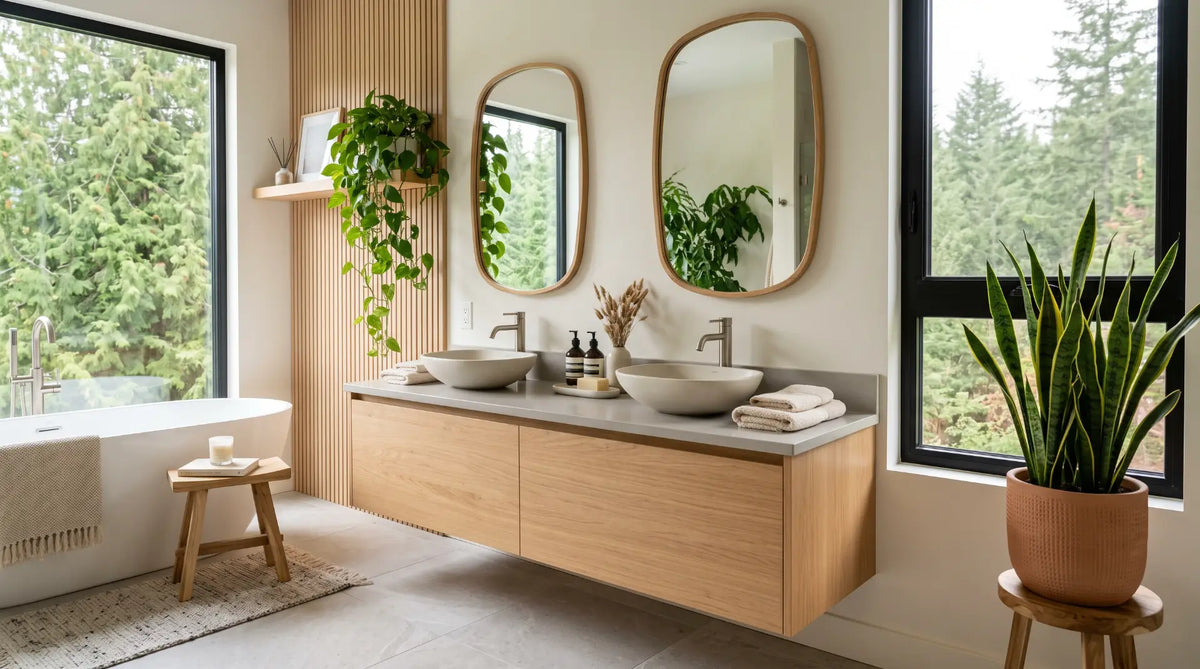
A fern on the vanity isn't biophilic design - it's a plant in a room that might kill it. Real biophilic design is five things working together: the right plants for real bathroom humidity, natural materials, daylight, ventilation, and organic shape. Here's how to build all five into a Canadian bathroom, with real Bathify products at every step.

Biophilic design comes from a genuine idea in environmental psychology: humans have an innate, measurable need for contact with nature, and rooms designed around that need show up as calmer, more restorative spaces to be in. It's a real design discipline with real research behind it - not a decorating trend, and not a synonym for "put a plant on the shelf." A single houseplant balanced on a vanity with no supporting light, material, or airflow is usually a dying plant within a season, and a bathroom that just has one is not a biophilic bathroom. It's a bathroom with a plant in it.
A genuinely biophilic bathroom works because five elements reinforce each other: plants chosen and placed for the room's actual humidity and light, natural or natural-look materials like wood and stone, daylight maximized rather than fought, real ventilation that keeps both the plants and the finishes healthy, and organic, curved shapes instead of hard rectilinear ones. Miss the light and ventilation half of that equation and the material and plant half collapses - which is exactly why this guide leads with the unglamorous mechanics before it gets to the plants and finishes everyone actually wants to shop for.
This guide breaks the look down element by element - materials, plants, light and ventilation, shape, and water - with real Bathify products at each step. If you're still comparing styles, our pillar guide to bathroom design styles for Canadian homes puts biophilic side by side with eight other looks, including its closest material relative, Japandi.
Read the defining-elements table first for the fast overview, then jump to whichever section you're actively working on. The plants and light/ventilation sections matter most for anyone who's tried this look before and had the plant die within a month - that's almost always a ventilation or light-placement problem, not a plant-choice one.
Before shopping fixture by fixture, here's the shorthand version - five elements that, taken together, are what separate a genuinely biophilic bathroom from a bathroom that simply happens to have a plant in it.

Species selected for the room's real humidity and light conditions, not whichever plant looked best at the garden centre.

Solid wood or wood veneer, properly sealed for wet-room use, carries the largest share of the room's natural-material presence.

Countertops and tile with genuine mineral veining echo natural stone without the maintenance load of raw quarried material.

Every plant and material choice downstream depends on how much real daylight the room actually receives.

The one element with no aesthetic payoff and the highest consequence if skipped - both plants and wood finishes depend on it.

Rounded silhouettes and the sound and feel of falling water are the sensory, not just visual, half of biophilic design.
Wood is the material that carries the most weight in a biophilic bathroom, both visually and literally - it's almost always concentrated in the vanity, the room's largest object. The one requirement that isn't optional: any wood used in a bathroom has to be properly sealed on every surface, including the back and underside, and built specifically for wet-room use rather than repurposed furniture-grade wood. A vanity engineered for humidity handles a Canadian bathroom's daily swings; one that isn't will warp, swell, or delaminate within a few years regardless of how good the ventilation is.
Stone-look surfaces do the same grounding work at the countertop. A genuine quartz or marble-look engineered top carries real mineral veining without the sealing and etching maintenance that raw quarried marble or limestone demands - our guide on using natural stone in a Canadian bathroom without overspending covers where true quarried stone fits if you want to go further than an engineered top.

The clearest biophilic vanity pick in the Bathify catalogue - and it's built and assembled in Ontario. The Chester is constructed from real Canadian maple with dovetail drawer boxes and full-extension soft-close slides, paired with a 3cm quartz countertop and an undermount sink that keeps the stone-look material working alongside the wood rather than against it. As a made-to-order piece it carries a 4-6 week lead time, so it's worth ordering early if this is part of a fuller renovation.

A wall-mounted, floating format that delivers the same warm wood-grain presence in a smaller footprint - a genuinely useful option for a condo bathroom or powder room where every square foot of visible floor matters. The moisture-resistant wood veneer cabinet is engineered for full waterproofing, and the floating profile keeps a visible strip of floor showing beneath it, which reads as considerably lighter than a vanity that runs flush to the ground.
A wood-veneer linen cabinet is a low-effort way to extend the same material into storage without a second wood tone competing for attention - see the Kube Bath Bliss 18" x 59" Linen Side Cabinet ($551.99 CAD) for a piece built to match the Bliss vanity line exactly. Our guide on why your bathroom needs a linen cabinet covers the functional case for adding one. Browse the wider range in Bathify's Bathroom Vanities collection.
This is the section most biophilic guides skip, and it's the one that decides whether the plant is still alive in six months. A bathroom is not a living room with more steam - it's a room with sharp, repeated humidity swings (dry, then a hot shower, then dry again), often lower and more indirect light than the rest of the house, and in many Canadian homes, no window at all. Plant selection has to start from those three real conditions, not from what looked good at the garden centre.
| Plant | Light needed | Why it works in a bathroom |
|---|---|---|
| Pothos | Low to indirect | The most forgiving choice for a small or frosted-window bathroom; tolerates neglect and humidity swings well |
| Snake plant (Sansevieria) | Low to indirect | Genuinely thrives on low water and low light - the best pick for a windowless powder room |
| ZZ plant | Low to indirect | Tolerates inconsistent watering and dim conditions better than almost any other houseplant |
| Boston fern | Bright, indirect | Wants the most humidity of this group and rewards a daily-use shower and real natural light |
Placement matters as much as species. Keep plants away from a heating vent or a spot that gets direct blasting hot water spray, and favour a shelf or ledge that gets indirect light through the day over a dark corner that happens to be free. A wood-veneer linen cabinet or open shelf near - but not directly under - a window gives most of these species enough to work with in a typical Canadian bathroom.
Every other style guide on this site treats ventilation as a code requirement to satisfy and move past. In a biophilic bathroom, it's a design element with a direct, visible payoff - it's the difference between a wood vanity that lasts fifteen years and one that swells and delaminates in three, and between a plant that thrives and one that quietly rots at the roots from excess ambient humidity with nowhere to go.
Canadian code sets exhaust fan minimums at 50 CFM for a standard bathroom under 40 square metres and 100 CFM for a combined bath-toilet room - these ratings should be the primary specification criterion for a fan, not its light kit or looks. Run the fan during every shower and for a further 15-20 minutes after, not just while the water is running, since humidity peaks after the shower ends. Our bathroom lighting & ventilation guide covers exact CFM specification, fan placement, and quality brands available at Canadian retailers.
For light, a large mirror is the single highest-leverage move available in a bathroom with limited daylight - it bounces available light back into the room and does more for both the plants and the finished look than almost any lighting fixture alone. Position it to catch whatever light the room gets, and size it generously relative to the vanity beneath it; our bathroom mirror sizing guide covers the exact proportions.

A wood-framed mirror with a bottom shelf, sized to sit above most single-sink vanities and finished-coordinated as a later-stage item that can arrive after the crew is on site without holding up a rough-in. In its Nature Wood or Butternut finish, it echoes the vanity's wood tone while doing the room's real work of reflecting whatever daylight is available - and the bottom shelf is a genuinely useful spot for a small humidity-tolerant plant that wants to sit at eye level rather than on the floor.
Nature rarely produces a perfect rectangle, and a biophilic bathroom borrows that logic through rounded, organic silhouettes rather than the hard geometric lines a style like modern or black-and-white design leans on. A round vessel sink, an oval freestanding tub, and a curved faucet spout all do quiet, cumulative work toward the same feeling - a room that reads as grown rather than engineered.

Made of porcelain with a central drain hole for maximum drainage, the Frido's round profile is the clearest single-fixture expression of organic shape in this guide. Set on a stone-look quartz or marble-look top, the rounded bowl softens what is otherwise the hardest-edged part of most bathrooms - the counter. Available in a matte white finish that keeps the material reading as natural rather than manufactured.

At 55 inches, the Adonis is a space-friendly freestanding soaker with a clean, minimally sculpted shell - a strong fit for the small-to-mid Canadian bathrooms this style most often appears in. Its rounded, unornamented profile keeps the room feeling open rather than boxed in, and it ships with a chrome overflow, pop-up drain, and levelling legs, with a range of drain and overflow finishes if you want to match a warmer metal tone throughout.
Browse the wider range in the Bath collection - tubs, showers, sinks, and everything in between.
Biophilic design isn't purely visual - the sound and feel of falling water is one of the most consistently cited sensory triggers for the calming response the whole discipline is built around. A wide rainfall-style shower head does more for this than almost any other single fixture decision, replacing a narrow, forceful spray with broad, even coverage that reads and sounds closer to natural rainfall.
A warm metal finish - brushed nickel or brushed gold rather than stark matte black - tends to suit this style better than the harder contrast finishes covered in our black & white bathroom guide, since it keeps the room's overall temperature reading warm and natural rather than graphic. The single-finish rule that governs every style at Bathify still applies here - one metal finish, carried through the faucet, shower trim, and hardware.

Riobel's Riu collection pairs a sleek, rounded spout with a ceramic-cartridge internal, designed and engineered in Montreal. In a brushed nickel or brushed gold finish, it carries the same organic, curved silhouette as the vessel sink and tub above while keeping the room's hardware in a single warm metal tone.
The palette here follows the materials rather than leading them - the goal is a room that reads as an extension of natural tones, not a colour scheme applied on top of them.
| Role | Typical choice | Why it works |
|---|---|---|
| Dominant tone | Warm white or soft warm grey walls and tile | Reflects daylight without competing with the wood and plant tones for attention |
| Primary material | Light to mid-tone wood - oak, maple, walnut - concentrated in the vanity | Carries the room's main natural-material presence in one consistent tone |
| Secondary material | Stone-look quartz or marble-look countertop | Adds mineral texture without a second wood tone competing with the vanity |
| Metal finish | One choice only - brushed nickel or brushed gold | Warm finishes read as natural; matte black is the harder-contrast exception, not the rule |
| Living accent | 1-3 plants sized to the room, not one oversized statement plant | Multiple smaller plants are easier to place near actual light sources than one large one |
The same five elements flex differently depending on which bathroom you're working on. Here's how to apply them by room type.
A single well-chosen low-light plant, a wood-veneer wall-mount vanity that keeps the floor visually open, and a generously sized mirror are enough to establish the look without crowding a tight footprint. For more layout tricks that pair naturally with this palette, see our guide on 10 small bathroom ideas that make a big impact.
Powder rooms are almost always windowless and shower-free, which removes the humidity that ferns and other higher-need plants rely on. Lean entirely on snake plant or ZZ plant here, and let the wood vanity and stone-look countertop carry most of the biophilic statement instead of the living element.
With more square footage and usually better light, a primary ensuite can carry a wider wood vanity, a genuine rainfall shower, an oval freestanding tub, and two or three plants at different heights without losing cohesion - the discipline that matters most here is still keeping to one wood tone and one metal finish even with more room to fill.
Biophilic design fails in a specific, predictable way: the visual elements go in without the supporting mechanics, and within a season the plant is dead and the wood is swelling. These are the mistakes that most often turn a well-intentioned biophilic bathroom into a maintenance problem.
| Mistake | Why it hurts the result | Fix |
|---|---|---|
| Buying a plant before checking the room's real light and humidity | Most bathroom plant deaths are a mismatch between species and actual conditions, not neglect | Choose from low-light-tolerant species (pothos, snake plant, ZZ plant) unless the room has a real window and daily shower use |
| Unsealed or furniture-grade wood in a wet room | Warps, swells, or delaminates within a few years regardless of ventilation | Confirm the vanity is sealed on every surface and built specifically for wet-room use |
| Skipping or under-running the exhaust fan | The single biggest cause of both plant failure and finish damage in this style | Confirm CFM meets code minimum and run the fan during and 15-20 minutes after every shower |
| Two competing wood tones | Fights for attention instead of reading as one cohesive material | Pick one wood tone (vanity or mirror frame) and repeat it, don't layer a second |
| One oversized statement plant instead of a few smaller ones | Harder to position near the room's actual (usually limited) light sources | Use 1-3 smaller plants placed individually near available light rather than one large plant in a fixed spot |
| Mixed metal finishes | Breaks the single-finish rule and reads as assembled rather than designed | Choose one warm finish (brushed nickel or brushed gold) before shopping and check it against every fixture |
Bathify carries the coordinated range needed to build a biophilic Canadian bathroom - solid-wood and wood-veneer vanities, stone-look quartz and marble-look tops, warm-finish faucets and shower systems, organically shaped tubs and sinks, and wood-toned mirrors, including several Canadian-made pieces from Mylo. Ordering across categories from one supplier keeps finishes matched and simplifies delivery timing if you're renovating rather than refreshing.
If you'd rather start from proven products than a blank collection page, this is the coordinated set covered in this guide - a solid-wood vanity, a warm-finish faucet and shower system, a water-efficient toilet, an organically shaped tub, and a wood-framed mirror. All prices are in CAD and all ship across Canada.
On a tighter footprint or budget, swap the Chester for the wall-mounted Kube Bath Bliss 40" in Nature Wood - it holds the same warm-wood formula in a smaller, floating format. For more ways to stretch a design budget without compromising the look, see our companion guide on luxury bathroom ideas on a budget.
Not sure which wood tone or finish fits your layout? The Bathify support team can help match products to your space, and every order ships across Canada with free ground shipping on orders over $50 and a straightforward 30-day return policy - so trying the look is low-risk.
Biophilic design is mechanics first, decoration second
Light and ventilation come before the plant. Choose species based on the room's real conditions, and confirm the exhaust fan actually meets CFM code minimums and gets used.
One wood tone, one metal finish. The same discipline that governs every style at Bathify - repeat the same tone and finish rather than introducing a second of either.
Wood has to be sealed for wet-room use. Furniture-grade or unsealed wood is the fastest way to turn this style into a maintenance problem.
Let shape do quiet work. A round sink or oval tub does as much for the "grown, not engineered" feeling as any material choice.
Then build it in order. Materials and mechanics first, plants and finishing touches second - reversing that order is why most attempts at this style don't last past the first season.
Ready to Build the Look? Shop Bathify Canada
Solid-wood and wood-veneer vanities, stone-look tops, warm-finish faucets, organically shaped tubs and sinks, and wood-toned mirrors - from Mylo, Riobel, Kube Bath, Vanity Art, Agua Canada, and more. Free ground shipping on orders over $50. Delivered across Canada.


