






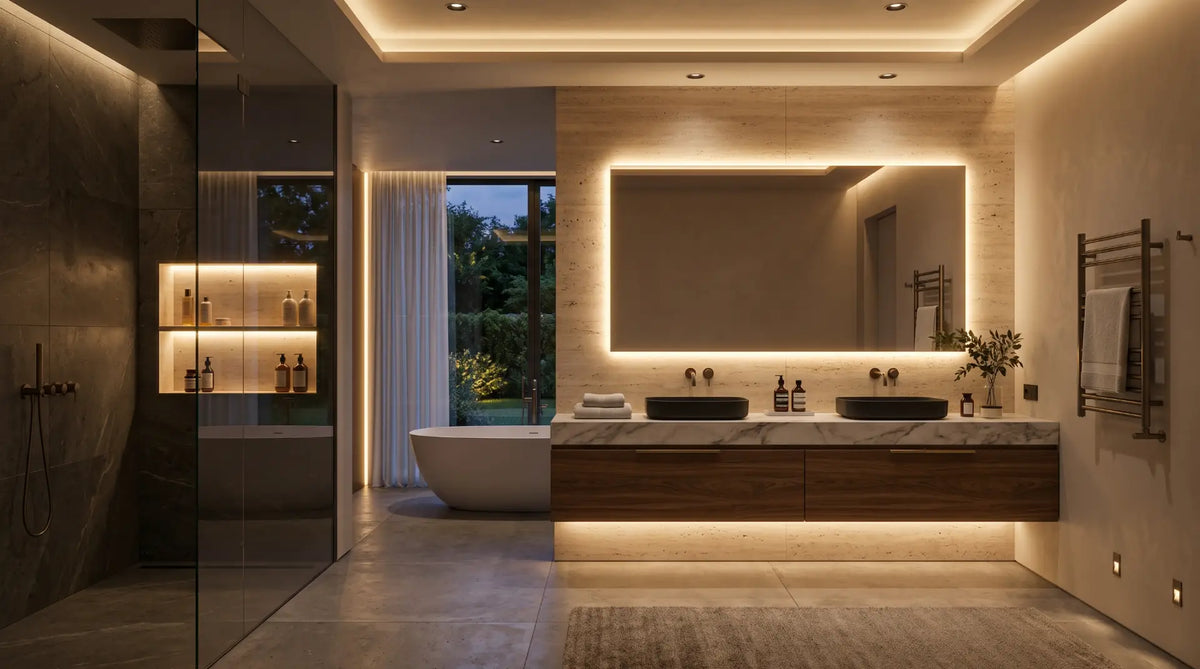
Bathroom lighting is the element most consistently underspecified, underbudgeted, and underappreciated in Canadian home renovations - and the one with the highest impact-to-cost ratio of any upgrade. This guide covers every lighting layer, fixture type, colour temperature, Canadian code requirements, and the specific decisions that separate a bathroom that looks and functions beautifully from one that always seems dim, harsh, or incomplete.
Most Canadian bathrooms are lit by a single ceiling fixture - a recessed pot light or a builder-grade dome fixture centred in the ceiling. This arrangement produces one consistent outcome: shadows directly on the face at the mirror, dim corners that make the room feel smaller, and a flat, clinical quality that no amount of tile or fixture quality can fully offset. It is the single most common design mistake in residential bathroom construction and renovation.
Good bathroom lighting is not about installing more fixtures - it is about installing the right fixtures in the right locations at the right specifications. A bathroom with two well-positioned light sources at the correct colour temperature and CRI outperforms a bathroom with six poorly positioned fixtures at inferior specifications every time. This guide works through the lighting decisions in the order they matter: the lighting layers, the fixture types for each layer, the technical specifications that determine quality, and the Canadian Electrical Code requirements that govern what is permitted where.
Every bathroom - regardless of size, budget, or style - should have at least two light sources operating from separate switches or on a single dimmer: a vanity task light that illuminates the face at the mirror without shadow, and an ambient source that fills the room from the ceiling. A single overhead fixture cannot do both jobs simultaneously. It either produces downward light that fills the room (but casts deep facial shadows at the mirror) or it is positioned over the mirror (but leaves the rest of the room dim). Two sources, positioned deliberately, solve both problems at a combined fixture cost of $150-$600 CAD - the highest-ROI lighting investment in a bathroom of any size.
Before choosing any fixture, settle two upstream technical decisions: the colour temperature (measured in Kelvin) and the Colour Rendering Index (CRI) of every bulb or integrated LED in the room. These specifications determine how the light looks, how skin tones render, and how the room feels - and they must be consistent across every fixture in the bathroom.

Vanity task lighting - the fixture or fixtures positioned at the mirror to illuminate the face - is the most functionally critical light in the bathroom and the one that most directly affects daily satisfaction. It must accomplish one specific thing: illuminate the face from the front and sides, without creating downward shadows from the brow, nose, or chin. A fixture above the mirror casts downward shadows that make the face look older and make grooming inaccurate. A fixture on each side of the mirror - sconces at eye level - eliminates those shadows by providing light from both sides simultaneously.
Side-mounted sconces at 60-65 inches from the finished floor (measured to the centre of the fixture) is the correct specification for shadow-free facial illumination. The sconce width should sit approximately 24-28 inches apart (centred on the mirror), so the light washes evenly across the full face width. Where the bathroom layout makes sconces on both sides impractical, a single bar fixture above the mirror is the acceptable alternative - but it must be wide enough to span the mirror width and positioned no higher than 75-80 inches from the floor to minimise downward shadow.
- Fixture type confirmed: side sconces at 60-65" (preferred), bar above mirror at 75-80", or LED backlit mirror
- If side sconces: electrical boxes positioned at 60-65" from finished floor, 24-28" apart, before drywall closes
- If bar fixture: bar width confirmed equal to or wider than mirror width
- Colour temperature confirmed: 2700-3000K warm white throughout
- CRI confirmed at 90 or higher - checked in product specification, not assumed from product description
- Fixture on a dimmer switch - dimmable LED driver confirmed compatible with dimmer type
- IP rating confirmed: IP44 minimum for fixtures within 1.8m of a water source (CEC requirement)

Ambient lighting - the general room-filling source from the ceiling - is the layer that determines how large and how bright the bathroom feels when you walk in. Unlike vanity task lighting, which must be positioned precisely for facial illumination, ambient lighting is positioned for room coverage: centred in the bathroom ceiling, or in the ceiling zone that best fills the corners and floor with even light. In a bathroom with adequate vanity task lighting, the ambient source can operate on a dimmer at a lower output, providing gentle room-fill without the harshness of a single bright ceiling fixture doing all the work.
Recessed LED downlights (pot lights) are the most common ambient ceiling fixture in Canadian bathroom renovations and the most appropriate for most layouts. A single 4-inch recessed LED fixture centred in a 5×8-foot bathroom provides adequate ambient fill when paired with vanity task lighting. In larger bathrooms (80+ square feet), two or three recessed fixtures in a symmetrical arrangement prevent the dim-corner effect that a single fixture produces. Recessed fixtures in shower zones must be rated for wet locations (IP65 or higher), while fixtures outside the shower but within 1.5 metres of the shower or tub edge must be rated for damp locations (IP44 minimum) under the Canadian Electrical Code.
The Canadian Electrical Code (CEC) establishes four bathroom lighting zones based on proximity to water sources, each with IP rating requirements for installed fixtures. Zone 0 (inside the tub or shower basin) requires IP67 minimum - no standard residential fixtures are appropriate here. Zone 1 (directly above the tub or shower to 2.25m height) requires IP44 minimum. Zone 2 (within 600mm of Zone 1) requires IP44 minimum. Fixtures outside these zones in the general bathroom space require no IP rating but must be on a GFCI circuit. When purchasing any bathroom fixture, confirm the IP rating is documented in the product specification - many fixtures are marketed "for bathroom use" without meeting the IP requirements for their intended zone, which creates both a safety risk and an electrical inspection failure.
- Recessed fixture position confirmed: centred in bathroom ceiling, not directly over mirror (that position adds to downward shadow)
- Fixture spec confirmed: 2700K, CRI 90+, dimmable LED
- Dimmable LED driver confirmed compatible with chosen dimmer switch - confirm before purchasing (incompatible combinations cause flickering)
- IP rating confirmed for each fixture relative to its distance from water source
- If above shower zone: IP65 minimum - confirm on product specification sheet
- Separate switch or dimmer from vanity task light - allows independent control of each layer

Accent lighting - LED strip lights under a floating vanity, within a shower niche, or behind a backlit mirror - is the layer that creates depth, visual warmth, and the spa-quality atmosphere that most homeowners are describing when they say they want a "luxurious" bathroom. It works by creating a separation between zones of brightness: a lit niche draws the eye and creates perceived depth in the shower wall; LED strips under a floating vanity illuminate the floor plane and make the vanity appear to float; a backlit mirror creates a soft halo of light that fills the space between the mirror and the wall behind the fixture.
Accent lighting in a bathroom must also meet CEC IP rating requirements if positioned within the water source zones described above. LED strip lighting installed under a floating vanity (outside all wet zones) requires no IP rating. LED strip lighting installed inside a shower niche must be IP67-rated - fully waterproof. A backlit LED mirror is sold as a complete unit with the LED integrated and waterproofed by the manufacturer; confirm the product's IP rating and any applicable Canadian electrical certifications (CSA or cUL mark) before purchase and installation.
- LED strip product confirmed as CSA-certified (not a generic import without electrical certification)
- If inside shower niche: IP67-rated product confirmed - IP44 is insufficient for direct water exposure zone
- Transformer/driver for LED strip confirmed outside the wet zone - cannot be installed inside a shower enclosure
- Colour temperature confirmed at 2700K - matching all other bathroom fixtures
- Floating vanity toe-kick lighting: conduit or sleeve protects wiring from moisture if floor tile abuts the LED housing

Most Canadian bathrooms have no dedicated light inside the shower enclosure - the shower is lit entirely by whatever ceiling light is in the general bathroom zone, filtered through a glass panel or curtain. The result is a dim, cave-like shower interior where hair colour is difficult to assess accurately and the tile quality is obscured by shadow. A single IP65-rated recessed LED fixture inside the shower ceiling (or positioned directly above the shower zone in an open-top walk-in configuration) transforms the shower from an afterthought in the lighting plan into an illuminated feature of the bathroom.
In-shower LED fixtures are installed by the electrician during the rough-in phase - the electrical box must be positioned in the ceiling before tile substrate and waterproofing are installed, because there is no practical way to add a ceiling fixture inside an existing tiled shower without significant demolition. This makes in-shower lighting a renovation-moment decision: it must be planned before the shower is built, not retrofitted after. The incremental cost during a renovation (IP65-rated fixture + electrical box positioning + wiring) runs $200-$500 CAD - a fraction of the cost of adding it outside the renovation window.
- Electrical box positioned in shower ceiling during rough-in - before tile substrate and waterproofing
- IP65 minimum confirmed on product specification sheet - IP44 is not sufficient inside shower enclosure
- CSA certification confirmed on fixture
- If steam shower: steam-room-rated IP65 fixture specified - not standard wet-zone fixture
- Fixture wired to separate switch or shared with ambient ceiling light - not on the same circuit as vanity task light
The vanity fixture is the only lighting element that is significantly visible as a design object in a bathroom - recessed ceiling lights and LED strip are largely invisible. Choosing a vanity fixture that fits the bathroom's design direction, finishes in the same metal as the hardware, and is appropriately scaled to the mirror size is the styling decision within bathroom lighting.
| Design direction | Recommended fixture style | Finish | Style notes |
|---|---|---|---|
| Contemporary / minimalist | Slim integrated LED bar or clean rectangular sconce with no visible bulb | Matte black or brushed nickel | Fixture profile should be thin - bulky contemporary fixtures contradict the clean-line aesthetic. Integrated LED is preferred over exposed bulb. |
| Modern farmhouse | Cage sconce with exposed Edison bulb, barn-style wall sconce, or industrial globe bar | Matte black or oil-rubbed bronze | The industrial-organic tension of the style is expressed through the fixture profile. Exposed filament or globe bulbs amplify the aesthetic. Always on a dimmer - these fixtures read better at 70-80% output. |
| Traditional / transitional | Multi-light vanity bar with glass or frosted shades, or classic sconce with fabric shade | Brushed nickel, polished chrome, or antique brass | Scale to mirror width - a multi-light bar should span 75-90% of the mirror width. Three-light and five-light bars are the most common formats. Match hardware finish exactly. |
| Spa / biophilic | Backlit LED mirror (full integration) or soft-edged diffused sconce | Brushed gold or brushed nickel | The goal is invisible fixture, visible light - diffused sources without harsh points. Backlit mirror with anti-fog is the defining choice. Warm brass finish reinforces organic warmth. |
| Luxury / premium ensuite | Statement sconces - large format, sculptural, or handmade glass shades on each side of mirror | Unlacquered brass, brushed gold, or matte black (premium version) | In a premium ensuite, the vanity fixture is a design statement - not just a light source. Budget $300-$900 CAD per sconce for this tier. Always two, always on a dimmer, always at 60-65" from floor. |
| Powder room | Single statement pendant or bold architectural sconce - powder rooms tolerate bolder fixtures than full bathrooms | Any finish - powder rooms are low-daily-use, high-guest-visibility spaces where bold choices land well | A powder room is the best place to use a fixture that would feel too strong in a primary bathroom. A $400-$800 statement pendant above or beside a small mirror creates the most impact per dollar of any bathroom lighting investment. |
A bathroom that functions well at 7 AM for makeup application under bright task lighting is not the same bathroom that functions well at 10 PM for a relaxing bath by low ambient light. Without dimmer control, you must choose one lighting scenario and accept it for every use of the bathroom. Dimmers resolve this entirely - and in Canada in 2026, LED-compatible dimmers are available from $25-$80 CAD at any hardware retailer.
The Canadian Electrical Code (CEC) Section 30 governs bathroom electrical installations, including fixture IP ratings by proximity zone. This table is the practical reference every Canadian homeowner should review before purchasing any bathroom fixture.
| Zone | Location | Min. IP rating | Typical fixtures | Notes |
|---|---|---|---|---|
| Zone 0 | Inside the tub or shower basin - in the water itself | IP67 - submersion resistant | Underwater tub lighting only - specialty product | Extremely rare in residential applications. No standard fixture is appropriate here. |
| Zone 1 | Directly above tub or shower to 2.25m height - the volume directly over the water | IP44 minimum (IP65 inside shower enclosure) | In-shower ceiling recessed fixtures, above-tub lighting | Shower ceiling fixtures must be IP65 or higher due to direct spray exposure. Above-tub only (no spray) may use IP44. |
| Zone 2 | Within 600mm of Zone 1 - the area immediately adjacent to the shower or tub | IP44 minimum | Wall sconces near shower or tub, vanity lights close to shower | Most vanity sconces mounted within 600mm of the shower entry fall in this zone. Confirm IP44 on product spec. |
| Outside zones | General bathroom area - more than 600mm from shower or tub, and not above either | No IP rating required - but GFCI circuit required for all outlets | Ceiling fixtures away from shower, wall sconces at vanity far from tub, recessed lights in general ceiling | Standard residential fixtures are appropriate here. All outlets must be GFCI protected regardless of zone. |
| Steam room zone | Inside a steam shower enclosure | IP65 steam-rated | Steam-room-rated recessed LED fixtures only | Standard IP65 wet-zone fixtures are not rated for sustained steam environment. Specify steam-room-rated product explicitly. |
Bathroom exhaust fan-light combination units - a single ceiling fixture that provides both ventilation and lighting - are extremely common in Canadian homes and appealing for their convenience: one electrical box, one ceiling cut-out, one switch. The problem is position. A properly positioned exhaust fan sits in the ceiling directly above the toilet or shower - the zone generating the most moisture that needs to be expelled. This is almost never the position that produces good task lighting at the mirror. Centring the fan-light over the toilet or shower puts the light source in the wrong position for vanity illumination, and the light output of most fan-light combinations (typically 60-100W equivalent) is insufficient as a sole light source for a full bathroom.
The better approach, available in any renovation where the walls are open, is to separate the functions: a dedicated exhaust fan (positioned correctly for ventilation above the toilet or shower) and a dedicated ceiling light positioned correctly for ambient fill. In Canadian buildings, the exhaust fan minimum is 50 CFM for a bathroom under 40 square metres, and 100 CFM for a combined bath-toilet room - these CFM ratings should be the primary specification criterion for the fan, not its aesthetic or whether it includes a light kit. The Broan-NuTone and Panasonic Whisper series are the most widely available quality exhaust fans in Canada, stocked at Home Depot Canada, RONA, and through electrical suppliers.
- Fan CFM confirmed: 50 CFM minimum for standard bathroom; 100 CFM for combined bath-toilet room under Canadian building code
- Fan positioned above toilet or shower - not above the mirror or centred in the room for aesthetic reasons
- Fan ducted to exterior - not into attic, soffit, or wall cavity (a common Canadian code violation in older homes)
- If combo fan-light: dedicated vanity task light also specified separately - fan-light combo not sufficient as sole light source
- Fan on its own switch, separate from lighting - allows ventilation to run independently
The optimal lighting plan differs by bathroom type. Here are the recommended minimum fixture configurations for each Canadian bathroom scenario.
| Bathroom type | Vanity task | Ambient ceiling | Accent / wet zone | Dimmer requirement |
|---|---|---|---|---|
| Powder room (half bath) | One statement sconce beside mirror or a bold bar above - this is the high-impact lighting opportunity in the home | One small recessed LED or a ceiling pendant if ceiling height allows | Optional - backlit mirror adds elegance without ceiling accent | Ambient ceiling on dimmer - vanity optional |
| Small full bath (under 50 sq ft) | Side sconces at 60-65" or LED backlit mirror - do not skip this layer even in small bathrooms | One 4" recessed LED centred in ceiling - on dimmer | In-shower fixture if walk-in shower present | Ambient ceiling dimmer essential - small bathrooms feel harsh with bright undimmed overhead light |
| Family bathroom (50-80 sq ft) | Bar fixture spanning mirror width or two sconces | One or two 4" recessed LED - on dimmer | In-shower ceiling fixture strongly recommended | Ambient ceiling dimmer; vanity task on separate switch |
| Primary ensuite (80+ sq ft) | Two side sconces at 60-65" - one on each side of mirror. Or LED backlit mirror for contemporary ensuite. | Two to three 4" recessed LED in symmetrical arrangement - on dimmer | In-shower ceiling fixture (IP65) + LED strip under floating vanity + optional niche lighting | Minimum two dimmers: ambient ceiling and vanity task. Consider smart dimmer system for scene programming. |
| Luxury ensuite (full renovation) | Statement sconces - architectural, sculptural, or handmade glass - one on each side at 60-65" | Recessed LED array on dimmer + optional decorative ceiling pendant in vanity zone | In-shower IP65 fixture, LED strip under floating vanity, backlit niche, and optional chromotherapy in steam shower | Full smart lighting system (Lutron Caseta or equivalent) - scene control for morning, evening, and spa modes |
- Colour temperature confirmed at 2700-3000K for all fixtures - no fixture in the bathroom exceeds 3000K
- CRI confirmed at 90 or higher for vanity task light - checked in product specification sheet
- IP rating confirmed for each fixture relative to its bathroom zone - IP44 for Zone 2, IP65 for shower interior
- CSA certification confirmed for all fixtures and LED strip products
- All LED fixtures specified as dimmable - and confirmed compatible with the dimmer switch being installed
- Fixture type confirmed: side sconces at 60-65" (preferred), bar at 75-80", or LED backlit mirror
- If side sconces: electrical boxes positioned at 60-65" from finished floor, 24-28" apart - confirmed with electrician before drywall
- If bar fixture: bar width confirmed equal to or wider than mirror
- Vanity task light on separate switch or dimmer from ambient ceiling fixture
- Ambient recessed fixture centred in ceiling - not directly over mirror
- Ambient fixture on dimmer switch
- If shower present: in-shower ceiling fixture electrical box positioned during rough-in - IP65, CSA certified
- If steam shower: steam-room-rated IP65 fixture specified explicitly
- Exhaust fan positioned above toilet or shower - separate from lighting, on its own switch
- Exhaust fan CFM confirmed: 50 CFM minimum for standard bathroom; 100 CFM for combined bath-toilet room
- Exhaust fan ducted to exterior - not into attic or soffit
- If LED strip under floating vanity: CSA-certified product confirmed - not generic import
- If LED strip in shower niche: IP67-rated product confirmed
- Dimmer circuit confirmed as separate from GFCI outlet circuit - electrician confirmation before rough-in sign-off
- All outlet circuits within 1.5m of water source confirmed as GFCI protected
- Final fixture positions reviewed against Canadian Electrical Code zone requirements before rough-in inspection
Shop LED mirrors, vanity fixtures, and bathroom lighting at Bathify
Anti-fog LED mirrors, vanity bars, sconces, and complete fixture sets - all specified for Canadian bathrooms and shipped across Canada. Free shipping on orders over $50.


