






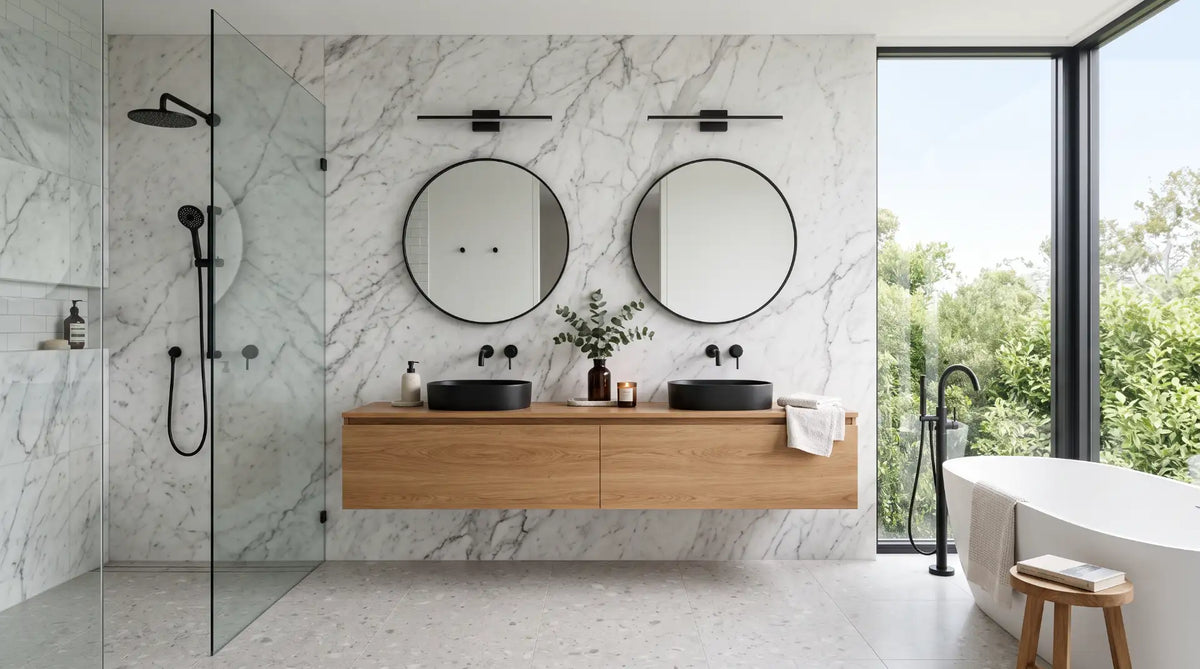
Stone tile, cast-marble sinks, travertine accents - this guide shows you exactly where to spend, where to save, and what to avoid so you get genuine stone character in your bathroom without a designer-level budget.

Natural stone in a bathroom doesn't look expensive because it's rare. It looks expensive because it's specific - every vein in marble, every texture variation in travertine, every crystalline flash in quartzite is genuinely one-of-a-kind. That specificity is what mass-produced tile has always struggled to replicate convincingly, and it's why a bathroom with even a small amount of genuine stone reads as higher-specification than a room tiled entirely in standard ceramic. Understanding that one insight is the foundation of every smart stone strategy: you don't need to cover the entire room in stone to get the visual effect that stone delivers. You need to place it where it does the most work.
For Canadian homeowners in 2026, natural stone comes with a set of considerations that don't apply in the same way south of the border. Stone is almost entirely imported, and the current CAD/USD exchange rate adds a significant premium to any figure quoted in US dollars - 25 to 35 percent in real purchasing terms. Import lead times can run six to twelve weeks for specialty stone. And Canadian climate conditions - specifically the humidity swings between a sealed, heated bathroom in winter and a warm, steam-heavy bathroom in summer - place real demands on installation quality and ongoing sealing. This guide addresses all of that directly, with real CAD price ranges, specific product recommendations from Bathify.ca, and installation guidance calibrated to Canadian conditions.
If you're planning a full stone bathroom renovation, read sequentially - the sections build on each other. If you're looking for the single highest-impact stone upgrade within a tight budget, go straight to Sections 3 (strategic placement) and 5 (stone sinks), which cover the two interventions that deliver the most stone character per dollar spent.
Not all natural stone behaves the same way in a bathroom environment. Porosity, hardness, slip resistance, maintenance requirements, and cost vary significantly between stone types - and the wrong stone in the wrong application is one of the most common and expensive renovation mistakes. Here's what you actually need to know about each stone before you commit.

A sedimentary limestone with a warm beige-to-ivory palette and characteristic pitting. The most budget-accessible genuine stone for Canadian bathrooms. Requires filling (grout or epoxy) and sealing before use. Works well on walls and in showers; use honed finish on floors for slip resistance.

The most visually prestigious stone - veined white Carrara, warm Crema Marfil, dramatic Nero Marquina. Also the highest maintenance: highly porous, etches on contact with acids, scratches with abrasive cleaners, and must be resealed annually in bathrooms. Best used on walls and as feature accents rather than high-traffic floors.

Quieter than marble, with a muted grey-to-beige palette and fine-grained texture. A natural fit for Japandi, Scandinavian, and transitional bathrooms. More porous than granite but less dramatic than marble. Responds well to honing. Avoid polished limestone on floors - it becomes slippery. Mid-range cost in Canada.

Slate is naturally cleft (textured), dense, and highly slip-resistant - making it exceptional for bathroom floors. Quartzite is denser than marble with similar veining but far better durability and acid resistance. Both require less frequent sealing than marble or travertine. Slightly higher install cost due to material hardness; cutting requires diamond blades.
The single most important decision in a budget-conscious stone bathroom isn't which stone to buy - it's where to put it. Stone placed in the wrong location (a high-traffic floor in a porous marble, for example) creates ongoing maintenance cost and eventual wear that erodes the investment. Stone placed in the right location - a shower niche, a feature wall behind the vanity, a countertop - delivers its maximum visual return while minimising surface area, installation complexity, and long-term upkeep.
A single feature wall in genuine stone - the wall behind the vanity, or the rear wall of the shower - delivers the full visual impact of a stone bathroom while covering the minimum surface area. A standard vanity wall runs roughly 1.5m × 2.4m (roughly 5' × 8'), or about 3.6 square metres (38 sq. ft.). At even premium marble pricing of $50 CAD per sq. ft., that's roughly $1,900 in supply for the most dramatic stone surface in the room. The remaining three walls, the floor, and the ceiling can be done in stone-look porcelain at $6-$10 per sq. ft. - and from a standing position in the room, the visual effect is indistinguishable from full stone throughout.
A recessed shower niche lined in a contrasting natural stone is one of the design-world's best-known budget tricks precisely because it costs almost nothing to execute and reads as a significant design decision. A standard shower niche runs roughly 30cm × 60cm (12" × 24") - under 0.2 square metres of stone. Even at $60 CAD per sq. ft. premium marble, that's under $120 in stone supply for the most photographed detail in the bathroom. The surrounding shower walls can be stone-look porcelain; the niche alone in genuine marble or travertine tells the whole story. Bathify's bathroom products collection includes shower niches and accessories to build out that finished look.
A natural stone countertop on a bathroom vanity brings the material into daily tactile contact - the quality most people associate with luxury in a bathroom. A 48" vanity countertop is roughly 1.2m × 0.5m, or about 0.6 square metres. That's a minimal stone purchase by any measure, but one that delivers constant sensory confirmation of material quality every time someone uses the sink. Travertine and honed limestone are the most practical choices here; marble works beautifully but requires the discipline of annual resealing and pH-neutral cleaners to prevent etching.
Lead with stone in the most-photographed location. In a bathroom renovation, the most-photographed location is always the view from the doorway - the vanity wall with the mirror above it. Concentrate your genuine stone budget on this sight line: a stone countertop, a stone niche, or a stone feature wall behind the vanity. Everything else can be a high-quality stone-look porcelain, and no photograph - or buyer - will know the difference.
| Stone Placement | Typical Area | Est. Supply Cost (CAD) | Visual Impact | Maintenance Level |
|---|---|---|---|---|
| Feature wall (behind vanity) | ~3-4 sq. m. | $1,200 - $2,800+ | Very High | Medium |
| Shower niche liner | ~0.2 sq. m. | $60 - $200 | High | Low |
| Vanity countertop | ~0.5-0.8 sq. m. | $250 - $600 | High | Medium |
| Shower floor mosaic | ~0.6-1.0 sq. m. | $300 - $900 | Medium | Medium |
| Full floor (all natural stone) | ~4-8 sq. m. | $1,500 - $6,000+ | Medium | High |
| Full shower surround | ~6-10 sq. m. | $2,400 - $8,000+ | Very High | High |

Stone-look porcelain has crossed a quality threshold in the last several years that makes genuine stone and porcelain a legitimate hybrid strategy rather than a compromise. The best large-format rectified stone-look tiles - particularly those in 60×120cm (24"×48") or 80×160cm (32"×63") formats - are visually convincing at normal bathroom viewing distances, completely non-porous, and immune to the etching, staining, and cracking that genuine stone requires you to manage. They cost 40 to 70 percent less than the stone types they replicate, and they never need sealing.
The limitation is tactile and material: under close inspection, good stone-look porcelain doesn't have the depth variation, the weight, the coolness to the touch, or the mineral uniqueness of genuine stone. Which is exactly why the hybrid strategy works so well - use porcelain where no one gets close enough to feel the difference (floors, large wall fields), and use genuine stone where the material is touched and examined (countertops, vessel sinks, shower niches).
Vessel sink, countertop, shower niche: genuine stone. Shower walls, bathroom floor, large field tile areas: stone-look porcelain in a matching base colour. This rule keeps your material budget concentrated where it delivers the highest sensory return, and your maintenance burden low where it would otherwise be high.
The quality gap between generic stone-look tile and premium stone-look porcelain is significant and visible. The markers of a better product: rectified edges (consistent dimension, allowing minimal grout joints of 1.5-3mm that disappear visually), multiple print variations per box so repeating patterns aren't obvious, surface texture that's tactilely varied rather than uniformly flat, and calibrated thickness. When selecting stone-look porcelain for a Canadian bathroom, ask your tile supplier for the shade variation rating - V3 or V4 (high to very high shade variation) is what you want for a genuinely stone-like result. V1 and V2 are uniform and read immediately as manufactured tile.
If there is a single stone upgrade that delivers the most visual and tactile return for the least square footage and the most manageable cost, it is a stone or stone-composite vessel sink. A vessel sink sits above the counter - it is the most seen, most touched, most photographed element in the bathroom. Replacing a standard ceramic sink with a cast-marble or stone-composite vessel sink changes the entire material read of the room without touching a single tile.
At Bathify.ca, the ICO Bath cast-marble vessel sink collection delivers genuine stone character through a material process that combines approximately 75% crushed dolomite rock with resin, finished with a UV-resistant gelcoat. This gives the sink the density, weight, and tactile quality of stone - including the characteristic coolness to the touch - while delivering the non-porous, fade-resistant, easy-clean surface behaviour of an engineered composite. These are made-to-order products with a 4-6 week lead time, so they need to be ordered early in a renovation sequence.

The Bassini is the most versatile ICO Bath vessel sink for a natural stone bathroom scheme. Its solid round form and deep, high-walled bowl give it the presence of a carved stone basin - which, in terms of material composition, it essentially is. The superior cast marble process achieves the spherical precision that raw stone cannot, while the gelcoat protection layer preserves the gentle surface sheen over years of daily use. It pairs naturally with a wall-mount vanity from Bathify's collection (the Kube Bath Bliss in walnut or the Cutler Kato) and a tall vessel faucet in matte black or brushed nickel from the Bathify faucet range.

For a bathroom where the sink is the design centrepiece rather than a background element, the Cavalli is the right choice. Its asymmetric basin shape - inspired by contrast and movement - creates a genuinely sculptural presence that no standard ceramic sink can approximate. Made from the same cast marble process as the Bassini (approximately 75% crushed dolomite, UV gelcoat protection), it brings lasting durability alongside its dramatic aesthetic. Best suited to larger bathrooms - a powder room, a primary ensuite - where the basin has visual breathing room to read as the statement piece it is.

The Rossini's angular tapered rim and shallow bowl profile make it the right cast-marble vessel sink for compact bathrooms and powder rooms where a deep bowl would overpower the vanity scale. The reflective surface finish - smoother and more luminous than the Bassini - catches light differently and works particularly well in lower-light powder rooms. Its shallower depth also drains quickly, a practical advantage in a high-use guest bathroom. At this format, the Rossini pairs naturally with the Kube Bath Bliss 18" or 24" wall-mount vanity for a powder room with full stone character at a manageable scale.
Order your vessel sink and vessel faucet at the same time. The vessel faucet must be specified to the correct height for the sink bowl - a tall single-hole vessel faucet clearing the bowl rim by 100-150mm is the standard. Bathify's sink faucet collection includes tall vessel-compatible faucets in matte black and brushed nickel. Coordinate finish before you order - returning a made-to-order stone sink because the faucet finish doesn't match is an avoidable cost.
Natural stone in a bathroom without proper sealing and maintenance will disappoint - not immediately, but progressively. The staining, etching, and dulling that give improperly maintained marble its bad reputation are entirely preventable with the right sealer, applied consistently, with pH-neutral cleaners used for ongoing cleaning. The failure is almost never the stone. It's the maintenance protocol.
New stone should be sealed before grouting - not after. Grout contains cement that can stain porous stone if the stone isn't sealed first. Apply a penetrating impregnator sealer (not a topical sealer, which sits on the surface and peels) in two coats with a 20-minute dwell time and a full wipe-down between coats. After installation and grouting, apply a final coat. The sealer should be a silicone- or fluorocarbon-based penetrating impregnator rated for wet areas. Avoid spray-and-wipe products from hardware stores - they don't penetrate deeply enough for a shower or bathroom floor application.
The simplest maintenance check for natural stone: put a few drops of water on the stone surface and wait 5-10 minutes. If the water beads up and sits on top, the sealer is active and the stone is protected. If the water absorbs into the stone and the surface darkens, the sealer has worn through and resealing is overdue. In Canadian bathrooms, where the contrast between winter heating and steam shower humidity cycles is significant, this test is worth doing twice a year.
The list of common household cleaners that damage natural stone is longer than most homeowners expect, and the damage - particularly etching on marble and travertine - is permanent without professional re-honing. The following are incompatible with natural stone in a bathroom:
Natural stone is one of the most import-dependent categories in Canadian home renovation. Unlike vanities, fixtures, and fittings - where Canadian-made options exist across all price points - virtually all natural stone tile sold in Canada comes from Italy, Spain, Turkey, Portugal, Brazil, or India. That supply chain has two important implications for Canadian buyers: the exchange rate matters significantly, and lead times are longer than domestic products.
When you see natural stone prices in a US renovation blog or a US tile retailer's website, those prices don't translate directly to Canadian dollars by multiplying by the exchange rate. The actual Canadian landed cost - after import duties, brokerage fees, exchange rate conversion, and Canadian retailer margin - is typically 35 to 50% higher than the equivalent USD price. A $15 USD/sq. ft. Italian marble tile is realistically a $21-$23 CAD/sq. ft. product in Canada. Always source Canadian prices from Canadian tile distributors; US pricing is not a reliable baseline.
Standard in-stock stone tile at a Canadian tile shop has the same lead time as any other tile product - typically 1 to 3 weeks for delivery. Special-order stone - specific slabs for custom countertops, non-stocked stone types, or large quantities of an imported material - can take 6 to 12 weeks. ICO Bath cast-marble vessel sinks from Bathify.ca operate on a 4-6 week made-to-order timeline. The practical implication: stone products should be ordered before a renovation starts, not during it. Order the sink and any special-order stone tile at the same time as your vanity - which at Bathify.ca for the Kato 48" or Bliss 48" wall-mount also operates on a made-to-order window. Everything arrives together, the tile-setter has materials when they arrive, and no one is waiting on a delayed delivery mid-renovation.
To make the numbers concrete: a 9 sq. m. (96 sq. ft.) Canadian bathroom renovated with a hybrid stone strategy - genuine stone feature wall and vessel sink, stone-look porcelain on floors and surrounding walls, new wall-mount vanity and matte black faucets - would typically cost in the following supply ranges before labour:
Order Bathify products before the renovation starts. The Kube Bath Bliss and Cutler Kato wall-mount vanities, and ICO Bath vessel sinks, are made-to-order products with 4-6 week lead times. Place your Bathify order at project kick-off - wall-mount vanities, vessel sinks, and faucets all ship free across Canada on orders over $50, so there's no minimum order incentive to delay.
Which Stone Strategy Is Right for Your Canadian Bathroom & Budget?
Tightest budget (under $2,000 total materials): Focus entirely on a cast-marble vessel sink from ICO Bath and a single stone-look porcelain tile in a large format for floors and walls. The vessel sink delivers genuine stone character at the point of highest daily impact; the porcelain handles everything else cleanly. Add a matte black faucet from Bathify's collection, and the result reads as a stone bathroom from every angle that matters.
Mid-range budget ($2,000-$5,000 materials): Use travertine or limestone on the feature wall behind the vanity (genuine stone, highest visual impact), stone-look porcelain for the floor and shower walls, and an ICO Bath cast-marble vessel sink. This is the hybrid strategy at its most effective - three material categories, each doing exactly the job it's best suited for, with the genuine stone budget concentrated where it earns the most return.
Comfortable budget ($5,000-$10,000 materials): Full travertine or limestone shower surround (floor to ceiling, one material, minimal grout joints), matching stone vanity countertop, ICO Bath vessel sink, and stone-look porcelain on the bathroom floor outside the shower. Add a marble or quartzite shower niche liner in a contrasting stone for the detail that photographs best.
Premium renovation (materials $10,000+): Genuine marble or quartzite throughout - floor, shower walls, vanity countertop - with a cast-marble vessel sink and matching faucet hardware. At this level, the tile installation budget is as important as the material: a premium stone tile installed poorly is worse than a mid-range tile installed by an expert. Budget accordingly for a tile installer with specific experience in large-format natural stone wet-area work.
If long-term maintenance is a concern: Quartzite or slate for floors (low porosity, infrequent sealing, high durability), stone-look porcelain for shower walls (zero maintenance), and a cast-marble vessel sink from ICO Bath (engineered composite - no sealing required, UV-stable finish). This combination delivers stone character across the room with the lowest ongoing maintenance burden of any genuine-stone-adjacent strategy available in Canada.
Shop Stone-Ready Fixtures at Bathify Canada
Bathify.ca carries ICO Bath cast-marble vessel sinks, wall-mount vanities in natural wood tones, and matte black and brushed nickel faucets from Riobel, Agua Canada, Delta, and Kube Bath - everything you need to complete a natural stone bathroom. Free ground shipping across Canada on orders over $50.


