






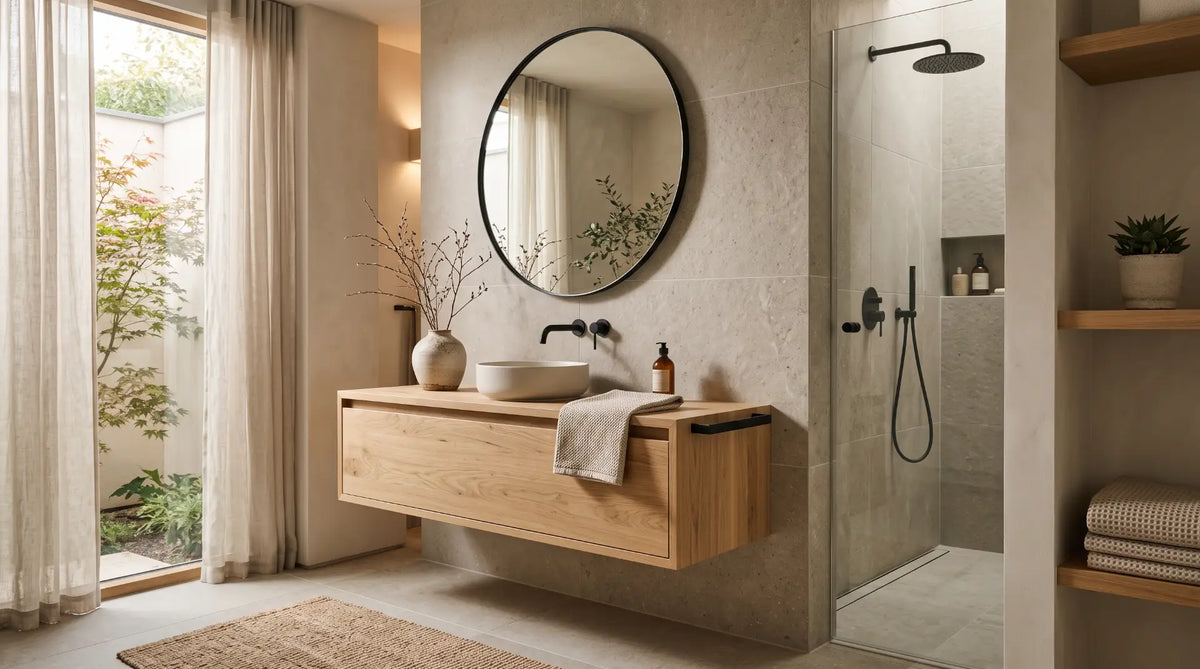
A practical guide to achieving the Japandi aesthetic in your Canadian bathroom - covering palette, materials, vanity selection, faucet finishes, tile, and the exact Bathify products that bring this design philosophy to life without compromise.

Japandi bathroom design sits at the intersection of two philosophies that were always heading toward each other. Japanese wabi-sabi teaches that beauty lives in imperfection, in aged wood, raw stone, and the quiet dignity of objects stripped of everything unnecessary. Scandinavian hygge argues for warmth, for a home that shelters you from a cold climate with soft textures and a palette that feels like candlelight. Together, Japandi produces spaces that are simultaneously serene, functional, and deeply liveable - and nowhere is that combination more welcome than in a Canadian bathroom, where the room needs to perform as both a utilitarian workhorse and a private retreat from a seven-month winter.
This guide covers every layer of a Japandi bathroom renovation: the colour rules that keep the look cohesive, the vanity and faucet decisions that anchor the style, the tile and material choices that ground the space, and the restraint in accessories that makes everything feel intentional rather than decorated. Throughout, you'll find specific Bathify products - all verified, all shipping across Canada - that slot directly into a Japandi scheme. The goal is to give you a design framework specific enough to act on, not a mood board you can't translate into a real renovation.
If you're planning a full renovation, read sequentially - the sections build on each other. If you're refreshing an existing bathroom with new fixtures, jump to the vanity (Section 3) and faucet (Section 4) sections, which have the highest visual impact per dollar. If you're in the early inspiration phase, the palette and tile sections show you what distinguishes a genuine Japandi space from a generic minimalist bathroom.
Japandi is not a trend in the way that subway tile or shiplap is a trend - something that peaks, saturates, and dates. It is a distillation of two centuries-old design traditions that happen to share a value system: simplicity, craftsmanship, natural materials, and the deep comfort of a space that doesn't demand attention. The name is a portmanteau of Japan and Scandinavia, but the underlying philosophy predates the label by decades.
In practice, Japandi bathrooms are defined by what they don't contain. No decorative items that don't also function. No colour palette that pulls the eye in competing directions. No finish combinations that feel busy or layered. What remains is: a floating vanity in a warm wood tone, a wall surface in one or two related neutrals, a single metal finish carried across faucet and accessories, and a floor that reads as continuous and calm.

Celebrates imperfection in natural materials, the beauty of empty space (ma), and organic form. In the bathroom: rough-textured stone tile, handmade ceramic accessories, and a vanity that shows its wood grain rather than hiding it behind paint or gloss.

Prioritises cosy livability, the idea of "just enough" (lagom), and multi-functional design. In the bathroom: warm-toned wood cabinets, soft textile accents like linen towels, and fixtures that are beautiful precisely because they are so perfectly suited to their function.

Both traditions favour materials that age beautifully and carry inherent character. Engineered wood vanities in walnut or oak finish, stone-look or genuine stone tile, unglazed ceramic accessories, and linen hand towels are the material vocabulary of a Japandi bathroom.

Every object in a Japandi bathroom earns its place through function. A small plant earns its place because it introduces the organic texture of nature. A ceramic soap dish earns its place because it keeps the countertop dry. A decorative figurine never earns its place because it only decorates.
The single most common mistake in attempting a Japandi bathroom is choosing the wrong white. Pure bright white - the white of a standard bathroom tile or semi-gloss wall paint - reads as clinical, institutional, and cold. It's the opposite of what Japandi is reaching for. Japandi white is the white of aged linen, of morning fog over still water, of bleached driftwood. It has warmth embedded in it, and that warmth is what distinguishes a Japandi space from a generic minimalist one.
Layer three neutrals, not two. A Japandi bathroom with only a white wall and a brown vanity can read as sparse rather than serene. The third neutral - a warm grey grout, a soft sage towel, a stone-look floor with a hint of taupe - adds the depth that makes the restraint feel intentional rather than unfinished.
In Canadian homes specifically, the Japandi palette performs exceptionally well against the backdrop of grey winter light. The warm underlying tones of greige walls and walnut wood read as actively warming when natural light is limited - a quality that cool, contemporary palettes lack entirely. Vancouver homeowners working with overcast coastal light, or Calgary and Edmonton residents navigating low-angle winter sun, will find that a Japandi palette makes their bathroom feel warmer and more luminous than it technically is.
The floating vanity is the foundational element of any Japandi bathroom - more important than any other single decision. It does three things simultaneously: it provides the warm wood tone that anchors the material palette, it expresses the minimalist silhouette through its wall-hung format (floor clear, no toe-kick, no base), and it demonstrates the functional elegance that both Japanese and Scandinavian design traditions prize. A vanity on legs or a freestanding unit with a standard base can approximate the look, but the true Japandi version always floats.
At Bathify.ca, the vanity range covers several options that work directly in a Japandi scheme - in wood tones and formats that require no adaptation. Here are the three strongest picks for a Japandi Canadian bathroom, all verified, all shipping across Canada.

The Kato is purpose-built for the Japandi aesthetic. Its warm, textured wood-grain finish - designed to replicate the spa-like character of natural timber without the moisture sensitivity - sits on a structural back panel of solid 3/4" UV birch plywood, meaning it can anchor into studs and carry its full weight without flex. Three soft-close drawers and two soft-close doors keep everything hidden; the integrated cultured marble top with rectangular sink keeps the countertop surface clean. Proudly made in Canada, the Kato carries genuine Canadian cabinetry standards - which matters here, because a floating vanity is only as good as its mounting structure, and this one is built for it.

The Bliss series gives you the Japandi floating-vanity silhouette at a more accessible price point, with wood-tone finish options - particularly walnut and butternut - that translate directly into a Japandi palette. The moisture-resistant wood veneer construction, seamless reinforced acrylic composite top, and European soft-close drawer hardware combine to deliver a product that looks and feels considerably more expensive than its price. For homeowners renovating on a tighter budget without wanting to compromise the core Japandi aesthetic, the Bliss in walnut is the most direct path there.

For a premium Japandi bathroom where material authenticity matters, the Mylo delivers with solid-wood construction and a maple, white oak, or toasted almond finish that carries genuine warmth and grain variation you can feel as well as see. Made in Canada, the Mylo is the right choice when the vanity needs to serve as a statement piece in a high-specification renovation - a main ensuite or a primary bathroom where the budget supports it. The Toasted Almond finish, in particular, has the soft amber warmth that sits at the heart of the Japandi warm-neutral palette.

In a Japandi bathroom, the faucet does more visual work than it does in any other style - because there's less competing for attention, every element is seen clearly. The wrong faucet finish (chrome in a warm-wood scheme, brushed gold in a cool-grey palette) reads as a mistake rather than a quirk. The right faucet finish reads as inevitable - the natural conclusion of the rest of the palette.
The two finishes that slot most naturally into a Japandi bathroom are matte black and brushed nickel. Matte black is the stronger contrast choice: it grounds the warm wood and neutral tile without any shine, and its depth reads as deliberate and calm rather than decorative. Brushed nickel sits warmer and slightly more luminous, and it pairs especially well with white oak or maple vanities where you want to avoid the starkness of black against a very pale wood tone. Brushed gold works in a warmer Japandi scheme but should be limited to a single fixture type - the faucet alone, not faucet plus towel bars plus accessories, which tips into maximalist territory that breaks the Japandi logic.
Choose one metal finish and apply it to everything: faucet, towel bar, toilet paper holder, robe hook, and drain cover. Mixing metals is a design choice that requires expertise and intention to pull off. In a Japandi bathroom, the visual restraint of a single finish is always the correct call - it reinforces the "nothing unnecessary" principle that sits at the heart of the style.
Beyond finish, the shape of the faucet matters in a Japandi bathroom. Clean geometric forms - a simple cylindrical spout with a lever handle, a straight rectangular body, a tall single-hole arc without ornamentation - align with the design vocabulary. Decorative faucets with curved, ornamental, or traditional cross-handle detailing introduce a visual complexity that conflicts with Japandi restraint. The spout should be something a Japanese product designer would nod at: functional, precise, and entirely without decoration for its own sake.
| Finish | Best Vanity Pairing | Palette Compatibility | Japandi Rating |
|---|---|---|---|
| Matte Black | Walnut, Butternut, Gray Oak | Warm neutrals, greige, off-white | Excellent |
| Brushed Nickel | White Oak, Maple, Light Wood | Soft whites, warm greys, sage | Excellent |
| Brushed Gold | Toasted Almond, Nature Wood | Warm beige, terracotta accent | Use Sparingly |
| Polished Chrome | Any | Any | Avoid |
| Oil-Rubbed Bronze | Nature Wood, Walnut | Deep warm neutrals | With Care |
Bathify carries bathroom faucets from Riobel, Delta, Kube Bath, and Agua Canada - in matte black, brushed nickel, brushed gold, and chrome finishes. For a Japandi bathroom, shop from the matte black and brushed nickel selectors; most of these brands offer clean-profile lever-handle or single-handle faucets in exactly the geometric shapes Japandi calls for. If you haven't yet settled on hole configuration or faucet type, the full faucet selection guide covers single-hole, widespread, and centerset options for every Canadian sink setup.
Match drain finish to faucet finish - always. In a Japandi bathroom where details are visible and considered, a chrome drain cover beneath a matte black faucet is a small but noticeable inconsistency. Bathify's accessories section includes drain covers and pop-up assemblies in black and nickel - verify finish before ordering.
Tile is where the Japandi bathroom earns its texture and depth - and where the distinction between a generic neutral bathroom and a genuinely Japandi space becomes most visible. The material vocabulary is narrow but specific: stone-look or genuine stone, concrete-look porcelain, honed marble, or textured ceramic with an artisanal quality. What it isn't: polished white subway tile, glossy large-format white, or anything that reads as typical builder-grade bathroom tile.

The Japanese aesthetic of ma - the meaningful use of empty space - is expressed in tile through large format. A 60×120cm (24"×48") or 60×60cm (24"×24") floor tile with a warm sand or greige base and minimal grout joints creates a continuous, uninterrupted floor plane that reads as calm and considered. The matte or honed finish matters: a polished floor in a Japandi bathroom is too bright, too reflective, and too reminiscent of commercial or hotel-lobby tile.

Japandi wall tile prioritises tactile quality over graphic pattern. A bouclé-textured wall tile in off-white, a limewash-effect tile in warm grey, or a zellige-style handcrafted ceramic tile in soft sage all introduce the surface variation that makes a monochromatic Japandi palette feel rich rather than flat. Avoid pattern - geometric tiles, Moroccan-style repeats, or anything with a strong graphic motif conflicts with the visual calm Japandi requires.

In a Japandi shower, the defining choice is continuity: one tile material carried from floor to ceiling, with no border, no accent strip, and no pattern interruption. This is the visual language of the Japanese onsen - the bath house - applied to a residential shower. A warm stone-look porcelain tile run floor to ceiling with a matching floor tile creates a seamless material envelope that reads as both luxurious and architecturally considered. A frameless glass shower panel or frameless glass door preserves the visual continuity by eliminating the visual weight of a frame.
This is where most Japandi bathroom attempts succeed or fail. The instinct when approaching a neutral, minimal bathroom is to add life through accessories - a plant, a candle, a small sculpture, a decorative tray, a woven basket, and then one more thing. Each individual choice seems justified. Together, they produce a cluttered surface that reads as "neutral bathroom with stuff on the counter" rather than the curated, breathing space that Japandi actually is.
The Japandi standard for accessories is ruthless: each item must function, and there should be no more than three items on any visible surface. A hand soap dispenser, a small ceramic dish for jewellery, and a single plant in a handmade pot - that is the counter. Everything else lives inside the vanity drawer, behind a closed cabinet door, or doesn't live in the bathroom at all.

Open shelving in a Japandi bathroom is a design feature that can anchor the style - or sabotage it, depending on what goes on it. The correct approach: a single floating shelf in natural wood (matching or complementary to the vanity tone), holding no more than four items arranged with visible breathing room between them. A folded linen hand towel, a ceramic soap dish, a small plant, and a glass bottle of liquid soap: that is a styled Japandi shelf. Twelve products, three candles, a photograph, and two succulents is a cluttered bathroom shelf that happens to have wood in it.
The floating vanity's closed drawers are the backbone of a Japandi bathroom's visual calm. Everything that would otherwise be visible - products, towels, cleaning supplies - goes inside. Bathify's Kato and Bliss vanities both offer multiple drawers and soft-close door cabinets specifically so the countertop can stay clear. If your current bathroom lacks sufficient closed storage, the vanity is the most impactful upgrade you can make before any other Japandi element.

A single plant is the one organic element Japandi permits - and it earns its place because it introduces the living, natural texture that both the Japanese and Scandinavian traditions value. The key is species selection: a small monstera, a peace lily, a snake plant, or a eucalyptus stem in a simple ceramic vase all work. A large, bushy arrangement of multiple species in a basket is too maximalist. The pot should be handmade-looking ceramic or simple matte clay - nothing glossy, nothing with a pattern, nothing that looks like it came from a mass-market homeware store.

Textiles in a Japandi bathroom stay within the palette: undyed linen, warm oatmeal, or soft sage. Two bath towels hung on the towel bar, a single bath mat in a coordinating neutral, and linen hand towels are the maximum. Turkish cotton in a very light natural or greige weave hits the tactile quality both Japanese and Scandinavian design traditions appreciate without adding bulk or colour that pulls against the palette. Avoid patterned towels, bright-coloured towels, or an excess of towels - a rack of seven towels in three colours is the opposite of Japandi.
The Japandi aesthetic didn't originate in a cold-climate country with seven-month winters, but its Scandinavian half did - and that half is very relevant to Canadian bathrooms. The design philosophy was partly developed in response to cold, dark climates where interior warmth and cosiness weren't optional luxuries but practical necessities. Canadian homeowners in Toronto, Calgary, Winnipeg, Vancouver, and Halifax are in exactly the climate for which hygge-influenced design was created.
A Japandi bathroom with a wood-tone vanity and natural material accessories requires excellent ventilation to protect those materials from moisture damage. Canadian building code (NBC) requires bathroom exhaust fans in all enclosed bathrooms, but the minimum code specification - typically 50 CFM for a small bathroom - is often insufficient for bathrooms with steam showers or deep soaking tubs. For a Japandi bathroom with a floating vanity, a quality exhaust fan rated at 80–110 CFM with a humidity sensor is the right specification. Run the fan during every shower and for 20 minutes after. The wood-tone vanity and any open shelving will thank you with years of sustained appearance.
Heated floors (electric radiant mat under large-format tile) are standard in high-specification Canadian bathroom renovations - and they are the single upgrade most aligned with the Japandi aesthetic. A heated stone-look tile floor means no bath mat is needed, keeping the floor plane clear and continuous. No bath mat means no textile clutter. No textile clutter means the floor reads exactly the way Japandi intends: as a calm, continuous material surface. The cost of an electric radiant mat in a standard Canadian bathroom runs roughly $400–$900 CAD in materials; the installation labour is typically included in the tile-setter's quote when done as part of a full bathroom renovation.
A full Japandi bathroom renovation in Canada ranges considerably by scope and city. The table below gives realistic CAD ranges based on current 2026 pricing, including materials and trade labour. For a detailed city-by-city cost breakdown, the bathroom renovation cost guide covers Toronto, Vancouver, Calgary, Edmonton, Ottawa, and smaller markets in full.
| Renovation Scope | What's Included | Typical CAD Range |
|---|---|---|
| Fixture Refresh | New floating vanity, new faucet, new mirror, repaint walls | $4,000 – $8,000 |
| Entry Renovation | Above + new floor tile, retile shower accent wall | $8,000 – $14,000 |
| Mid-Range Renovation | Full tile replacement, new walk-in shower, new vanity, heated floor | $14,000 – $22,000 |
| Premium Renovation | Custom millwork, soaking tub, designer fixtures, full bespoke build | $22,000 – $35,000+ |
A Japandi bathroom requires a contractor who understands that precision and restraint are the hardest combination to deliver. The tile work must be near-perfect - a poorly aligned large-format tile with irregular grout joints destroys the material calm that makes Japandi work. The floating vanity mounting must be structurally correct - a wall-hung vanity that shifts or flexes ruins both the aesthetics and the plumbing. Ask any contractor about their large-format tile experience and wall-mount vanity installation history before committing. Our guide to finding a bathroom contractor in Canada covers the right questions to ask, licensing requirements by province, and how to avoid the common hiring mistakes.
Which Japandi Approach Is Right for Your Canadian Bathroom?
Full renovation with a fixed budget: Start with the Kube Bath Bliss vanity in walnut or butternut - it delivers the foundational Japandi element (floating, wood-tone) at the most accessible price point on Bathify.ca. Add a matte black single-hole faucet, repaint walls in a warm greige, and update the floor with a large-format stone-look porcelain tile. This scope falls in the $8,000–$12,000 CAD range in most Canadian markets and delivers a visibly Japandi result.
Premium ensuite renovation: Build around the Mylo or Kato vanity (both Made in Canada), add in-floor heating under large-format tile, select a frameless glass shower panel, and use brushed nickel or matte black faucets throughout. Budget $18,000–$28,000 CAD for a finished ensuite that reads as architect-designed rather than assembled.
Fixture-only refresh (renting, condo, or budget limits): Replace only the vanity and faucet. Even without new tile, a warm-wood floating vanity with a matte black faucet in a previously generic bathroom shifts the entire character of the space. Add a frameless mirror, a single plant, and fold two linen towels on the towel bar - the result is closer to Japandi than most bathrooms achieve with a full renovation.
Small bathroom or powder room: The Bliss 16", 18", or 24" wall-mount vanities are purpose-built for compact spaces, and the floating format is especially valuable in a small room where floor visibility creates the illusion of more space. A Japandi powder room - 24" walnut floating vanity, matte black faucet, stone-look tile, single linen hand towel - is also the highest-impact renovation for guest impressions relative to its cost.
Working within an existing bathroom layout: Japandi is one of the few design styles that works in most existing floor plans, because it doesn't demand a specific room shape or fixture configuration. The style is defined by material choice and restraint, not by architecture. You can execute a credible Japandi bathroom in a 5×8 standard Canadian bathroom, a condo ensuite, or a Victorian semi-detached with no structural changes at all.
Shop Japandi-Ready Fixtures at Bathify Canada
Bathify.ca carries floating wall-mount vanities in walnut, oak, maple, and butternut finishes - plus matte black and brushed nickel faucets, bathroom accessories, and mirrors from brands including Kube Bath, Cutler, Mylo, Riobel, and Agua Canada. Free ground shipping across Canada on orders over $50.


