






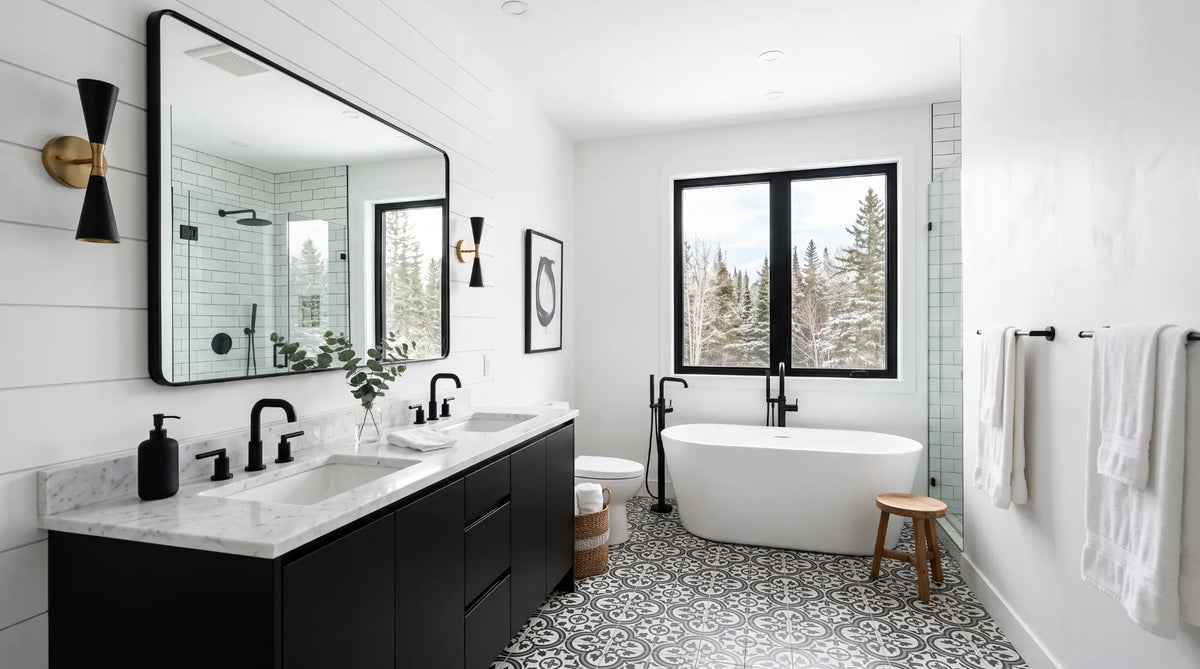
Black and white bathrooms have been in continuous rotation since the early 1900s, and they still top wish lists in 2026 - not because the look is trendy, but because it isn't. Here's how to build a black and white bathroom that reads as timeless contrast rather than a stark, dated checkerboard, with real Bathify products at every step.

Black and white checkerboard floors showed up in North American bathrooms in the early 1900s, went in and out of fashion magazines through the Art Deco era, the mid-century, and every decade since, and are still one of the most searched bathroom looks in Canada today. That's not a coincidence - it's the entire point of the style. Black and white is a neutral pairing rather than a colour trend, which is exactly why it never really leaves and never really dates, the way an avocado-green or millennial-pink bathroom eventually does.
But "black and white" is also one of the most loosely used labels in bathroom design, and a lot of what gets called black and white is actually something else. A charcoal vanity with grey-veined tile is dark and moody, not black and white - see our guide to dark & moody bathroom ideas if that's closer to what you're picturing. Two contrasting wood tones with a splash of black hardware is a two-tone scheme - our two-tone bathroom ideas guide covers that pairing on its own terms. A genuinely black and white bathroom uses true black, deliberately, as a minority contrast colour against a majority white or off-white field - no grey substitutes, no warm taupe standing in for white, no charcoal standing in for black.
This guide breaks the look down fixture by fixture - vanity, faucet, tub and shower, toilet, mirror and sink - with real Bathify products at each step, plus the ratio and finish rules that keep the result looking curated rather than like a checkerboard floor thrown into a plain box. If you're still comparing styles altogether, our pillar guide to bathroom design styles for Canadian homes puts black and white side by side with eight other looks.
Read the defining-elements table first for the fast overview, then jump to whichever fixture category you're actively shopping for. Every product section links to a real Bathify item so you can see the contrast translated into something you can actually buy, and the "by room" section shows how the ratio flexes for a powder room versus a full primary ensuite.
Before shopping fixture by fixture, here's the shorthand version - six elements that, taken together, are what separate a genuinely black and white bathroom from a bathroom that simply happens to have some black hardware in it.
White or off-white walls, tile, and typically the tub cover the large majority of the room, so the black elements read as deliberate contrast rather than clutter.
Matte or gloss black - never a dark grey or charcoal substitute - concentrated in one or two decisions: the vanity, the hardware, or a tile pattern.
Faucet, shower trim, mirror frame, and hardware all carry the same metal finish. Mixing two finishes is the fastest way to make this look accidental.
Clean rectilinear vanities, square-edged sinks, and angular faucet handles carry the contrast better than soft, organic silhouettes.
A patterned black-and-white floor or shower feature is the single most recognisable move in this style, and it's the one most worth planning around.
A matte black vanity next to a glossy black tile reads as mismatched. Pick one sheen level per material family and hold the line.
The vanity is the biggest single decision in a black and white bathroom, because it's the largest object in the room and the one that decides which direction the contrast runs. There are two valid routes, and both are correct - they just behave differently.
Black vanity, white room. A black vanity against white walls and white or light tile is the bolder, more furniture-like statement. It reads as the room's single largest black element, so everything else - hardware, mirror frame, accessories - should stay in that same finish rather than adding a second competing black surface. This is the version that photographs best and carries the most visual weight in a primary ensuite.
White vanity, black accents. A white or off-white vanity paired with black hardware, a black-framed mirror, and black fixtures is the lighter, more flexible route. It keeps more reflective surface in the room, which matters in a smaller or lower-light Canadian bathroom, and it's the easier version to build gradually if you're refreshing fixtures over time rather than replacing everything at once.
Whichever direction you choose, the 60/40 rule still applies: white should remain the dominant field. A black vanity in an otherwise black-tiled room isn't black and white anymore - it's dark and moody wearing a different name.

The clearest "black vanity, white room" pick in the Bathify catalogue - and it arrives as a complete set. The Paris pairs a black cabinet with an engineered marble top that keeps a soft white-and-grey vein running through the room's dominant white field, plus a matching wall mirror with a black frame, so the vanity and mirror finish arrive already coordinated. Soft-close dovetailed drawers and brushed nickel hardware round out the build; swap the included hardware for matte black pulls if you want a single unbroken black finish throughout.

The Bliss is the vanity to reach for if you want the floating, minimal-footprint look this style pairs so well with, and it works for either contrast direction: order it in Gloss White for the "white vanity, black accents" route, or in Black for a floating take on the statement-vanity approach. The reinforced acrylic sink and countertop form a seamless, non-porous surface, and the wall-mounted profile keeps a visible strip of floor showing beneath it - a genuinely useful trick for making a small bathroom's checkerboard floor read as a complete pattern rather than a partially hidden one.
Browse the wider range in Bathify's Bathroom Vanities collection, and if budget is the deciding factor between the two routes above, our guide on what a bathroom vanity actually costs in Canada breaks down real project totals including faucet, mirror, and installation.
Matte black is by far the most common way this style gets introduced, because it's the black element that's easiest to add without committing to a black vanity or a patterned floor. A single matte black faucet against a white vanity top and white walls is often enough to establish the whole scheme on its own. Chrome is the quieter, more period-correct alternative - it's what the original Art Deco and mid-century black-and-white bathrooms actually used, so it reads slightly more classic and slightly less contemporary than matte black.
Whichever finish you choose, it needs to run through every metal surface in the room without exception - faucet, shower trim, towel bar, robe hook, mirror frame if it has one. This is the single-finish rule that governs every style at Bathify, and it matters more here than almost anywhere else, because a black-and-white room with two competing metal finishes reads as unfinished rather than intentional.

Riobel's Riu collection pairs a sleek, rounded spout with a ceramic-cartridge internal, and it's designed and engineered in Montreal. In its black finish, it's one of the most reached-for faucets for exactly this look - clean enough to read as contemporary, dark enough to register as a real contrast statement against a white vanity top. The same family is also available in chrome if you're leaning toward the period-correct route instead.
Finish the look with hardware and a towel bar in the same finish from the Bathroom Accessories collection, and browse the wider range in Faucets & Shower Systems.
A freestanding tub is the largest single object most bathrooms will ever contain, which makes it either the strongest black statement in the room or a wasted opportunity if it's left white by default. If you've already put your black into the vanity, keep the tub white to protect the 60/40 ratio. If your vanity stayed white, a matte black freestanding tub is one of the most effective ways to introduce real drama without touching a single tile.
For showers, a checkerboard or contrast-grout tile floor inside the enclosure is the version of this style that shows up most often in current Canadian bathroom photography - it concentrates the pattern in a contained area rather than committing the whole room to it, which keeps the option open even in a smaller footprint.

Contemporary, ergonomic lines in a genuine matte black finish - not a dark grey approximation - make the Bradley the tub to reach for if you want the black-and-white contrast to peak at the tub rather than the vanity. Built from acrylic reinforced with fibreglass, it ships with an included pop-up drain system, so a faucet from the same finish family is the only other decision left to make. Its footprint and drain location are rough-in-defining, so it belongs on the order list before demolition day if this is a full renovation rather than a refresh.

The same Riu family used in the faucet above, scaled up to a full shower system - a thermostatic/pressure-balance (Type T/P) coaxial 2-way valve with an 8" head and hand-shower rail, available in the matching black finish. Carrying the identical faucet family from sink to shower is what makes a black-and-white bathroom's hardware read as specified rather than assembled piece by piece.
Browse the wider range in the Bath collection - tubs, showers, and everything in between.
The toilet is the one fixture in this guide that should almost never be the black element. A black toilet is a genuinely difficult piece to source, to keep looking clean day to day, and to pair convincingly with the rest of a contrast scheme - it tends to read as an odd, heavy note rather than a deliberate one. The far more reliable move is a clean, rimless white toilet that stays out of the way, with the black-and-white statement carried entirely by the vanity, hardware, and tile around it.

A one-piece, rimless, dual-flush toilet that's WaterSense certified and rated as a High-Efficiency Toilet (HET) - a low-water fixture that also happens to qualify for many municipal and utility rebates in Canada. The skirted trapway wipes clean in one pass and the soft-close seat is included, and the standard 12" rough-in fits most existing Canadian bathrooms without moving the flange - exactly the low-fuss white anchor a black-and-white scheme needs.
Browse the wider range in Bathify's Bath collection.
A black-framed mirror is one of the highest-impact, lowest-risk moves in this entire style. It sits at eye level, it's the object a person looks at every single day, and a defined black frame against a white wall does more to read as "black and white bathroom" than almost any other single decision short of the floor tile. If the vanity itself stayed white, this is very often where the room's black statement should live.
A vessel sink in matte black is the other concentrated-contrast option worth considering, particularly on a white or marble-look countertop where the round black bowl becomes a genuine focal point rather than a background fixture.

A framed mirror with a bottom shelf, sized to sit above most single-sink vanities and finished-coordinated as a later-stage item - it can arrive after the crew is on site without holding up a rough-in. In its black finish, it's the single most reliable way to add black-and-white contrast at eye level, and the bottom shelf keeps one or two everyday items within reach without cluttering the counter beneath it.

Made of porcelain with a central drain hole for maximum drainage, the Frido is a compact, genuinely striking way to introduce black at counter height. Set on a white or marble-look vanity top, the round black bowl becomes a real focal point rather than a background fixture - pair it with a matching matte black vessel faucet from the Faucets collection to keep the finish continuous.
If you're deciding between a vessel sink and a standard integrated or drop-in basin for this look, our guide on vessel sink vs. drop-in sink covers the real trade-offs in height, cost, and daily maintenance. For sizing the mirror correctly against your vanity width, see our bathroom mirror sizing guide.
The palette here is narrower and more binary than most styles, which is what makes the ratio rule so important. Get the proportion wrong and the same two colours that read as timeless at 60/40 start to read as either washed-out (too little black) or heavy and clinical (too much). Materials follow the same discipline as the colour itself - consistency of sheen and finish matters as much as the colours chosen.
| Role | Typical choice | Why it works |
|---|---|---|
| Dominant tone | White or off-white walls, tile, and tub - 60-80% of visible surface | Keeps the black elements reading as deliberate contrast, not clutter |
| Contrast anchor | True black - vanity, hardware, or a tile pattern, not all three at once | One or two black decisions carry the statement; more than that competes |
| Metal finish | One choice only - matte black or chrome, never mixed | The single-finish rule that ties every Bathify style together |
| Tile pattern | Checkerboard, herringbone, or penny tile in black and white | The style's most recognisable signature move, best contained to floor or a feature wall |
| Sheen level | All matte or all gloss per material family - don't mix within the same surface type | Mismatched sheen reads as unfinished even when the colours are correct |
On materials: a marble or marble-look quartz countertop is the most common way to soften pure black-and-white into something that still feels warm underfoot and at the counter, since its natural veining carries both colours without adding a third. Large-format white tile with minimal grout lines keeps the dominant field feeling calm, while the black-and-white pattern stays contained to a floor, a shower, or a single feature wall rather than covering every surface in the room.
The same contrast principles flex differently depending on which bathroom you're working on. Here's how to apply them by room type.
Keep white dominant and use black as a concentrated accent rather than reversing the ratio - a white vanity with black hardware, a black-framed mirror, and a checkerboard floor (rather than black walls) keeps a tight footprint feeling open. Checkerboard flooring is genuinely small-space friendly, since the pattern itself adds visual interest without adding heavy colour. For more layout tricks that pair naturally with this palette, see our guide on 10 small bathroom ideas that make a big impact.
A powder room is the lowest-risk place to commit to the bolder black-vanity route, since it's occasional-use rather than a daily workhorse. A black vanity, a large black-framed mirror, and white walls will read as fully realised black and white at a glance, without needing every element the full guide covers.
With more square footage available, a primary ensuite can carry a black freestanding tub as a genuine focal point, a wider double-sink white or black vanity, and a full checkerboard or contrast-grout shower floor without losing the style's essential balance - the discipline that matters most here is still resisting the temptation to make everything black just because there's more room to fill.
Black and white is forgiving on budget - it doesn't require expensive statement pieces - but it's unforgiving on ratio and consistency. These are the mistakes that most often push an otherwise well-chosen set of fixtures toward looking stark or accidentally dated instead of timeless.
| Mistake | Why it hurts the look | Fix |
|---|---|---|
| 50/50 or black-dominant ratio by default | Reads as heavy or clinical rather than balanced contrast | Keep white at 60-80% of visible surface; treat a black-majority room as a deliberate, separate choice |
| Substituting grey or charcoal for black | Loses the crisp contrast that defines the style and drifts into dark & moody instead | Use true black - if you want a softer look, that's a different style with its own guide, not a compromise on this one |
| Mixed metal finishes | Breaks the single-finish rule and makes hardware look assembled piece by piece | Choose one finish (matte black or chrome) before shopping and check it against every fixture |
| Black tile floor-to-ceiling in a small bathroom | Absorbs light in exactly the rooms that need it most | Contain black tile to a floor, a niche, or one feature wall in tight or low-light spaces |
| Black toilet as the contrast element | Hard to source, hard to keep looking clean, reads as an odd note rather than intentional | Keep the toilet white and carry the black statement through the vanity, hardware, or tile instead |
| Mixed sheen levels (matte cabinet, gloss tile) | Reads as mismatched even when the colours themselves are correct | Pick one sheen per material family and hold it across the whole surface type |
Bathify carries the coordinated range needed to build a black and white Canadian bathroom - black and white vanities, matte black and chrome faucets and shower systems, freestanding tubs in both finishes, rimless white toilets, and black-framed mirrors. Ordering across categories from one supplier keeps finishes matched and simplifies delivery timing if you're renovating rather than refreshing.
If you'd rather start from proven products than a blank collection page, this is the coordinated set covered in this guide - a statement vanity, a matte black faucet and shower system, a water-efficient white toilet, a black freestanding tub, and a black-framed mirror. All prices are in CAD and all ship across Canada.
Prefer the lighter "white vanity, black accents" route instead? Swap the Paris for the Kube Bath Bliss 48" in Gloss White and keep every other item on this list unchanged - the black hardware, faucet, and mirror carry the contrast on their own. For more ways to build the look gradually rather than all at once, see our companion guide on luxury bathroom ideas on a budget.
Not sure which contrast direction fits your layout? The Bathify support team can help match products to your space, and every order ships across Canada with free ground shipping on orders over $50 and a straightforward 30-day return policy - so trying the look is low-risk.
Black & white works because it's a ratio, not a colour
Keep white dominant. A 60-80% white field with black concentrated in one or two decisions is what separates timeless contrast from a stark or heavy room.
Use true black, not a substitute. Grey and charcoal are different styles with their own guides - swapping them in trades this look for dark and moody without meaning to.
One metal finish, no exceptions. Matte black or chrome, carried through every fixture, is what makes the room read as specified rather than assembled.
Let the toilet stay quiet. Keep the black statement in the vanity, hardware, or tile - not the one fixture that's hardest to keep looking clean in black.
Then build it in either order. Start with the vanity if you want the bold version, or with the mirror and hardware if you want the lighter one - both routes are genuinely timeless when the ratio holds.
Ready to Build the Look? Shop Bathify Canada
Black and white vanities, matte black and chrome faucets, freestanding tubs in both finishes, and black-framed mirrors - from Vanity Art, Riobel, Kube Bath, Agua Canada, and more. Free ground shipping on orders over $50. Delivered across Canada.


