






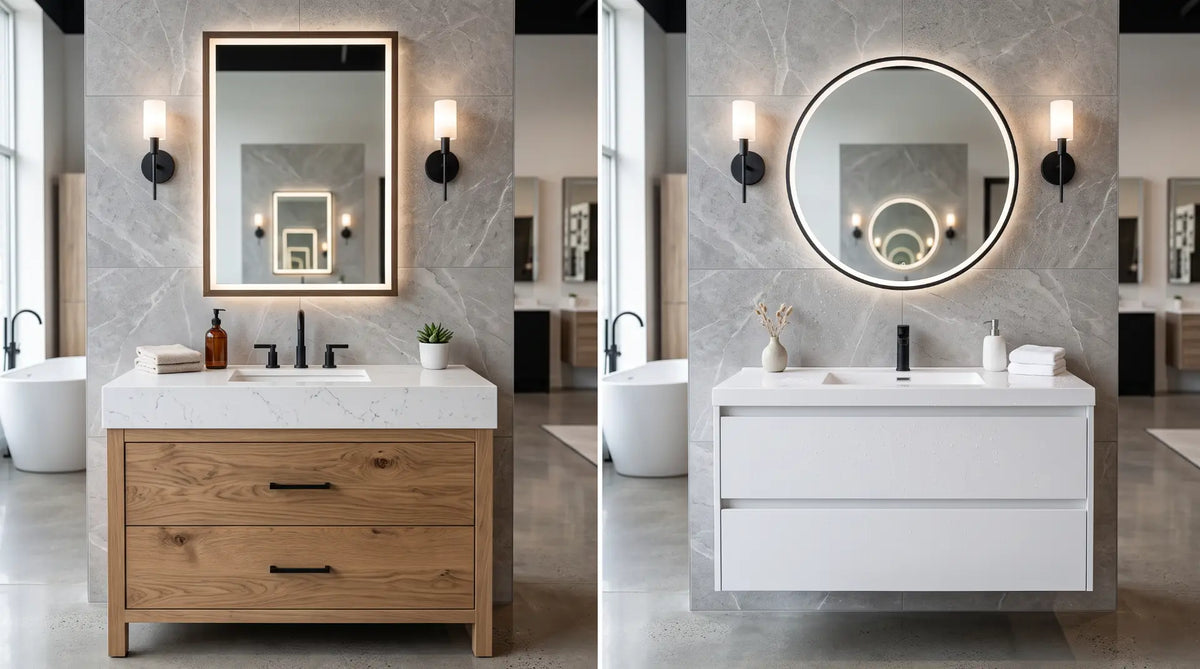
"Waterproof PVC" sounds like the obvious answer to a humid bathroom - until you look at what actually causes a vanity to fail. Here's an honest, material-level comparison of wood and PVC cabinets for Canadian bathrooms, and why the real question usually isn't the material at all.
For most Canadian bathrooms with reasonable exhaust ventilation, a properly engineered wood vanity - solid wood or plywood box construction, sealed or marine-grade veneer finish, and a non-porous countertop - performs excellently under daily humidity, and offers meaningfully better structural longevity, style range, and refinishability than PVC. A genuine PVC-cabinet vanity has a real edge in one specific scenario: a bathroom with poor or no ventilation on a tight budget, where the material's baseline moisture tolerance matters more than usual and buys some margin for error.
The honest twist most comparisons skip: the material is rarely the deciding factor. Humidity damage to a vanity is overwhelmingly local - shower steam and standing water in a room without adequate airflow - not a function of Canada's climate or region. A cheap, unsealed wood vanity will fail faster than a well-built PVC one; a well-built wood vanity will generally outlast a PVC one in the same room. This guide covers both materials honestly so you can match the choice to your actual bathroom, not a marketing claim.
Most "wood vs PVC vanity" content online is written for a generic climate, which misses two things that are specifically true of Canadian homes. First, the humidity that actually threatens a vanity is almost always local and behavioural - shower steam, splashed water, and a poorly ventilated room - rather than driven by whether you're in humid coastal British Columbia or the drier interior. A vanity in Winnipeg and a vanity in Vancouver face the same daily stress if the bathroom lacks a properly sized exhaust fan run during and after every shower.
Second, and less discussed: most of Canada runs forced-air heating through a long, dry winter, which pulls indoor relative humidity down sharply compared to summer. That seasonal swing - humid bathroom air in summer, dry heated air in winter - puts wood joints and finishes through more expansion-and-contraction cycling over a year than a consistently humid climate would. It's a genuine reason finish quality and construction method matter more here than in a milder, more stable climate, and it applies regardless of which material you choose.

A "PVC vanity" typically means the cabinet box and doors are built from rigid PVC board - sometimes marketed as waterproof board or a similar trade name - rather than any wood-based material. It's a fully synthetic, non-porous product: unlike wood, plywood, or MDF, it has no wood fibre to absorb water, swell, or delaminate. That's the entire basis of the "waterproof" marketing claim, and on that one specific point, it's accurate.
The trade-offs show up elsewhere. PVC board generally has lower structural rigidity than solid wood or good-quality plywood, and it doesn't hold a screw as securely - hinges and drawer slides can work loose over years of daily use unless the cabinet is reinforced with metal inserts at the mounting points. PVC is also heat-sensitive in a way wood isn't, and can soften or warp near an unvented hair dryer or space heater. Style range is narrower too: PVC cabinets are almost always flat, modern slab-front doors, since the material doesn't lend itself to traditional profiles, raised panels, or the kind of detailing seen on furniture-style vanities. And unlike wood, PVC can't be sanded and refinished - surface damage or a dated colour generally means living with it or replacing the piece.

This is where most comparisons oversimplify. "Wood vanity" covers an enormous range, from a raw, unsealed particleboard box that genuinely will swell in a humid bathroom, to a solid hardwood cabinet with a sealed, marine-grade finish that's engineered specifically to resist moisture. Treating those as the same category is how "wood vanities swell in humidity" complaints get generalized into avoiding wood entirely - when the actual cause is almost always a construction or finish shortfall, not the base material.
Unfinished particleboard or thin veneer without sealed edges. Exposed cut edges - around a sink cutout or the back panel - absorb water first, causing swelling and delamination. This is the case most humidity complaints describe.
Solid hardwood with a proper sealed finish resists moisture penetration on all surfaces, including cut edges. Refinishable over decades. Bathify's Mylo Chester collection uses this construction with solid Canadian maple.
A plywood or engineered core with a moisture-resistant veneer face, explicitly engineered for bathroom humidity. Lighter and often more affordable than solid wood while retaining strong moisture performance.
Engineered wood board fully sealed with a multi-coat waterproof lacquer. A common, cost-effective construction on modern-style vanities, provided the finish is genuinely complete and unbroken at every edge.
This compares a genuine PVC-cabinet vanity against a properly engineered wood vanity (sealed solid wood, marine-grade veneer, or fully sealed moisture-resistant MDF) - not against raw, unsealed wood, which loses on moisture resistance to almost anything.
| Factor | PVC Cabinet | Properly Engineered Wood |
|---|---|---|
| Base material moisture tolerance | Non-porous; won't swell or absorb water | Strong when fully sealed, including cut edges |
| Structural rigidity | Lower; can flex on wide spans | High, especially solid wood and dense plywood |
| Hardware / screw-holding | Weaker; needs reinforced mounting inserts | Strong; holds screws and hinge mounts securely |
| Heat sensitivity | Can soften or warp near unvented heat sources | Not heat-sensitive in normal bathroom use |
| Style range | Narrow - mostly flat modern slab fronts | Wide - traditional through contemporary |
| Repairability | Not refinishable; damage often means replacement | Can typically be sanded, resealed, or refinished |
| Weight | Generally lighter | Heavier, especially solid wood |
| Typical price tier | Budget-focused | Budget through premium, depending on construction |
| Available at Bathify | No | Yes - Mylo, Cutler, Kube Bath, Vanity Art, OVE Decors |
Understanding the failure mechanism is more useful than picking a material in the abstract, because it explains why some wood vanities last decades and others fail in a couple of years - and why PVC isn't automatically immune either.
Water rarely damages a flat, finished wood surface. It gets in through unsealed or exposed edges - most commonly around a sink cutout, a back panel opening for plumbing access, or a seam where two pieces meet. Once moisture reaches raw substrate at an edge, the wood fibres swell, and repeated wet-dry cycling can eventually delaminate a veneer or laminate layer from its core. This is the single most common failure mode for lower-quality wood vanities, and it's entirely preventable with a fully sealed edge.
Mould needs moisture and organic material to feed on, which is why unsealed wood or MDF binder is a genuine risk in a consistently damp room. But PVC isn't immune to the broader problem - mould can still develop on grime, silicone seams, or nearby surfaces in a bathroom with poor airflow, regardless of what the vanity cabinet is made from. A non-porous cabinet doesn't fix a room that never dries out.
Humidity affects metal hardware - hinges, drawer slides, screws - in both materials, but the failure mode differs. In wood, repeated screw insertion into a substrate that's been softened by moisture can strip the mounting hole over time. In PVC, the material's lower baseline screw-holding strength means the same wear happens faster unless the manufacturer has reinforced the mounting points with metal inserts, which not every budget PVC cabinet includes.
If you're choosing wood, these are the specs that separate a vanity built for bathroom humidity from one that merely happens to be in a bathroom.
| Check | Why it matters |
|---|---|
| Plywood box construction (not raw particleboard) | Plywood swells more slowly and holds screws far better than particleboard |
| Sealed finish on every surface, including cut edges | Exposed edges around the sink cutout or back panel are where damage almost always starts |
| Marine-grade or explicitly moisture-resistant veneer | Confirms the finish was engineered for wet-room use, not just decorative |
| Non-porous countertop (quartz, cultured marble, acrylic composite) | Prevents water pooling at the cabinet-countertop seam, a common weak point |
| Soft-close, corrosion-resistant hinges and slides | Humidity affects metal hardware too - coated or stainless hardware lasts longer |
| A warranty that names the cabinet material | Some warranties cover the countertop only - confirm the cabinet itself is included |
One more general note: composite wood products (plywood, MDF, particleboard) sold in Canada increasingly carry low- or no-added-formaldehyde labelling. If indoor air quality matters to your household, it's worth checking that language on the spec sheet alongside the moisture-resistance claims.
No, and it's worth saying plainly. Bathify's vanity catalogue - Mylo, Cutler Kitchen & Bath, Kube Bath, Vanity Art, and OVE Decors - is built entirely around solid wood, engineered wood, and marine-grade veneer construction with sealed finishes and non-porous countertops, not PVC cabinet boards. That's a deliberate positioning, not an oversight: PVC vanities are more common in ultra-budget and import channels, and they trade structural longevity, hardware durability, and style range for a lower price point and a marginal moisture-tolerance edge on the raw material alone.
Every vanity brand Bathify carries documents moisture-resistant or fully waterproof construction language on its own product specifications - not as a generic claim, but tied to specific construction details like sealed maple, marine veneer, or moisture-resistant MDF paired with a non-porous top. If a genuine PVC-cabinet vanity is specifically what you're after, this guide has laid out the honest trade-offs above. If you want the humidity protection without giving up structural longevity, style range, or the option to refinish it in fifteen years, the Verified Picks below are the strongest matches in Bathify's own catalogue.
Three constructions across the price range, each explicitly engineered for bathroom moisture rather than just decorated for one. All prices are in CAD and ship across Canada.

The cabinet is built from solid Canadian maple with a plywood box and maple veneer for structural stability - and, critically, it's explicitly sealed to help resist moisture, with dovetail drawer construction and full-extension slides that hold up under daily use. The 3 cm quartz countertop and undermount ceramic sink form a non-porous top, and a matching quartz backsplash closes off the seam where water would otherwise collect. Made and assembled in Ontario.

A solid wood cabinet frame with a warm walnut finish, explicitly described by the manufacturer as a "high-quality moisture-resistant finish for long-lasting use in bathrooms" - not a generic decorative coat. Fluted accents and slim shaker detailing give it a furniture-style look PVC can't replicate, while the scratch- and stain-resistant quartz top keeps the working surface non-porous and easy to clean.

A moisture-resistant wood veneer cabinet designed specifically to handle daily bathroom humidity, paired with a reinforced acrylic composite countertop and integrated sink - a seamless, non-porous top that eliminates the cabinet-to-counter seam entirely. European push-open drawer hardware keeps daily operation smooth without exposed handles to catch moisture or grime.
Ready to Shop Humidity-Ready Vanities?
Sealed solid wood, marine-grade veneer, and moisture-resistant construction across every vanity Bathify carries - built for Canadian bathrooms, not just decorated for them. Free ground shipping on orders over $50. Delivered across Canada.


