






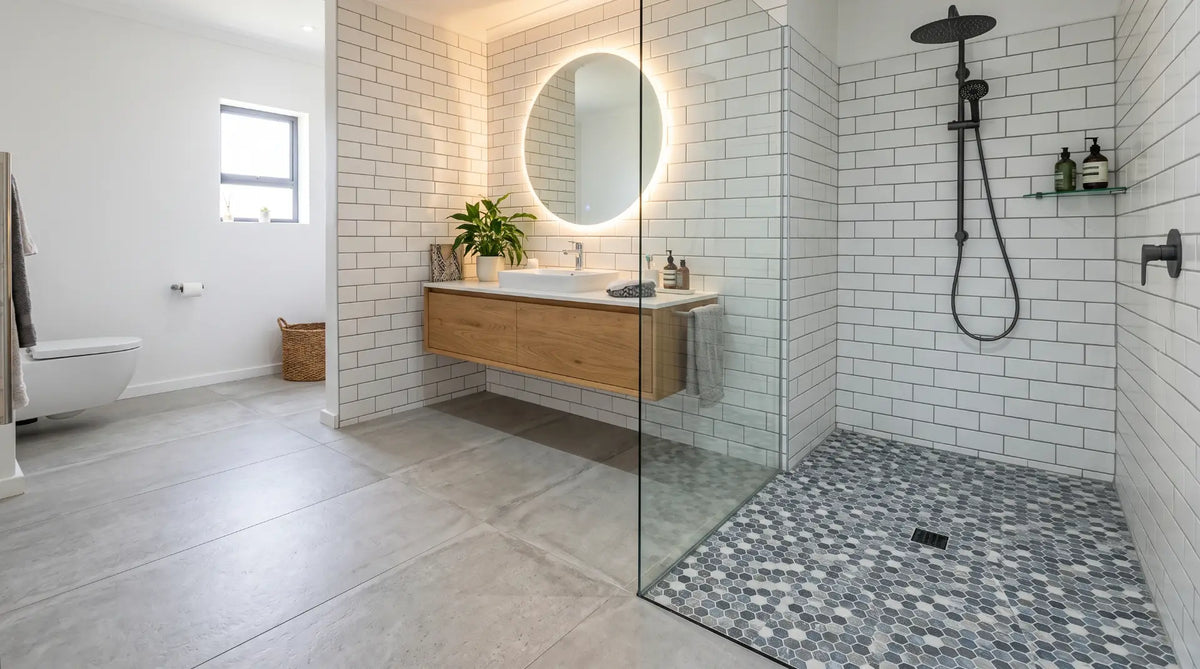
Tile is the most permanent decision in a bathroom renovation - it outlasts fixtures, finishes, and paint by decades. This guide covers every major tile type across floors, walls, and shower surrounds: format, finish, pattern, grout strategy, and the Canadian-market considerations that most tile guides overlook.
The bathroom tile market in Canada has expanded significantly in the past five years - formats, finishes, and materials that were previously available only through specialty tile studios are now broadly stocked at Canadian retailers. That's good for options. It's less good for decision-making, because more choices with more variables make a tile selection that feels right at the outset and still feels right in ten years considerably harder to arrive at.
This guide organises the decision by application zone - floors, walls, and shower surrounds - because the requirements for each are distinct enough that a tile that performs well in one zone may be inappropriate in another. Within each zone, we cover the top tile types available in Canada in 2026, with format recommendations, finish guidance, pattern options, and grout strategy for each one.
Before choosing a specific tile, settle three upstream decisions first: the format (how large the tile is), the finish (matte, satin, or polished), and the grout colour (how much contrast between tile and joint). These three choices determine spatial perception, maintenance requirements, and visual style more than the tile material itself. A 12×24-inch matte porcelain with charcoal grout reads as a completely different space than the same tile in polished finish with white grout - same material, same format, fundamentally different room. Make these three decisions in sequence before browsing specific tiles.
Bathroom floor tile must meet a more demanding set of requirements than wall tile: it bears foot traffic, must be slip-resistant when wet, and needs to tolerate cleaning products without surface degradation. The PEI hardness rating and coefficient of friction (COF) are the two specifications that determine whether a tile is safe and durable on a bathroom floor - and both should be confirmed before purchase.

Large-format porcelain (12×24 inches or 24×24 inches) is the dominant bathroom floor tile choice in Canadian renovations in 2026. The appeal is spatial: fewer tiles covering the same area means fewer grout lines, and fewer grout lines means the floor reads as a more continuous, larger surface. In a 5×8 bathroom, the difference between a 4-inch hexagon tile floor and a 12×24-inch porcelain floor is substantial - the large-format floor reads as measurably more spacious even though the square footage is identical.
Porcelain is the preferred material for Canadian bathroom floors for a practical reason beyond aesthetics: it is virtually non-porous, freeze-thaw stable, and resistant to the thermal cycling that Canadian homes experience with forced-air heating systems creating dry conditions in winter and high humidity in summer. Ceramic tile (the lower-cost alternative) is more porous and less resistant to both the thermal cycling and the cleaning products used in Canadian bathrooms. For a renovation that's expected to last 15-20 years, porcelain is the correct specification.
- PEI rating confirmed at 3 or higher for residential floor use
- COF (wet) confirmed at 0.42 or higher - check product specification sheet, not just the tile label
- Finish confirmed as matte or satin - polished surface excluded from floor application
- Subfloor flatness assessed by tile setter - self-levelling compound in scope if deviation exceeds 3mm over 3m
- Tile direction confirmed: long dimension running down the room's longest wall
- Layout planned from centre of room - avoid thin slivers at walls by adjusting starting point

Honed (matte-finished) natural stone - Carrara marble, limestone, and travertine being the three most common in Canadian bathroom floors - produces a quality of warmth and organic character that no porcelain can fully replicate. The variation in stone grain, the subtle texture of a honed surface, and the way stone responds to light differently at different times of day give premium bathrooms a living quality that manufactured tile cannot match. For homeowners investing at the $50,000+ renovation level, natural stone floor tile is a specification that holds its appeal and perceived quality over decades.
The maintenance requirements are real and should be understood before specifying. Natural stone is porous and must be sealed before use and re-sealed annually or biannually depending on use frequency. Acidic cleaners (including many standard bathroom cleaning products) etch and dull the surface - only pH-neutral cleaners should be used on natural stone. In Canadian homes where the primary bathroom is used daily by multiple people, the cleaning discipline required for natural stone is achievable but should be confirmed as something the household will actually maintain before committing to the material.
- Stone type and finish confirmed: honed surface - polished excluded for floor safety
- If travertine: confirmed as factory-filled - no unfilled voids
- Penetrating sealer purchased and applied before grouting and before first use
- pH-neutral cleaning products purchased and household briefed on cleaning restrictions
- Re-sealing schedule noted: annually for high-use bathrooms, biannually for lower-use

Encaustic cement tiles - handmade tiles with colour patterns pressed into the surface rather than glazed on top - produce some of the most visually compelling bathroom floors available. In a powder room or a dedicated feature zone (a bath mat area in front of a freestanding tub, for example), an encaustic pattern floor creates genuine personality and visual depth that standard field tile cannot match. The pattern is inherent to the tile rather than printed or glazed, so it holds its character as the tile wears.
The limitations are practical. Cement tiles are highly porous - more so than natural stone - and require meticulous sealing before grouting, after grouting, and at regular intervals thereafter. They are also softer than porcelain and more susceptible to scratching from abrasive cleaning and chipping from dropped objects. In a primary family bathroom with daily high-traffic use, cement tile floors become a maintenance burden. Their ideal application in a Canadian bathroom is the powder room - a space with lower daily traffic that nonetheless receives significant visual attention from guests, where the design impact is highest relative to the maintenance cost.
- Application zone confirmed as powder room or low-traffic accent area - not primary bathroom floor
- Sealing protocol confirmed with tile supplier: pre-installation seal, post-grout seal, annual maintenance seal
- Grout colour selected to complement pattern - swatch tested against tile before committing
- Household maintenance requirements communicated - pH-neutral cleaners only, no abrasives
Wall tile requirements differ significantly from floor tile - slip resistance and PEI hardness rating are not relevant, because wall tile bears no foot traffic. What matters for wall tile is the visual effect it creates, its moisture resistance, and how it performs over time with the cleaning and humidity conditions typical of a Canadian bathroom. This freedom opens the wall tile selection to formats and materials that would be impractical or unsafe on a floor.

Subway tile is the most enduring bathroom wall tile in North America for a reason: its rectangular format creates a natural visual rhythm that reads as ordered and clean without requiring pattern complexity, and it pairs with virtually every vanity style, hardware finish, and floor tile choice. The classic 3×6-inch format has been in continuous production since the early 1900s - its longevity is itself a resale argument, because buyers do not associate it with a particular decade or trend the way they do with more era-specific tile choices.
The most significant development in subway tile in the past five years is the proliferation of elongated formats - 3×12, 4×16, and 4×24 inches - that provide the same visual rhythm as classic subway tile but read as more contemporary and vertically dynamic. Installed vertically (the long dimension running floor to ceiling), elongated subway tile is one of the most effective tools for raising perceived ceiling height in a bathroom without structural work. The format choice within the subway tile family is the primary style differentiator - classic 3×6 reads as transitional to traditional; elongated formats read as modern to contemporary.
- Format confirmed: classic 3×6" (traditional lean) or elongated 3×12"+ (modern lean)
- Installation direction confirmed: horizontal brick offset (classic) or vertical stack (contemporary)
- Grout colour confirmed with style direction: white (traditional), charcoal (modern farmhouse), tone-matched grey (contemporary)
- Tile quantity ordered with 10-15% overage for cuts, waste, and future repairs
- If white tile: confirm warm white vs. cool white undertone matches wall paint and floor tile

Large-format wall panels - porcelain slabs at 24×48 inches or larger, including the now widely available 48×96-inch and 60×120-inch formats - represent the closest thing to a grout-free wall finish in tile. With fewer, thinner joints (often 1.5mm or smaller with rectified tiles), large-format walls read as an almost continuous surface and remove the visual busyness of a grid entirely. In a premium ensuite or a shower enclosure where the goal is a hotel-level finish, large-format panels in a marble-look or concrete-look porcelain produce a result that reads as significantly more expensive than the actual material cost.
The installation challenge is real. Large-format panels require a perfectly plumb and flat wall substrate - any deviation creates visible lippage or joint gaps that are impossible to correct without re-tiling. The panels are also significantly heavier than standard tile and require large-format tile adhesive (with greater coverage and bond strength than standard thinset) and back-buttering on both tile and wall for full coverage. In Canada, not all tile setters are experienced with very large format tile - confirm your installer has completed similar projects before signing the contract.
- Wall substrate confirmed as perfectly plumb and flat - tile setter has assessed and confirmed before tile order
- Large-format tile adhesive specified - not standard thinset
- Back-buttering confirmed in tile setter's scope - both tile and wall adhesive coverage required
- Installer experience with large-format panels confirmed - ask for reference projects before signing contract
- Grout joint size confirmed: 1.5mm minimum with rectified tile for near-invisible joint

Zellige tile - a Moroccan handmade glazed tile with irregular surface variation, subtle colour shifts, and a depth of glaze that machine-made tile cannot replicate - has become one of the most sought-after wall tile choices in Canadian bathroom design over the past three years. Its appeal is the quality of light it creates: the slight surface variation causes each tile to catch and reflect light differently, giving a tiled wall an animated, living quality that flat machine-made tile does not have. On a bathroom vanity wall or a shower feature wall, well-installed zellige creates a room that looks better in person than in photographs - which is the opposite of most contemporary tile choices.
The installation requirements are specialised. Zellige tiles are not rectified (cut to precise uniform dimensions) - each tile varies slightly in size and thickness, which means the tile setter must work with wider, variable grout joints and cannot use tile spacers in the standard way. Not all tile setters in Canada are experienced with zellige installation, and a poorly installed zellige wall - with inconsistent joint widths, insufficient adhesive coverage, or incorrect setting material - will not reflect the quality of the tile. Confirm installer experience specifically with zellige or handmade tile before proceeding.
- Installer experience with zellige or handmade (non-rectified) tile confirmed before signing contract
- Box-mixing confirmed in tile setter's scope - tiles mixed from multiple boxes during installation
- Grout colour confirmed as tone-matched - not contrasting
- Grout joint width confirmed as 3-5mm variable - tile spacers not used in standard configuration
- 10-15% overage ordered - handmade tiles have higher cut waste than rectified machine-made tile
Shower tile operates in the most demanding zone in the bathroom - constant water exposure, temperature cycling, and cleaning frequency. The shower floor has the most stringent requirements (slip resistance is critical), while shower walls have more flexibility but must be fully waterproofed behind the tile and grouted with a product rated for wet-area application. Every tile choice in this section is evaluated against those baseline requirements first.

Mosaic tile - tiles 2 inches square or smaller, typically installed on mesh sheets for alignment - is the standard shower floor specification for a practical reason: the higher number of grout lines per square foot creates more surface texture and grout-to-tile edges, which produces a higher effective coefficient of friction than large-format tile of the same material. A 1×1-inch mosaic floor has significantly more grip when wet than a 12×12-inch tile of identical material and finish, because the grout lines themselves function as traction elements.
The design range within mosaic tile is substantial. Classic white square mosaic (1×1 or 2×2-inch) on a shower floor reads as clean and spa-like. Grey or charcoal mosaic reads as contemporary. Penny tile (small circular tiles on mesh) reads as vintage or boutique-hotel. Patterned mosaic (black-and-white hex, geometric arrangements) creates a feature floor that draws the eye down into the shower. The unifying requirement across all formats is the R10 slip resistance rating - confirm this on the product specification before purchase.
In Canadian building practice, the shower floor waterproofing membrane (Schluter Kerdi, Laticrete Hydro Ban, or similar) must be installed under the tile and confirmed by the tile setter before tile installation begins. A shower floor tiled without a proper waterproofing membrane will leak into the subfloor and floor joist cavity over time - this is the most common cause of catastrophic subfloor damage in Canadian bathroom renovations. If a tile setter quotes only for tile installation without including waterproofing membrane supply and installation, that scope is incomplete - request an itemised quote that includes waterproofing.
- R10 slip resistance confirmed on product specification sheet - not assumed from tile appearance
- Waterproofing membrane confirmed as in scope - Schluter Kerdi, Laticrete Hydro Ban, or equivalent
- Slope to drain confirmed: minimum 1/4" per foot in all directions toward drain
- Epoxy grout specified - cement grout in a shower floor is acceptable but requires sealing and more frequent maintenance
- Grout colour confirmed as tone-matched - white grout on light mosaic is a maintenance burden in high-use showers

Porcelain tile on shower walls is the most reliable, low-maintenance, and versatile choice for Canadian bathroom renovations across all budget levels. Its near-zero porosity makes it genuinely waterproof at the tile surface level (the waterproofing system behind the tile remains the critical waterproofing layer - the tile is the aesthetic surface, not the water barrier), it doesn't require sealing, it tolerates all standard cleaning products, and it's available in a range of formats and finishes that cover every design direction from basic white subway to premium marble-look large-format slabs.
The most significant trend in Canadian shower wall tile in 2025-2026 is the continued growth of large-format stone-look porcelain - 24×48-inch and larger panels in marble-look, limestone-look, and concrete-look finishes that produce the visual quality of natural stone without the maintenance requirements. For homeowners who want the aesthetic of honed marble in a shower without the sealing, etching risk, and cleaning restrictions that come with real marble, large-format marble-look porcelain is the correct specification. The digital print technology in premium large-format porcelain has improved to the point where the tile requires very close inspection to distinguish from genuine stone.
- Waterproofing membrane confirmed as in scope and installed before tile
- Epoxy grout specified for shower interior - standard cement grout is a maintenance downgrade
- If large-format (24×48"+ ): wall flatness and plumb confirmed by tile setter before tile order
- Niche waterproofing confirmed - niches are the most common shower leak point when membrane is not applied inside
- Tile selection for niche interior confirmed - accent tile inside niche adds a design detail that reads as intentional

Natural stone on shower walls - Carrara marble, Calacatta marble, limestone, or slate - produces a quality of enclosure that sits in a different category from manufactured tile. The organic variation in stone veining and colour creates a shower that is genuinely one-of-a-kind, and honed or leathered stone surfaces have a tactile quality that manufactured tile cannot replicate. In a primary ensuite shower where design quality is a priority and the homeowner is committed to the maintenance requirements, natural stone walls are a specification that continues to improve in perceived quality over time as the stone develops a gentle patina.
The commitment required is significant. Natural stone in a shower must be sealed before grouting and re-sealed every 6-12 months depending on use frequency. Soap, shampoo, and hard water leave deposits on stone that require specialised stone cleaners to remove - standard bathroom cleaners etch and dull the surface. In a shower used daily by multiple people, the sealing and cleaning discipline is not trivial. The worst outcome is a beautifully specified stone shower that develops etch marks, soap scum staining, and grout discolouration within two years because the maintenance protocol was not followed.
- Stone type and finish confirmed: honed - polished finish excluded from shower application
- Sealing protocol established: before grouting, after grouting, and on an ongoing schedule
- pH-neutral stone cleaner purchased and household briefed on cleaning restrictions
- Epoxy grout specified - cement grout is a significant maintenance downgrade in a natural stone shower
- Water hardness in local Canadian municipality assessed - if hard water, stone shower maintenance commitment is substantially higher
Grout is treated as an afterthought in most bathroom renovations and makes up a disproportionate share of the visual quality and maintenance burden of the finished tile installation. The three decisions - grout type, grout colour, and joint width - each carry more weight than most homeowners anticipate.
| Tile type | Floor | Wall | Shower floor | Shower wall | Maintenance |
|---|---|---|---|---|---|
| Large-format porcelain (12×24"+) | Yes | Yes | Matte only | Yes | Very low - no sealing required |
| Classic subway tile (3×6" porcelain) | With slip rating | Yes | Not recommended | Yes | Low - grout sealing only |
| Mosaic tile (1×1" to 2×2") | Yes | Yes | Best choice | Yes | Low-medium -0 more grout lines to clean |
| Honed natural stone (marble, limestone) | Yes | Yes | With seal + R10 rating | Yes - with sealing protocol | High - annual sealing, pH-neutral cleaners only |
| Encaustic / cement tile | Powder room only | Yes - feature zones | Not recommended | Not recommended | High - frequent sealing required |
| Zellige / handmade glazed tile | Not recommended | Yes - feature walls | Not recommended | Yes - with experienced installer | Low - glazed surface, pH-neutral cleaners |
| Large-format wall slab (24×48"+) | Not typical | Yes - premium walls | Not recommended | Yes - with experienced installer | Very low - near-grout-free surface |
- PEI hardness rating confirmed at 3 or higher for any tile used on the floor
- COF (wet) confirmed at 0.42 or higher - checked on product specification sheet
- Finish confirmed as matte or satin - polished tile excluded from floor application
- Subfloor flatness assessed - self-levelling compound in scope if required
- If natural stone: penetrating sealer purchased and sealing protocol established
- If encaustic/cement tile: application limited to powder room or low-traffic feature zone
- Format confirmed with style direction: classic subway (3×6") for traditional/transitional; elongated format for modern
- Installation direction confirmed: horizontal brick offset (classic) or vertical stack (contemporary height effect)
- If large-format (24×48"+): experienced installer confirmed and wall substrate assessed for flatness and plumb
- If zellige/handmade tile: non-rectified tile installer confirmed; box-mixing in scope
- 10-15% overage ordered for all tile selections
- Waterproofing membrane confirmed in installer's scope - Schluter Kerdi, Laticrete Hydro Ban, or equivalent
- Shower floor R10 slip resistance confirmed on product spec sheet
- Shower floor slope confirmed: minimum 1/4" per foot toward drain in all directions
- Niche waterproofing membrane confirmed - inside all niche surfaces before tile
- Epoxy grout specified for all shower surfaces - cement grout is acceptable with sealing commitment but substantially higher maintenance
- If natural stone: sealing protocol established and hard water level in local municipality assessed
- Grout type confirmed: epoxy for shower and high-use floor; cement with sealer acceptable for lower-use zones
- Grout colour confirmed against physical tile swatch under bathroom lighting - not selected from a digital image
- White grout excluded from shower applications and high-traffic floors
- Schluter trim strips or equivalent specified at all tile-to-surface transitions (tile to drywall, tile to cabinet, tile to floor threshold)
Shop bathroom vanities and fixtures to complete your tile renovation at Bathify
Your tile is only as good as the fixtures around it. Browse vanities, LED mirrors, faucets, and hardware - all shipped across Canada. Free shipping on orders over $50.


