






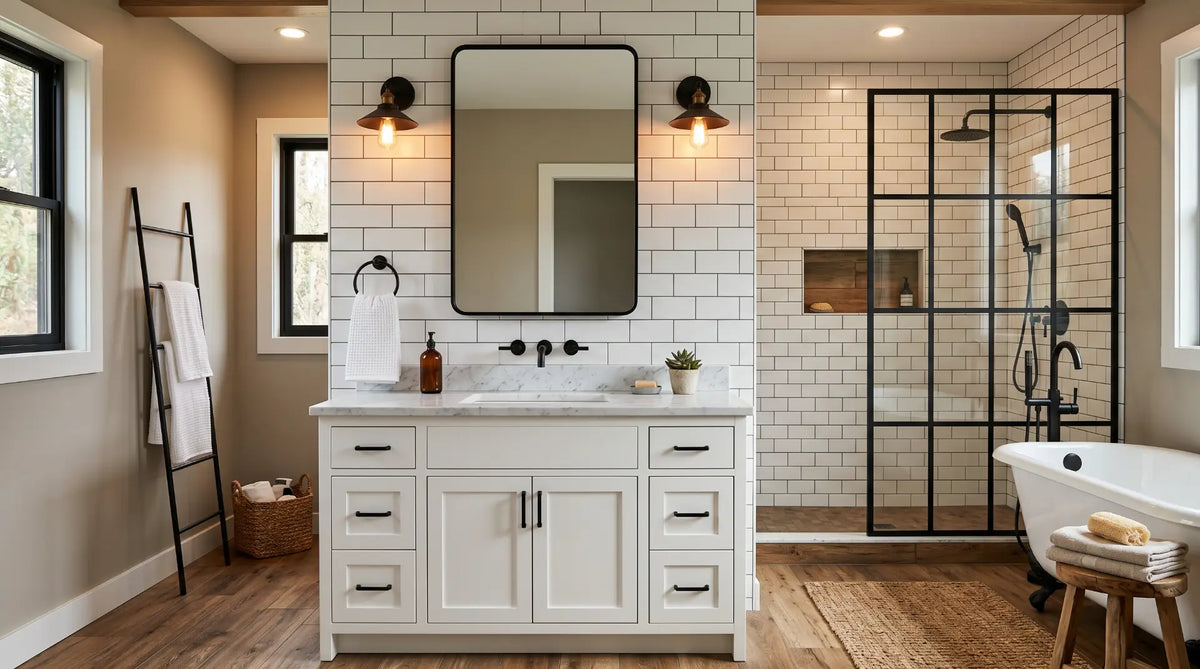
Modern farmhouse isn't a single material or a shiplap accent wall - it's a balance between raw, tactile elements and clean, contemporary restraint. This guide covers every design decision: vanity style, tile, hardware finish, fixtures, lighting, and colour palette, so you can build the look intentionally rather than assemble it by accident.
Modern farmhouse is one of the most searched bathroom styles in Canada - and one of the most inconsistently executed. Done well, it's a bathroom that feels warm, grounded, and effortlessly lived-in, with enough refinement to read as current rather than rustic. Done poorly, it's a collection of shiplap, mason jar accessories, and mismatched finishes that looks assembled from a big-box store flyer rather than thoughtfully designed.
The difference between the two outcomes is understanding what modern farmhouse actually is: not a list of materials, but a design language built on contrast. Rough against smooth. Dark against white. Industrial hardware against natural wood. Every decision in this guide is made through that lens - contrast held in balance. Too much raw texture tips into rustic; too much sleekness tips into contemporary. The middle ground, maintained deliberately, is what produces the look.
Modern farmhouse bathrooms work because they combine two things that don't often appear together in bathroom design: warmth (wood tones, warm whites, natural textures) and restraint (clean lines, limited palette, consistent hardware finish). The warmth makes the space feel inviting rather than sterile. The restraint keeps it from tipping into country-cottage territory. Every element you choose should pass one test: does it add warmth, restraint, or both? If it adds neither - if it's just decorative noise - it doesn't belong in a modern farmhouse bathroom.

The vanity is the design anchor of any bathroom, and in a modern farmhouse bathroom it carries the most stylistic weight. The two most reliable vanity choices for this style are a shaker-door cabinet in a painted finish (white, warm off-white, or soft sage) and a natural or whitewashed wood vanity with a flat or shaker-door front. Both approaches work - they just pull the overall look in slightly different directions.
A painted white or warm cream shaker vanity is the classic modern farmhouse foundation. It reads as clean and timeless, gives the room a bright, airy quality, and pairs with virtually every tile and hardware choice in the style category. It's also the most forgiving option if other elements aren't perfectly coordinated. A natural wood vanity (white oak, light walnut, or reclaimed wood) reads as warmer and more organic - it brings the earthy, textural quality of the style to the forefront and pairs particularly well with matte black hardware and white tile. The trade-off is that it requires more deliberate coordination of everything else in the room, because the wood tone sets a specific warmth level that all other finishes need to respect.
In Canadian homes built before 1990, standard vanity rough-in dimensions are often shallower (16-18") than the 21" depth of most modern freestanding farmhouse vanity styles. Confirm rough-in depth before ordering a freestanding vanity - a depth mismatch requires either plumbing adjustment or a custom-built vanity base, both of which add cost and time to the renovation.
- Vanity style confirmed: shaker painted (versatile) or natural wood (warmer, requires more coordination)
- Rough-in depth measured and confirmed compatible with selected vanity depth before ordering
- If apron-front sink: vanity base style confirmed as freestanding or furniture-leg - not standard closed cabinet
- Vanity finish (paint sheen or wood stain) confirmed to read as warm - avoid cool whites or high-gloss surfaces

Nothing separates modern farmhouse from traditional country-cottage more definitively than hardware finish. Traditional farmhouse uses polished brass, antique gold, and ornate fixture profiles. Modern farmhouse uses matte black - consistently, across every metal surface in the room. Matte black against white subway tile and a wood or painted white vanity is the defining visual of the style. It reads as industrial-meets-rustic, which is exactly the contrast that defines modern farmhouse at its best.
Oil-rubbed bronze is the warm alternative that works equally well for homeowners who want a slightly more traditional feel without going country. It pairs particularly well with warm wood vanities and beige or cream wall tile, and it reads as more organic than matte black. The one finish to avoid in a modern farmhouse bathroom is polished chrome - it reads as too contemporary and too cold to sit comfortably with the warm, textural materials the style requires.
- Dominant finish confirmed: matte black (modern farmhouse signature) or oil-rubbed bronze (warmer alternative)
- All metal surfaces specified in dominant finish: faucet, drain, cabinet pulls, towel bar, toilet paper holder, robe hook, mirror frame, light fixture
- All plumbing hardware ordered from one manufacturer's product line to ensure consistent finish
- Polished chrome excluded entirely - replaced or excluded from the design

Tile selection is where most modern farmhouse bathrooms either succeed or slip into generic territory. The style has a specific tile vocabulary - subway tile in a classic or elongated format, natural stone with visible texture, or large-format white or cream field tile - and working within that vocabulary is more reliable than trying to introduce something outside it. The tile format and installation pattern are the primary differentiators between traditional farmhouse and modern farmhouse.
| Tile choice | Format | Best application | Modern or traditional lean |
|---|---|---|---|
| Classic subway tile | 3×6" white or off-white | Shower surround, tub surround, accent wall | Classic with dark grout = modern; white grout = traditional |
| Elongated subway tile | 3×12" or 4×16" | Shower walls, full bathroom walls | More contemporary - leans modern farmhouse strongly |
| Large-format matte tile | 12×24" or 24×24" cream or warm grey | Floor, feature wall | Modern - works best when balanced with raw texture elsewhere |
| Encaustic / cement tile | 4×4" or 8×8" patterned | Floor accent zone, bath mat area | Traditional farmhouse - use sparingly in modern applications |
| Honed marble or limestone | 12×12" or 12×24" | Floor or shower floor | Elevated farmhouse - adds luxury without losing warmth |
| Shiplap (accent, not tile) | 3-6" horizontal boards | One accent wall only - behind vanity or tub surround | Classic farmhouse signature - use on one wall maximum in a modern application |
Grout colour is the most underestimated decision in farmhouse tile selection. Classic 3×6 subway tile with white grout reads as traditional and country. The same tile with dark grey or charcoal grout reads as modern farmhouse immediately - the contrast outlines every tile and creates a grid that anchors the wall visually. This single change (grout colour from white to charcoal) is the most efficient way to shift subway tile from traditional into modern farmhouse territory.
- Tile format selected from the farmhouse vocabulary: subway (3×6" or elongated), large-format matte, or honed natural stone
- Grout colour confirmed: dark charcoal or warm dark grey for modern farmhouse lean; white for traditional farmhouse
- Shiplap limited to one accent wall - not ceiling, not all four walls
- Floor tile confirmed in warm cream, light grey, or honed natural stone - cold blue-white tiles avoided
- Tile pattern confirmed: brick offset or vertical stack for subway - avoid herringbone in full-room applications (too busy)

Fixture profile - the visual shape and handle design of the faucet, shower valve, and tub filler - is the detail that most precisely places the bathroom on the spectrum between modern farmhouse and traditional farmhouse. Cross-handle faucets (the X-shaped handles common in vintage-inspired plumbing) read as traditional. Single-lever faucets in clean profiles read as contemporary. The modern farmhouse sweet spot is a fixture with slight architectural character - a gooseneck spout, a slightly squared handle, or a bridge faucet style - finished in matte black or oil-rubbed bronze.
For showers, an exposed shower system (where the plumbing pipes and valve body are visible on the wall rather than concealed behind tile) is a strong modern farmhouse statement. Exposed black or bronze pipe fittings against white subway tile is one of the most recognisable visual signatures of the style. It's also a more straightforward installation in a renovation context because it doesn't require tiling around concealed valve bodies to the same precision as a fully in-wall system.
- Faucet profile confirmed: bridge, gooseneck, or slightly architectural - not waterfall or rounded contemporary
- Faucet handle style confirmed: cross or lever - not single-lever minimalist (too contemporary) or ornate (too traditional)
- Shower system type decided: exposed pipe system (farmhouse signature) or concealed (more contemporary)
- All fixture finishes confirmed in dominant finish - matte black or oil-rubbed bronze throughout

Lighting in a modern farmhouse bathroom serves two roles simultaneously: it illuminates the space and it contributes to the visual language of the style. The fixture profile and finish are as important as the light output. Industrial-style vanity lights - cage pendants, exposed-bulb sconces, or barn-style light bars - in matte black or oil-rubbed bronze are the most direct expressions of the modern farmhouse lighting aesthetic. They introduce the industrial element that balances the warmth of wood and white tile without feeling out of place.
Bulb colour temperature is especially important in farmhouse bathrooms because the style relies on warm, organic tones to work. A 2700K warm white bulb amplifies wood grain, makes white tile read as warm rather than clinical, and gives the whole space the inviting quality that defines the style at its best. A 4000K or 5000K cool white bulb in the same fixture makes the same room feel cold and washes out the warmth of the wood and warm-toned finishes. Specify 2700K across every fixture in the room.
All light fixtures within 1.8 metres (6 feet) of a water source in a Canadian bathroom must meet the applicable IP (Ingress Protection) rating under the Canadian Electrical Code. Many industrial-style cage sconces and exposed-bulb fixtures marketed for bathroom use are not rated for wet or damp locations - confirm the IP rating (minimum IP44 for damp locations, IP65 for wet locations within the shower zone) before purchasing. Fixtures that aren't rated for their installation zone fail electrical inspection and can be a safety risk in humid bathroom environments.
- Fixture profile confirmed as industrial or barn-style - cage, exposed bulb, or barn sconce in matte black or oil-rubbed bronze
- Fixture finish confirmed to match dominant hardware finish throughout the bathroom
- Colour temperature specified: 2700K warm white for all fixtures
- CRI 90+ confirmed for vanity task lighting
- IP rating confirmed for all fixtures within 1.8m of a water source (Canadian Electrical Code requirement)
- Dimmer switch specified for ceiling ambient fixture

The modern farmhouse colour palette is one of its most defining characteristics - and one of the easiest to get wrong by adding too much. The palette has three elements: a warm white or warm cream field (walls, tile, ceiling), a natural wood tone (vanity, shelf, or accessory), and one grounding dark element (matte black hardware, dark grout, or a single dark-painted accent wall or shiplap wall). Everything in the room should be traceable back to one of these three elements. A fourth colour - a sage green accessory, a terracotta accent tile, a warm beige paint - can work, but it requires deliberate placement and should be used sparingly.
The warm white used for walls and tile matters more than most homeowners expect. Not all whites are the same: a cool white with blue or grey undertones will read as antiseptic against warm wood and black hardware, and the contrast between the cool white and warm finishes will feel unresolved. Warm whites with yellow, cream, or pink undertones (Benjamin Moore White Dove OC-17, Sherwin-Williams Alabaster SW 7008, or Benjamin Moore Chantilly Lace OC-65 as a slightly cooler but still warm option) sit comfortably alongside wood tones and dark hardware without creating the visual tension that cool whites introduce.
| Palette variation | Field colour | Wood tone | Dark anchor | Overall feel |
|---|---|---|---|---|
| Classic modern farmhouse | Warm white walls + white subway tile | White oak vanity or shelving | Matte black hardware + charcoal grout | Light, airy, with strong graphic contrast |
| Warmer farmhouse | Warm cream walls + cream or beige tile | Light walnut or honey oak | Oil-rubbed bronze hardware + warm dark grout | Cosy, organic, slightly more traditional |
| Moody farmhouse | Dark sage or charcoal shiplap accent wall + white tile | Reclaimed pine or dark walnut | Matte black hardware + white or cream grout | Dramatic, atmospheric, strongly contemporary edge |
| Elevated farmhouse | Warm white walls + honed marble tile | Unlacquered brass accents (limited) | Matte black primary + warm brass accent (70/30) | Refined, luxurious, firmly modern farmhouse |
- Warm white or warm cream confirmed for walls - cool whites with blue or grey undertones excluded
- Wood tone identified and limited to one: vanity, open shelf, or accessory - not all three
- Dark anchor identified: matte black hardware and charcoal grout, or oil-rubbed bronze and warm dark grout
- Paint swatches viewed under the bathroom's actual lighting (not store lighting) before final selection
- Fourth colour element reviewed critically - if present, it should serve a deliberate purpose, not just add interest
Modern farmhouse is one of the most commonly attempted and most commonly mis-executed bathroom styles. The mistakes are consistent and avoidable once you know what to look for.
| Mistake | What it looks like | The fix |
|---|---|---|
| Too much shiplap | Shiplap on all four walls and the ceiling - reads as country cottage, not modern farmhouse | Limit shiplap to one accent wall. The other walls should be smooth tile or painted drywall. |
| Mixed metal finishes | Matte black faucet, chrome towel bar, brushed nickel drawer pulls, oil-rubbed bronze mirror - visual chaos in a small space | Pick one dominant finish and apply it to every metal surface. Replace mismatched pieces before finishing the room. |
| Cool-white paint with warm materials | Bright blue-white walls behind warm oak vanity and dark bronze hardware - the wall fights the fixtures | Switch to a warm white (White Dove, Alabaster) that reads neutrally alongside wood tones and dark finishes. |
| White grout on subway tile | Classic subway tile with white grout reads as traditional country bathroom, not modern farmhouse | Switch to charcoal or dark grey grout. The same tile becomes modern farmhouse immediately. |
| Too many farmhouse accessories | Mason jar soap dispensers, "wash your hands" signs, wicker baskets, rope mirrors - the room looks like a décor catalogue | Limit decorative accessories to two or three items maximum. Let the architecture - tile, hardware, vanity - carry the style. |
| Farmhouse style elements with contemporary fixtures | Shiplap accent wall with a waterfall faucet, vessel sink, and frameless LED mirror - the styles don't coexist | Commit to one direction. If the fixtures are contemporary, remove the farmhouse elements and let the room be contemporary-transitional instead. |
- Vanity style confirmed: shaker painted (white or warm cream) or natural wood (white oak or light walnut)
- Rough-in depth measured - confirmed compatible with selected vanity before ordering
- If apron-front sink: freestanding or furniture-leg base confirmed - not standard closed cabinet
- Vanity finish confirmed as warm - warm undertone, matte or satin sheen only
- Dominant finish confirmed: matte black or oil-rubbed bronze - applied to every metal surface in the room
- All plumbing hardware from one manufacturer's product line - finish consistency confirmed
- Faucet profile confirmed: bridge, gooseneck, or architecturally detailed - not waterfall or rounded contemporary
- Shower system type decided: exposed pipe in matte black (farmhouse signature) or concealed in-wall
- Polished chrome excluded from the design entirely
- Tile format confirmed from farmhouse vocabulary: subway (3×6" or elongated), large-format matte, or honed natural stone
- Grout colour confirmed: charcoal or dark grey (modern farmhouse) or warm dark brown (warmer farmhouse)
- Shiplap limited to one accent wall - not ceiling, not all four walls
- Floor tile confirmed in warm cream, light grey, or honed natural stone
- Vanity light profile confirmed: cage, exposed-bulb bar, or barn-style sconce in dominant finish
- All fixtures specified at 2700K warm white colour temperature
- IP rating confirmed for all fixtures within 1.8m of a water source (Canadian Electrical Code)
- Wall colour confirmed as warm white or warm cream - cool whites excluded
- Paint swatch viewed under actual bathroom lighting before final selection
- Palette limited to three elements: warm white field + wood tone + dark anchor hardware
Shop farmhouse vanities and fixtures at Bathify
Browse shaker vanities, farmhouse sinks, matte black fixtures, and barn-style lighting - curated for Canadian homes. Free shipping on orders over $50.


