






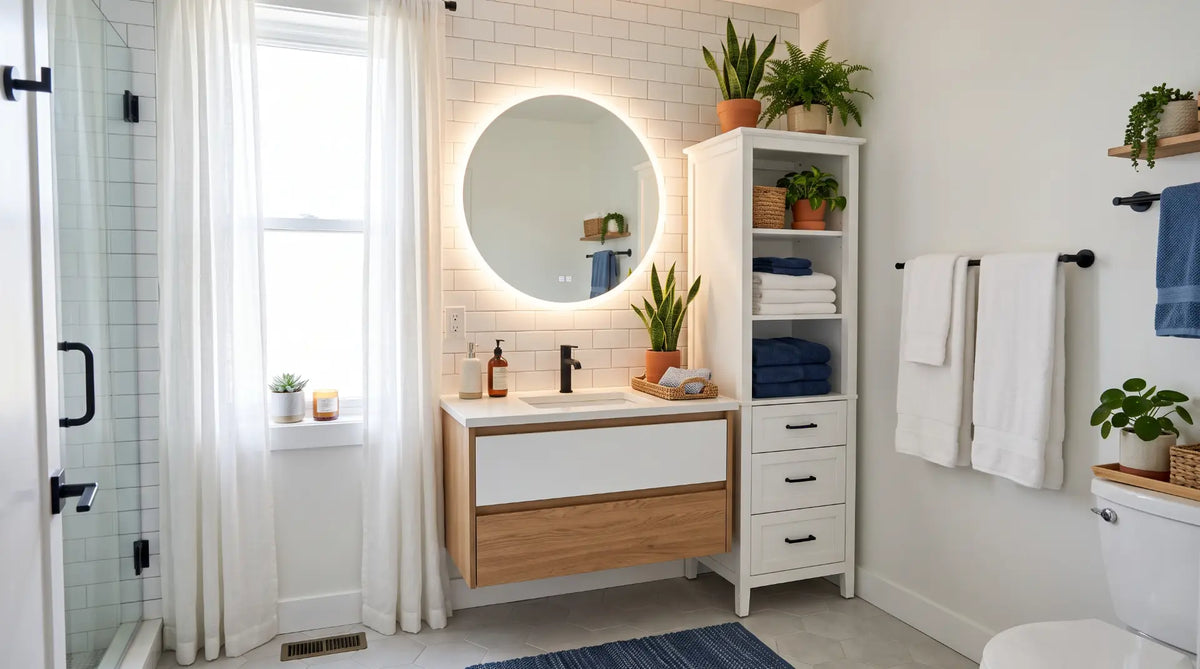
You don't need a renovation - or your landlord's contractor number - to make a rental bathroom feel like yours. This guide covers the swaps that are fully reversible, damage-deposit-safe, and permit-free: what to change, what to leave alone, and exactly what to box up and take with you when the lease ends.
Yes - a genuinely satisfying bathroom makeover in a Canadian apartment or rental is entirely possible without a renovation, a permit, or a call to the landlord's maintenance line. The trick is choosing upgrades that are reversible: nothing that touches plumbing rough-ins, nothing that requires house wiring, and nothing that can't be undone cleanly before your final walkthrough. Freestanding storage, plug-in lighting, and swap-and-save fixtures cover almost everything a rental bathroom actually needs.
What doesn't belong on a rental makeover list: anything that moves a drain or supply line, any hardwired electrical work, and anything installed with adhesive or fasteners strong enough to damage the wall on removal. Those changes belong to the world of ownership - see When You Need Landlord Sign-Off Anyway below for the handful of situations where it's worth having that conversation regardless.
Start with the renter-friendly test, then work through the five zones - storage, lighting, fixtures, hardware, and soft goods - picking the upgrades that fit your bathroom and lease. Keep the deposit-protection section in mind before you buy anything, not after. If your unit is a starter step toward eventually owning and renovating, our complete bathroom renovation guide picks up exactly where this one leaves off.

Before adding anything to cart, run it through four questions. If the answer to all four is yes, it's a safe rental upgrade. If any answer is no, treat it as a bigger decision - one that needs a lease check or a landlord conversation first.
- Does it avoid plumbing? No moved drains, no altered supply lines. A swap-and-save fixture (same connection point, original kept for reinstallation) passes; a relocated fixture doesn't.
- Does it avoid house wiring? Plug-in and battery-powered fixtures pass. Anything requiring a junction box or a licensed electrician doesn't.
- Can it be fully removed? Freestanding furniture, adhesive-free mounts, and small screw holes that patch cleanly all pass. Anything requiring drywall cutting, tile removal, or permanent adhesive doesn't.
- Do you still have the original? If you're swapping a fixture the unit came with, keep the original boxed and labelled so it goes back on before you move out.
The same category of upgrade often comes in both a rental-safe and a renovation-only version. Here's how the most common bathroom upgrades split.
| Upgrade | Rental-safe version | Renovation-only version |
|---|---|---|
| Mirror & lighting | Plug-in LED mirror - hangs like a picture, plugs into an existing outlet | Hardwired LED mirror - needs an electrician and a junction box |
| Storage | Freestanding linen cabinet - stands on the floor, no wall anchoring required | Built-in / recessed medicine cabinet - requires cutting into the wall |
| Showerhead | Swap-and-save showerhead - threads onto the existing arm, original reinstalled at move-out | New shower valve or system - plumbing rough-in work |
| Faucet | Aerator or handle swap - reversible in minutes with basic tools | Full faucet replacement - fine if you keep the original box, riskier without it |
| Hardware finish | Cabinet knobs, towel bar, hooks - screw-mount, small holes that patch easily | Built-in niches, glass shelving set into tile - permanent and tile-dependent |
Work through the bathroom zone by zone rather than trying to change everything at once. Most rental makeovers land their biggest visual impact from just two or three of the five zones below.
A plug-in LED mirror hangs on the wall like a picture frame and plugs into any CSA-compliant outlet - no electrician, fully reversible. It replaces a dim overhead fixture with proper face-level task lighting, which is the single biggest quality-of-life upgrade a rental bathroom can get.
Most rental bathrooms are short on storage. A freestanding linen cabinet stands on its own feet with no wall anchoring required, adds real cabinet and drawer space, and moves with you when the lease ends.
A new showerhead or sink faucet threads onto the same connection point the old one used - no plumbing rough-in. Keep the original in a labelled box; reinstalling it at move-out takes minutes and is the difference between a clean walkthrough and a deposit dispute.
Cabinet knobs, a towel bar, hooks, a soap dispenser - replacing mismatched builder-grade hardware with one coordinated finish is screw-mount, patches cleanly, and is one of the cheapest ways to make a rental bathroom look intentional rather than assembled.
Round out the makeover with items that need no installation at all: a new shower curtain and rings, a bath mat, matching towels, and a tension-mounted shower caddy for anything that would otherwise need a shelf. None of these touch the renter-friendly test above - they're simply not fixtures.

Rental bathrooms are frequently smaller and more oddly proportioned than owned homes, so measuring before ordering matters even more than usual.
- Mirror width: aim for 4-8 inches (10-20 cm) narrower than your vanity's total width on each side, and confirm your outlet position lines up with a plug-in mirror's cord length before ordering.
- Freestanding cabinet footprint: measure the actual floor clearance next to the toilet and vanity, not just the wall length - door swing and toilet clearance are the two dimensions renters most often forget to check.
- Showerhead thread size: Canadian shower arms are almost universally a standard 1/2" NPT thread, but confirm before ordering if your unit is in an older building - some pre-1980s Canadian buildings use non-standard fittings that need an adapter.
- Faucet aerator size: most Canadian kitchen and bathroom faucets use a 15/16"-27 or 55/64"-27 thread, but older fixtures can vary - bring the old aerator to match size rather than guessing.
The upgrades in this guide are chosen specifically to be reversible - but reversible only works if you plan the reversal from day one, not the week before you move out.
- Photograph the original condition of the bathroom - every fixture, every wall - before you change anything, dated and saved somewhere you'll still have access to a year from now.
- Box and label every original part you remove: showerhead, faucet aerator, cabinet knobs, toilet seat. A shoebox in the closet is enough - the goal is knowing exactly where they are when you need them.
- Choose the smallest fastener that works. A picture-hanging hook or a small screw patches with a dab of spackle and touch-up paint; a heavy-duty anchor leaves a hole that's harder to disguise.
- Reinstall before your walkthrough, not during it. Put the original fixtures back on and patch any holes a few days before your move-out inspection, so paint has time to dry and cure to a matching finish.
- Keep receipts. If a landlord questions a change, being able to show it was a swap-and-save upgrade rather than a permanent alteration resolves most disputes quickly.
- Throwing out the original fixtures. The showerhead and faucet aerator that came with the unit are the landlord's property - keep them, don't recycle them.
- Choosing a hardwired fixture to save a few dollars. The install cost difference rarely justifies losing full reversibility - stick to plug-in and battery options in a rental.
- Skipping the outlet check before buying a plug-in mirror. Confirm a GFCI outlet exists within cord reach of your intended mirror position before ordering, not after it arrives.
- Using heavy-duty wall anchors for light items. Match the fastener to the load - an over-built anchor for a light towel bar leaves a bigger hole to patch than necessary.
- Assuming all leases are the same. Some leases explicitly permit cosmetic changes; others don't. A five-minute read of your lease's alterations clause avoids most disputes before they start.
All of the picks below meet the renter-friendly test above - reversible, no plumbing changes, no house wiring.

Stands on its own feet with no wall anchoring required, so it's fully mobile between rentals. Three soft-close drawers and a door provide real storage in a bathroom category - the vertical linen tower - that most rental units skip entirely.

ICO Bath's LED mirror range - including the Camden, Bennett, Eden, and Kiara models - offers a plug-in power option alongside hardwire, so the exact same front- and back-lit mirror can be a fully reversible rental upgrade or a permanent renovation fixture depending on which power option you choose at checkout. For the rental-safe version, always select plug-in.
Because none of these upgrades involve labour, the entire budget goes into products. A realistic full makeover across two or three zones lands well under what even a cosmetic renovation refresh would cost.
| Upgrade | Typical CAD range | Notes |
|---|---|---|
| Plug-in LED mirror | $250 - $500 | Size and feature-dependent; choose plug-in at checkout |
| Freestanding linen cabinet | $300 - $900 | Solid wood and Canadian-made options run higher |
| Showerhead swap | $40 - $150 | Keep the original boxed for move-out |
| Faucet or aerator swap | $30 - $250 | Aerator-only is the cheapest reversible faucet upgrade |
| Hardware set (knobs, towel bar, hooks) | $60 - $200 | Buy as a matched finish set for a coordinated look |
| Full reversible makeover (2-3 zones) | $150 - $600 | No labour cost - everything is self-install |
If your next home is one you'll own, our bathroom remodel cost breakdown by room size shows what the next tier - a permanent renovation - actually costs across Canada.
A handful of upgrades sit outside the reversible category no matter how carefully they're done. It's worth having the landlord conversation for these rather than assuming a rental workaround exists.
- Any change to house wiring. A hardwired mirror, a new light fixture, or a GFCI outlet must be installed and inspected under your provincial electrical safety authority - the ESA in Ontario, Technical Safety BC, and equivalents elsewhere - and is not a tenant-initiated project in most leases.
- Moving or adding plumbing. Relocating a drain or supply line, or adding a fixture where one didn't exist, is renovation-scale work regardless of who's paying for it.
- Removing or replacing a vanity, toilet, or tub. Even a like-for-like swap changes fixtures the landlord owns and is responsible for maintaining - always get written approval first.
- Anything involving tile, paint colour changes, or wallpaper. These affect the unit's resale and re-rental condition and are almost always covered explicitly in a standard Canadian residential lease.
Reversible, not permanent, is the whole strategy
A rental bathroom makeover succeeds by staying reversible. Freestanding storage, plug-in lighting, and swap-and-save fixtures deliver most of a renovation's visual impact with none of its permanence.
Box the originals before you install anything new. A labelled shoebox of showerheads, aerators, and knobs is the cheapest insurance your damage deposit will ever get.
Save wiring and plumbing changes for ownership. Everything in this guide skips both - which is exactly what makes it rental-safe in every Canadian province.
Ready to Order? Shop Bathify Canada
Plug-in LED mirrors, freestanding storage, faucets, and accessories - from Riobel, ICO Bath, Vanity Art, Mylo, Agua Canada, and more. Free ground shipping on orders over $50. Delivered across Canada.


