






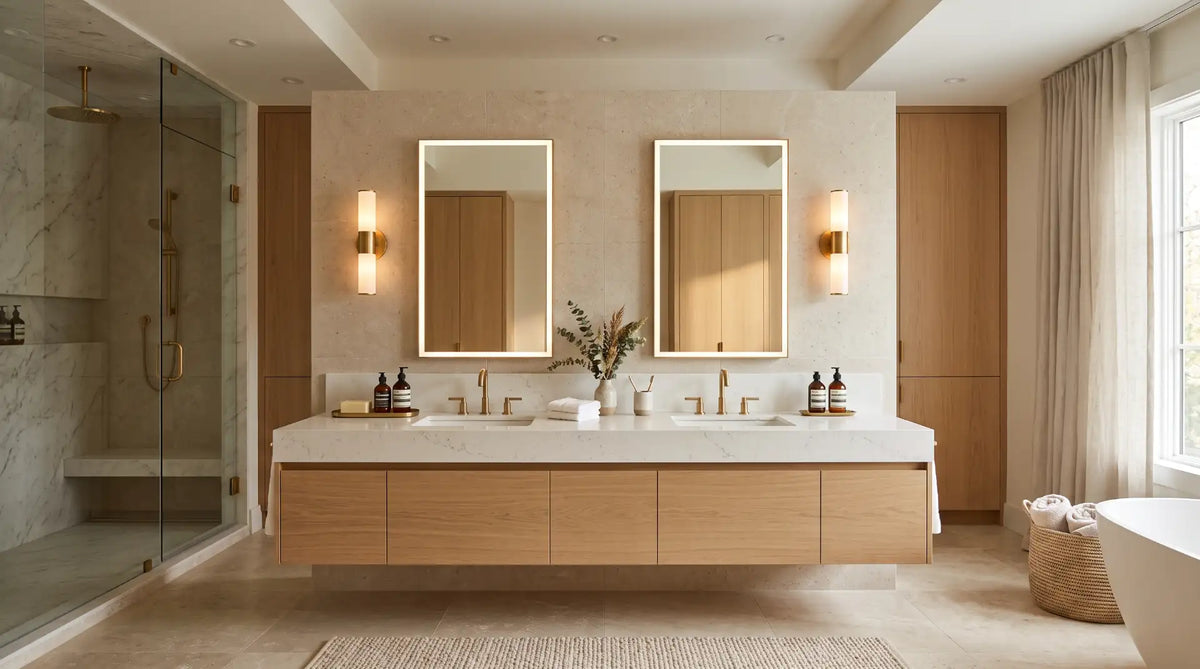
The fixture you buy matters less than where you put it. Almost every "my bathroom lighting just doesn't feel right" complaint traces back to two numbers - mounting height and spacing - not the finish or the brand. Here's exactly where Canadian bathrooms get vanity lighting wrong, and the placement rules that fix it before you buy anything.

Vanity lighting gets more attention paid to its style than any other fixture in the bathroom - the finish, the shape, whether it matches the faucet - and less attention paid to the two variables that actually determine whether it works: mounting height and spacing relative to the mirror and the face using it. A beautifully finished sconce mounted at the wrong height still throws shadows across the eyes. A well-reviewed light bar centred on the wrong point still leaves half the mirror dim.
This is also the step most renovation guides skip entirely, because it isn't a shopping decision - it's a measuring one. This guide gives the concrete numbers Canadian bathrooms need: the exact height range for sconces and light bars, the spacing formula for single and double-sink vanities, the colour temperature and CRI figures that actually matter, and the code requirements around damp ratings and GFCI protection that apply regardless of which fixture you choose.
If you haven't chosen your vanity or mirror yet, start with our complete bathroom vanity buying guide for Canada - it covers sizing, materials, and countertops before you get to lighting. This page assumes you already know, or are close to knowing, your vanity and mirror width, and focuses entirely on where the light goes.
Read the height and spacing sections in order - they're the two numbers everything else depends on. If you already have a fixture type in mind, jump straight to the colour temperature and code sections before you buy. If you're deciding between sconces and an LED mirror, the comparison table under "Sconces vs LED Mirrors vs Light Bars" lays out the trade-off directly. The FAQ at the bottom answers the six questions Canadian homeowners search most.
Six rules cover essentially every vanity lighting placement decision. Get these right and the fixture you choose becomes a style question, not a functional gamble.

Light should hit the face straight on, not fall from the ceiling. Side fixtures mounted at eye level do this automatically.

Light from the sides fills in the shadows that a single overhead source always creates under the eyes and chin.

Spacing is set by the face using the mirror, centred on the sink - not by the width of the vanity cabinet underneath.

Colour temperature sets the mood; CRI sets the accuracy. A vanity needs both, or skin tones and makeup read wrong.

Any fixture near a sink needs a damp rating under the Canadian Electrical Code. Bathroom humidity isn't optional to plan for.

An LED mirror places the light source at face height by design, removing the height and spacing decisions entirely.
Mounting height is the single most common vanity lighting mistake in Canadian bathrooms, and it's almost always the same error: fixtures installed too high, at whatever height the previous builder-grade strip light happened to occupy, rather than at a height chosen for the person actually using the mirror. The fix is a genuinely simple rule - task lighting at a vanity should land at eye level, because that's the angle that lights a face evenly instead of from above.
| Fixture type | Recommended height | Why |
|---|---|---|
| Wall sconces (flanking mirror) | 60"-65" to fixture centre | Roughly eye level across a typical adult height range - lower than most builder-grade installs default to |
| Single light bar above mirror | 3"-6" above the mirror's top edge (often ~78"-80" to centre) | Clears sightlines into the mirror while still angling light down and forward onto the face |
| LED-backlit or edge-lit mirror | No separate height decision | The light source is built into the mirror at face height by design, so the mirror's own mounting height sets it |
| Ceiling-mounted downlight (supplemental) | Standard ceiling height, positioned forward of the mirror | Useful as ambient fill light, but should never be the vanity's only light source - see the mistake below |
This is also why so many existing Canadian bathrooms feel dimly or harshly lit despite having a working fixture: the light is there, but it's mounted at a height that was convenient for the original wiring rather than correct for the face beneath it. Correcting height on an existing switched box is often a straightforward fixture swap - see our guide to installing a bathroom vanity in Canada for the adjacent plumbing and mounting considerations if you're tackling both at once.
Once height is set, spacing is the number that determines whether light actually falls evenly across the face rather than clustering to one side. For a pair of wall sconces flanking a mirror, the workable range is 24-36 inches apart on-centre, and the spacing should be centred on the sink and the face using it - not on the vanity cabinet as a whole. That distinction matters most on offset sinks, vessel-sink vanities, and any layout where the sink isn't dead-centre on the cabinet.

A single recessed ceiling light or pot light positioned directly above the mirror is the most common vanity lighting setup in Canadian homes, and it's also the least functional one for the task actually performed at a vanity. Light falling straight down from above the head lands on the top of the face and casts shadows downward, under the eyes, along the sides of the nose, and beneath the chin - precisely the angle that makes shaving nicks and uneven makeup application more likely, because the person can't see their own face clearly.
This isn't an argument against ceiling lighting - it plays a legitimate role as ambient, whole-room illumination. The problem is relying on it as the only light source at the mirror. A vanity needs dedicated task lighting that hits the face from the sides or straight on at face height, which is exactly what wall sconces, a properly placed light bar, or an LED-backlit mirror are built to do.
All three fixture types can light a vanity correctly - the difference is how much placement precision each one demands from you, and how much electrical work each involves.
| Fixture type | Placement precision needed | Face coverage | Electrical complexity |
|---|---|---|---|
| Wall sconces (pair) | High - two numbers to get right (height and spacing) | Excellent - even light from both sides | Usually two wired points; more involved if boxes don't already exist |
| LED-backlit mirror | Low - height and spread are built into the mirror | Excellent - even light surrounding the face | Usually a single power point at the existing mirror location |
| Single light bar above mirror | Medium - one height number to get right | Good - front-only, can leave the lower face slightly shadowed | Single power point above the mirror, often an existing location |
For a renovation where the electrical is already open, sconces give the most classic, layered look and are worth the extra placement care. For a refresh where you'd rather not add or move wiring, an LED-backlit mirror is usually the simpler upgrade - it replaces the mirror and the light source in one product, at the power point that's often already there. Bathify's LED Mirrors collection - including the ICO Bath Iris and Denver lines detailed further down this page - is built specifically to solve this without a placement calculation.

A single-sink vanity has one lighting zone: centre the fixture (or fixture pair) on the sink and mirror, and the rest of this guide applies directly. A double-sink vanity is functionally two vanities sharing one countertop, and the lighting should treat it that way - each sink gets its own centred lighting zone, rather than one central pair of sconces awkwardly serving both users from the middle of the cabinet.
In practice this usually means one of two approaches: two matching LED mirrors, one per sink, each centred on its own sink and lit independently; or a continuous light source - a wide light bar or a run of sconces - that spans both zones evenly rather than concentrating light in the centre of the vanity where neither sink actually sits.
Planning a double-sink vanity from scratch? Our guide to the best double vanities for master bathrooms in Canada under $2,000 covers the layout and plumbing side of a double-sink project, which is worth locking down before you plan the lighting zones above it.

Colour temperature, measured in Kelvin (K), describes how warm or cool a light source looks - not how bright it is. For a bathroom vanity, the practical range worth choosing from is 2700K to 4000K. At the lower end, 2700-3000K reads warm and cozy, close to a traditional incandescent bulb, and suits bathrooms where the fixture is also meant to feel comfortable at night. At the upper end, 3500-4000K reads neutral to cool, closer to daylight, and is generally considered better for precise tasks like matching makeup shades or a close shave, because it renders detail more crisply.
Colour temperature alone doesn't guarantee accurate colour, though - that's what CRI (colour rendering index) measures. CRI scores a light source from 0-100 on how faithfully it reveals true colours compared to natural daylight. A budget fixture can carry a flattering-sounding Kelvin rating and still have a low CRI, which shows up as skin looking slightly duller, greyer, or off compared to how it actually looks in daylight. For a vanity specifically, aim for a CRI of 90 or higher - it's the difference between makeup that looks right at the mirror and looks wrong the moment you step outside.
Placement and style aside, every fixture installed near a bathroom sink or vanity in Canada has to meet a basic safety requirement: it needs to be rated for a damp location under the Canadian Electrical Code, and anything installed inside or directly above a shower or tub zone needs a wet rating instead. This isn't a style consideration - it's the difference between a fixture that lasts and one that corrodes or shorts out from ordinary bathroom humidity within a couple of years. Product listings and specification sheets will state the rating directly; if a fixture doesn't mention one, treat that as a reason to check before buying, not assume it's fine.
| Situation | What's usually required | Notes |
|---|---|---|
| Fixture swap, same wired location | Usually no permit | A like-for-like light fixture change on an existing switched box is typically straightforward |
| New wall box for sconces | Licensed electrician | Adding or relocating a box is electrical work, not a cosmetic swap |
| Fixture near the sink/vanity | Damp-rated fixture | Required under the Canadian Electrical Code for the humidity in this zone |
| Fixture in or above the shower/tub zone | Wet-rated fixture | A higher rating than damp-rated; check the zone distance rules for your province |
| Vanity circuit | GFCI protection | Standard requirement for bathroom circuits; confirm with your electrician if unsure |
Not sure if your lighting change needs a permit? Our guide to bathroom renovation permits in Canada walks through exactly where the line sits between a cosmetic fixture swap and permitted electrical work, by province. If lighting is part of a larger renovation, our step-by-step guide to planning a bathroom renovation in Canada covers how electrical fits into the full order of trades.
Height and spacing cover the two biggest errors, but a handful of smaller decisions reliably undermine an otherwise correct layout.
A 3000K sconce pair next to a 5000K ceiling pot light reads as mismatched even when each fixture is individually fine - the eye notices the contrast immediately. Keep every fixture in the bathroom within a similar Kelvin range, even if they come from different collections.
Many Canadian homes built in the 1980s and '90s have builder-grade strip lights mounted well above the eye-level range described earlier, often 74-80 inches up. It's tempting to reuse that exact spot when replacing the fixture - resist it, and remeasure to the 60-65" range instead.
A fixed-brightness vanity light is either too harsh for a 2 a.m. bathroom trip or too dim for a careful morning shave. A dimmer switch, or a fixture with built-in adjustable brightness like an LED mirror's touch controls, solves both without needing two separate light sources.
A standard interior-rated fixture is usually cheaper than its damp-rated equivalent, which makes it tempting to substitute one for the other. It's a false saving - a fixture not built for bathroom humidity tends to fail within a few years, at which point the "savings" have been spent twice.
Run through this before you buy or install. If every box is checked, the fixture itself becomes a style decision rather than a functional risk.
| Checklist item | Done when... |
|---|---|
| Height set | Sconces centred at 60-65" from the floor, or a light bar 3-6" above the mirror's top edge |
| Spacing set | Fixtures 24-36" apart, centred on the sink and face - not the cabinet |
| Fixture type chosen | Sconces, light bar, or LED-backlit mirror selected based on how much electrical work you want to take on |
| Damp rating confirmed | Fixture spec sheet confirms a damp rating, or wet rating if near a shower/tub |
| Colour temperature & CRI confirmed | 2700-4000K chosen, with a CRI of 90 or higher |
| Circuit confirmed | GFCI protection verified, and any new or relocated box confirmed with a licensed electrician |
| Dimmer or brightness control included | A dimmer switch or built-in adjustable brightness is part of the plan |
Once the height, spacing, and colour temperature decisions above are made, Bathify carries the fixtures to act on them - LED-backlit mirrors that build the placement math in, and framed mirrors designed to pair with separately mounted sconces - all with free ground shipping on orders over $50 and delivery across Canada.
These are standout picks across the sizes and budgets most Canadian vanities need. All prices are in CAD and all ship across Canada.

This is the placement shortcut described throughout this guide in product form: front and backlighting built into the mirror at face height, so there's no separate height or spacing calculation to make. It's dimmable with adjustable colour temperature, constructed with a high-quality aluminum frame and copper-free glass, and can be hardwired or plugged in (hardwiring should go through a licensed electrician). Backed by ICO Bath's 5-year warranty.

A compact, square-format LED mirror sized for a 24" vanity or a powder room where a full sconce pair wouldn't have the wall space to be spaced correctly. Front and backlighting, dimmable with adjustable colour temperature, and available in Brushed Bronze, Brushed Gold, or Matte Black to match the rest of your finish scheme.

The wide-format version of the Denver, sized for a 40-48" single-sink vanity where two sconces would otherwise need to span a wider gap than is ideal. Even front and back LED lighting covers the full width of the mirror, so face coverage stays consistent regardless of where you stand at the sink. Same dimmable, adjustable-colour-temperature controls and finish choices as the 24" model.

If you'd rather build the classic layered look - a framed mirror with a pair of wall sconces mounted at the 60-65" height described earlier - this is the mirror to pair them with. Its wood-trim frame and bottom shelf are sized to span a wide single vanity or a double-sink layout, leaving the lighting entirely up to a separately chosen pair of sconces from Bathify's Wall Sconces collection.
Not sure which approach fits your layout? The Bathify support team can help match a fixture to your vanity width and wiring situation - and every order ships across Canada with a straightforward 30-day return policy, so a placement adjustment on a single item is easy to correct.
Height and spacing first, fixture second
Mount at eye level. Side lighting belongs at 60-65" from the floor; a light bar belongs 3-6" above the mirror's top edge. Measure before you buy, not after you've hung the fixture.
Space to the face, not the cabinet. Two sconces should sit 24-36" apart, centred on the sink and the person using it - especially important on offset sinks and double-sink vanities.
Never rely on overhead alone. A ceiling fixture is fine as ambient light, but the vanity needs dedicated task lighting from the sides or built into the mirror to avoid shadowing the face.
Match colour temperature and CRI. Stay within 2700-4000K and look for a CRI of 90 or higher so skin tones and makeup colours read accurately, not just brightly.
Confirm the code basics. Damp-rated fixture, GFCI-protected circuit, and a licensed electrician for any new or relocated wiring - non-negotiable regardless of which fixture you choose.
Or skip the math with an LED mirror. A mirror with integrated LED lighting removes the height and spacing decisions entirely, which is often the simplest correct choice for a straightforward refresh.
Ready to Order? Shop Bathify Canada
LED mirrors, wall sconces, vanities, faucets, and everything else to finish the job - from ICO Bath, Kube Bath, Mylo, Vanity Art, and more. Free ground shipping on orders over $50. Delivered across Canada.


