






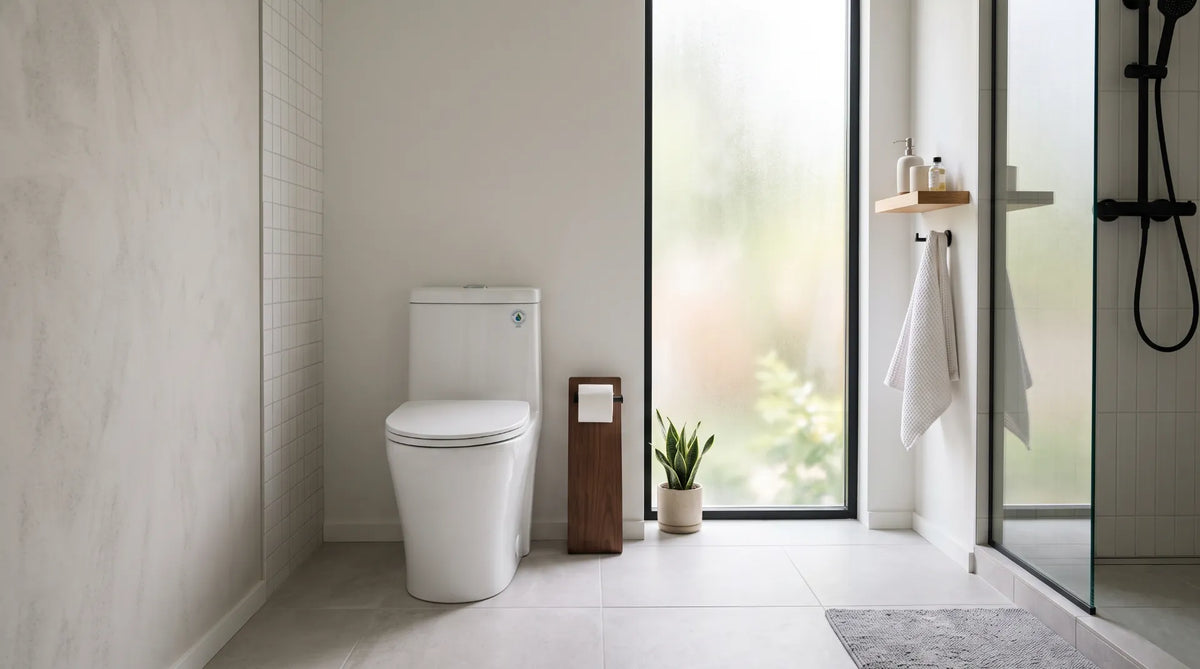
"Water-saving" gets printed on more toilet boxes than it actually applies to. At Bathify, our team fields a steady stream of questions about what WaterSense and MaP scores really mean, whether dual-flush is worth the extra cost, and which Canadian rebates are still active in 2026 - so here's the direct answer to all three, plus the real Bathify toilets we recommend at every budget.
At Bathify, our answer is that "water-saving" really only means one thing worth checking: a WaterSense-certified toilet using 4.8 litres (1.28 US gallons) or less per flush. Beyond that baseline, dual-flush versus single-flush is mostly a matter of chasing marginal extra savings, not a meaningful difference in hygiene or performance. Bathify stocks WaterSense-certified, high-efficiency toilets from Agua Canada and Caroma across every price point, starting at $529.99 CAD, and this guide walks through what the certifications actually mean, how much water and money an upgrade genuinely saves, which Canadian rebates are worth checking in 2026, and the real Bathify toilets we recommend.
If you're deciding on a toilet more broadly - format, height, bowl shape, rough-in - our complete toilet & bidet buying guide is the hub this article supports.
If you just want to know whether your current toilet needs replacing, jump to the old-toilets section. If you already know you need a new one and want the real Bathify picks, skip to the picks-by-budget section. Everything in between is the certification and rebate detail our team gets asked about most.

Every toilet Bathify sells lists a flush volume in GPF (gallons per flush) or LPF (litres per flush), and it's worth knowing the conversion, since Canadian manufacturers and spec sheets use both interchangeably: 1 US gallon is roughly 3.785 litres, so a 1.28 GPF toilet and a 4.8 LPF toilet are, for practical purposes, the same fixture. Dual-flush toilets list two numbers - a full flush for solid waste and a lighter flush for liquid waste - such as the 1.28/0.8 GPF (4.8/3 LPF) rating on Bathify's Caroma Caravelle Smart 270.
Our team's advice: don't get hung up on GPF versus LPF as if they're different technologies - they're the same measurement in two units. What actually matters is the number itself, and whether it clears the WaterSense bar covered next.
WaterSense is a third-party certification program that confirms a toilet meets a tested standard for both water efficiency and flushing performance - not just water use on its own. At Bathify, we treat the WaterSense label as the baseline test for whether a toilet genuinely qualifies as water-saving, since it's also the label the large majority of Canadian municipal and utility rebate programs require before they'll pay out.
To carry the label, a toilet must flush at 4.8 litres (1.28 US gallons) or less - for a dual-flush model, that's the average of two light flushes and one full flush combined, not just the lighter setting on its own. Every water-efficient toilet in Bathify's catalogue, including the Agua Canada Totem and the Agua Canada Tyrone, is built to clear that bar. Our team's general rule for customers: if a toilet doesn't carry a WaterSense label or an explicit flush rating at or under 4.8L/1.28 GPF, don't assume it qualifies for a rebate application, even if the listing calls it "efficient" or "eco."
Three terms show up constantly on Bathify's own toilet listings, and our team finds most customers have heard all three without ever having them explained together.
An HET is simply the formal name for a toilet that meets the WaterSense 4.8L/1.28 GPF threshold - it's not a separate technology, just the category name. At Bathify, when we describe a toilet as an HET, like the Agua Canada Totem, we mean it's been certified at or below that flush volume.
A dual-flush toilet offers two flush volumes from the same tank - a lighter flush for liquid waste and a full flush for solid waste - selected by a button or lever. The mechanism was pioneered commercially by the Australian manufacturer Caroma in 1980, and it's still the format most associated with the brand today; Bathify's Caroma Sydney Smart II and Caravelle Smart 270 both carry that engineering forward. At Bathify, dual-flush is what we sell the large majority of in this category, since the light-flush option adds a genuinely free extra saving on top of an already WaterSense-certified toilet.
A MaP (Maximum Performance) score is an independent, third-party test that measures the maximum grams of solid waste a toilet can clear in a single flush, up to a ceiling of 1,000 grams. It exists to answer the practical worry that comes with any low-flow toilet: will it actually clear the bowl, or will it need a second flush that quietly cancels out the water savings. At Bathify, we consider MaP score genuinely useful information rather than marketing noise - our Agua Canada Tyrone, for example, is tested to the maximum 1,000-gram MaP score, which is the number our team points to when a customer is specifically worried about low-flow flushing power.

The single biggest jump in water savings doesn't come from choosing between two modern toilets - it comes from replacing anything installed before the mid-1990s. Toilets from that era commonly used 13 to 20 litres per flush, several times the 4.8-litre WaterSense threshold that every water-efficient toilet Bathify sells is built to. According to the City of Guelph's toilet rebate program, flushing toilets alone account for roughly a third of a home's total indoor water use - which is exactly why municipalities keep funding rebate programs specifically targeted at this one fixture rather than water use generally.
At Bathify, our team's practical test for customers unsure whether their current toilet counts as "old" in this sense: check the manufacture date stamped inside the tank lid, and look for a flush rating printed on the tank or in the manual. No rating at all, or anything above 6 litres, is a strong signal the toilet predates modern low-flow standards entirely - not a toilet that's merely a little less efficient than today's best.
Bathify's water-efficient toilets run from $529.99 CAD to $866.99 CAD, and the payback math is most favourable exactly where the water savings are largest: swapping a genuinely old, pre-1990s toilet for any current WaterSense model. Comparing two modern WaterSense toilets against each other - single-flush versus dual-flush - the marginal water and cost difference is real but modest; comparing a modern toilet against a decades-old one is where the meaningful, ongoing water-bill savings actually live.
Stacking a municipal rebate on top of the purchase - commonly $50 to $100 CAD per toilet across the Canadian programs our team sees customers use - further shortens the payback period. Our advice, consistently: don't chase the difference between two efficient toilets looking for savings; if your current toilet is old enough, the upgrade itself is where the payback is.
At Bathify, we tell customers upfront that rebate programs for water-saving toilets change by province and municipality, and open, close, or adjust their funding frequently - so treat the examples below as a starting point to search from, not a guarantee. As of 2026, the federal Canada Greener Homes Grant and Loan are both closed to new applicants, which makes provincial and municipal programs the main source of savings for a Canadian household.
| Level | Program / Region | What It Typically Offers |
|---|---|---|
| Federal | Canada Greener Homes Grant & Loan | Closed to new applicants as of 2026 |
| Provincial | CleanBC (British Columbia) | Home efficiency incentives, varies by category |
| Provincial | Efficiency Manitoba | Residential efficiency programs, check current toilet eligibility |
| Provincial | RénoClimat (Quebec) | Home efficiency program, varies by upgrade type |
| Municipal | City of Guelph - Royal Flush Toilet Rebate | $50 CAD per WaterSense HET toilet replacing a 6L+ model |
| Municipal | Various Ontario regions (e.g. Halton, York) | $50-$100 CAD per WaterSense toilet, varies by region |
| Municipal | Various BC municipalities | $50-$100 CAD per toilet, some as a percentage rebate |
Four real, currently sold toilets, all WaterSense-certified, spanning Bathify's full water-saving price range. Free ground shipping on orders over $50 and delivery across Canada on all of them.

Caroma pioneered the world's first two-button dual-flush toilet, and the Sydney Smart II carries that engineering into the most affordable water-saving toilet in Bathify's current lineup. It's the two-piece toilet our team points budget-focused customers toward first, since it delivers genuine WaterSense dual-flush savings without the one-piece price premium.

A one-piece, rimless, dual-flush toilet that's WaterSense certified and rated as a High-Efficiency Toilet (HET) - exactly the category most Canadian municipal and utility rebates target. The skirted trapway wipes clean in one pass, the soft-close seat is included, and the standard 12" rough-in fits most existing Canadian bathrooms without moving the flange. This is the one-piece water-saving toilet Bathify recommends most often when a customer's main priority is a low-water, low-maintenance upgrade.

The Caravelle Smart 270 posts a 1.28/0.8 GPF (4.8/3 LPF) dual-flush rating, meaning its light flush uses noticeably less than many other WaterSense toilets on the market. Its top-mounted flush buttons and completely skirted bowl give it a clean, modern profile, and Caroma's flexible installation accommodates a 10" to 12" rough-in - a genuine advantage for the older Canadian homes our toilet buying guide flags as sometimes having a non-standard rough-in.

The Tyrone pairs a WaterSense-certified 4/6L dual-flush rating with a 1,000-gram MaP score - the maximum possible on the independent MaP scale - so there's no trade-off between saving water and actually clearing the bowl. The fully skirted trapway and rimless tornado-effect flush keep cleaning simple, and it's available in matte white or matte black, a styling option most water-saving toilets at this efficiency level don't offer.
| Toilet | Format | Flush | Price (CAD) | Best For |
|---|---|---|---|---|
| Caroma Sydney Smart II | Two-piece | WaterSense dual-flush | $529.99 | Lowest-cost replacement |
| Agua Canada Totem | One-piece | WaterSense HET, dual-flush | $609.99 | Most Canadian bathrooms |
| Caroma Caravelle Smart 270 | One-piece, top flush | 1.28/0.8 GPF (4.8/3 LPF) | $749.99 | Older homes, flexible rough-in |
| Agua Canada Tyrone | One-piece | 4/6L, MaP 1,000g | $866.99 | Style + maximum flush confidence |
| Situation | Upgrade Now or Wait? |
|---|---|
| Toilet predates the mid-1990s, no flush rating printed anywhere | Upgrade now - this is where the real water and cost savings are. |
| Current toilet already carries a WaterSense label | Can wait - you've already cleared the bar most rebates and savings target. |
| A local rebate program is active and funded | Upgrade now - stacking a rebate on top shortens the payback further. |
| Toilet is functional but from the early 2000s, roughly 6L flush | Optional - some savings available, but smaller than replacing a true pre-1990s model. |
At Bathify, dual-flush is what our team sells the overwhelming majority of within the water-saving toilet category - customers consistently choose it over single-flush WaterSense options even though, as covered above, the practical difference between the two is smaller than the jump from an old toilet to any current model. Our read on this pattern is that dual-flush has simply become the expected default for a "water-saving" toilet in the Canadian market, the way dual-flush buttons are now what most people picture when they think of an efficient toilet at all.
The Agua Canada Totem remains one of the most consistent sellers in this category for Bathify, largely because it sits at a price point and rough-in size that fits the most common replacement scenario our team sees: a straightforward like-for-like swap in an existing Canadian bathroom. Where we see a genuine style upgrade paired with the efficiency purchase, matte black and matte white finishes - like those on the Agua Canada Tyrone - have been showing up in more orders, a shift our team attributes to water-saving toilets increasingly being treated as a design decision, not just a utility one.
The question our support team fields most often in this category isn't about flush technology at all - it's whether a specific rebate program will actually accept a specific Bathify toilet. Our answer is consistent: check the flush rating and WaterSense status on the product page against your municipality's current program requirements before you buy, since Bathify lists both clearly on every water-efficient toilet we carry.
The Bottom Line: Check the Age First, Then the Label
If your current toilet predates the mid-1990s, or has no flush rating printed anywhere on it, that's where the real Bathify recommendation is simple: replace it. The water and cost savings from that single swap outweigh almost any other bathroom efficiency upgrade available, and a $50-$100 CAD municipal rebate, where available, shortens the payback further.
Once you're shopping, the WaterSense label and a 4.8L/1.28 GPF or lower flush rating are the only two things that actually confirm a toilet qualifies as water-saving - everything else, including the dual-flush versus single-flush choice, is a smaller optimization on top of that baseline. If flushing power is a specific worry, check the MaP score; a toilet like the Agua Canada Tyrone, tested to the maximum 1,000-gram score, removes that concern entirely.
Bathify carries WaterSense-certified toilets across every format and budget in this guide, from $529.99 CAD to $866.99 CAD, with free ground shipping on orders over $50 and delivery across Canada.
Ready to Upgrade? Shop Water-Saving Toilets at Bathify
WaterSense-certified 1-piece and 2-piece toilets from Agua Canada and Caroma. Free ground shipping on orders over $50. Delivered across Canada, with a 30-day return policy.


