






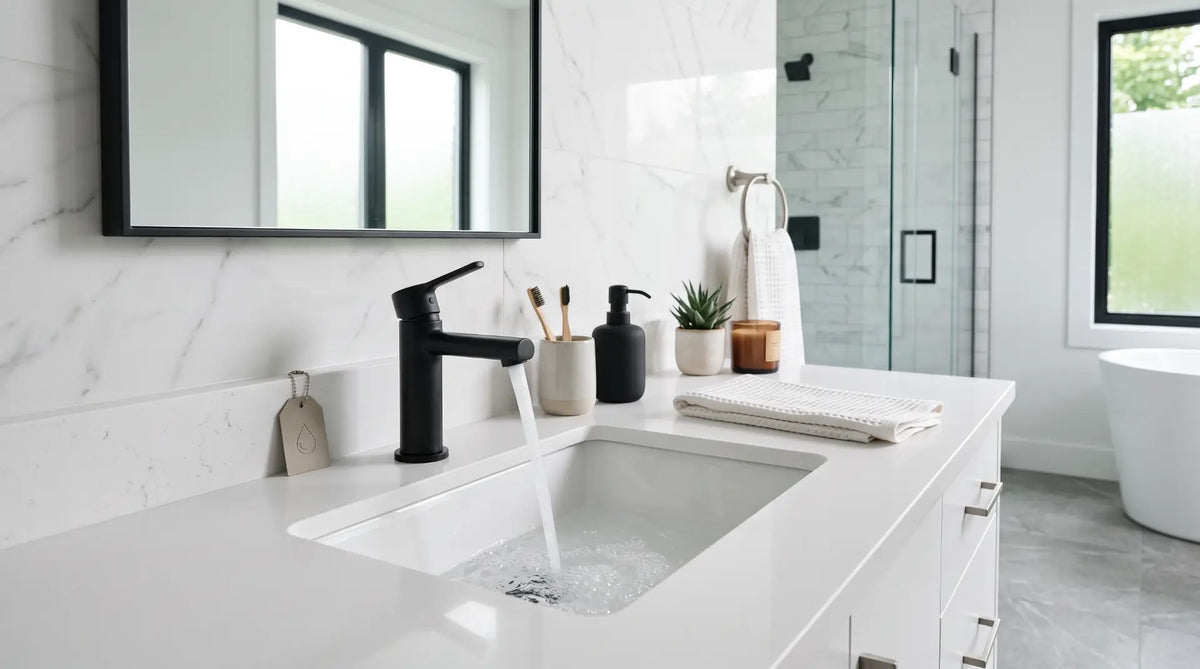
A water-saving faucet is one of the rare upgrades that costs no more than a regular one, cuts your water and water-heating bills every day, and doesn't ask you to compromise on pressure. This is the Canadian guide to getting it right in 2026 - what WaterSense and CSA B125.1 actually mean, how much you save, and which faucets to buy.
Canadians use more water per person than almost anyone else on Earth, and the bathroom sink is one of the quietest contributors - a tap run at full flow for hand-washing, tooth-brushing, and shaving, several times a day, by everyone in the house. Individually, none of it feels wasteful. Added up across a year and multiplied by every faucet in the home, it becomes a line on your utility bill that a five-minute upgrade could shrink.
The appealing part is that a water-saving faucet asks almost nothing of you. It doesn't cost more than a comparable standard faucet, it looks identical, and - if it's engineered properly - it feels no weaker at the tap. The saving is invisible: less water down the drain, and, because a good share of what a bathroom faucet uses is hot, less energy spent heating it. In many Canadian homes the water-heating saving is actually the larger one.
This guide is written to make the decision simple. We'll separate the two labels that matter - the mandatory Canadian standard and the voluntary efficiency label - show you what a low-flow faucet genuinely saves, and point you to the water-saving options worth buying. It's a supporting guide within our broader best bathroom faucets in Canada guide for 2026, so once you've settled the efficiency question here, you can step back to the full brand-and-finish picture there.
If you just want the fastest, cheapest win, jump to the aerator retrofit - it's a two-minute job under $15. If you're buying a new faucet, read the WaterSense vs CSA section so you know exactly what to look for on the box, then go straight to the best options. Everything is written to Canadian standards and Canadian pricing for 2026.
Almost all of the confusion around water-saving faucets in Canada comes from mixing up two different things: the standard every faucet must meet to be sold here, and the voluntary label that identifies the genuinely efficient ones. They're not the same, and knowing the difference is most of the battle.
Every bathroom faucet legally sold in Canada must carry CSA B125.1 certification. This is the plumbing-fittings standard, enforced at the retail level, and it has been the efficiency baseline since 2014. It caps a bathroom faucet's flow at 8.3 litres per minute (2.2 gpm) at standard water pressure. In practice, most quality Canadian-market faucets already flow well under that ceiling - typically between 5.7 and 7.6 L/min - so meeting code is a floor, not a badge of efficiency. What CSA B125.1 guarantees is that the faucet is legal to install and won't jeopardise a plumbing permit; it does not, on its own, tell you the faucet is especially water-thrifty.
WaterSense is a labelling program run by the U.S. Environmental Protection Agency. To earn the label, a bathroom faucet (or a faucet accessory such as an aerator) must flow at no more than 5.7 L/min (1.5 gpm) at 60 psi - roughly 30% below the standard maximum - while still delivering at least 0.8 gpm at low pressure so it performs properly. Crucially, WaterSense certification also requires independent third-party testing for performance and durability, not just a flow number. It's built directly on the same ASME A112.18.1 / CSA B125.1 standard Canada already uses, which is exactly why WaterSense-labelled faucets are sold widely across Canada even though the program itself is American.
| What It Is | CSA B125.1 | WaterSense |
|---|---|---|
| Type | Mandatory Canadian standard | Voluntary efficiency label (US EPA) |
| Max flow rate | 8.3 L/min (2.2 gpm) | 5.7 L/min (1.5 gpm) |
| Min flow at low pressure | Not specified for efficiency | ≥ 0.8 gpm at 20 psi (performance-tested) |
| Independent testing | Certification required | Third-party verified |
| Tells you it's efficient? | No - it's the legal floor | Yes - ~30% below max |
| Available in Canada? | All Canadian faucets carry it | Widely - carried at Bathify |

The headline figure is straightforward: a WaterSense faucet uses about 30% less water than an older 2.2 gpm faucet doing the same job. The U.S. EPA estimates that switching a single faucet or aerator to a WaterSense model saves roughly 2,600 litres (about 700 gallons) of water per year, per faucet. In a household with three or four faucets in daily use, the annual total climbs into the thousands of litres without anyone changing a single habit.
The dollar value depends heavily on where you live, because Canadian municipal water-and-sewer rates vary widely, and some homes aren't metered at all. On its own, the water saving per faucet is usually modest - a handful of dollars a year on metered water and sewer. The bigger lever is energy. Because a meaningful portion of the water drawn at a bathroom sink is heated, cutting the flow also cuts the load on your water heater, and water heating is one of the largest energy uses in a Canadian home. Between the two, a full set of water-saving faucets and aerators typically pays for itself many times over across the fixture's life.
Don't buy a water-saving faucet to chase a big line-item cut on next month's water bill - buy it because it's free efficiency (it costs no more than a standard faucet), it lowers water-heating energy every day, and it's the responsible default in a country that uses a lot of water. The savings are real but cumulative, not dramatic.
A water-saving faucet isn't a fundamentally different fixture - it's a standard faucet fitted with a smarter flow device at the spout tip. Understanding the three common types explains why a good low-flow faucet feels no weaker than a thirsty one.
Mixes air into the water stream so it feels full and soft while using less water. It's the little screen that unscrews from the spout tip - and the reason a 5.7 L/min faucet can feel just as satisfying as an 8.3 L/min one.
Splits the water into dozens of tiny parallel streams for a clear, non-aerated column that resists splashing and doesn't introduce air. Common in premium and design-forward faucets where a crisp, glassy stream is the look.
A fixed insert that limits maximum flow through a smaller opening. Effective and cheap, but a basic restrictor without aeration is the type most likely to feel weak - which is why the aerator and laminar approaches are preferred.
Some newer faucets default to cold or mixed water when the handle is centred, so you don't call for hot water by accident on a quick rinse. It saves water-heating energy on top of the flow reduction.
The takeaway: the water saving lives in a small, replaceable part. That's good news, because it means you don't necessarily have to replace a whole faucet to get most of the benefit - and it's exactly why the aerator retrofit below is such an easy win.
Choosing a water-saving faucet is the same process as choosing any bathroom faucet - fit first, then quality, then efficiency. Efficiency is the easy part once you know the two labels; the parts people get wrong are almost always fit and build. Run through this checklist before you buy.
The number-one reason faucets get returned in Canada is a hole-configuration mismatch - not efficiency. Before anything else, check whether your sink is single-hole, centerset (about 100mm / 4" spread), or widespread (200mm+ spread), because that decides which faucet body you can even install. If you're unsure, our companion guide on widespread vs centerset faucets walks through the measurement, and the full how to choose a bathroom sink faucet guide covers every dimension to record.
CSA B125.1 must be present - it's the law. WaterSense is the one that signals real efficiency. A faucet carrying both is legal in Canada and independently verified to use about 30% less water. If a listing states a flow rate, look for 5.7 L/min (1.5 gpm) or lower. If it only quotes 8.3 L/min, it meets code but isn't a water-saving faucet in any meaningful sense.
A water-saving faucet is only a saving if it lasts. The same build rules apply as for any faucet: a solid brass body (not zinc alloy, which corrodes internally within a few years) and a ceramic disc cartridge (not a rubber washer, which drips as it wears). A dripping faucet quietly wastes far more water than a low-flow aerator ever saves, so durability and efficiency are the same goal. Confirm both explicitly in the spec sheet, and prefer a five-year-or-better finish warranty.
Efficiency doesn't change the design rule: one dominant metal finish across every surface - faucet, towel bar, toilet-paper holder, shower hardware. Matte black, brushed nickel, and brushed gold lead Canadian preference in 2026, and all are available in WaterSense-rated faucets. If you're coordinating a whole set, our guide on matching vs mixing bathroom hardware finishes covers how to keep it cohesive.
Shopping at Bathify, the fastest route to a verified low-flow faucet is to start in the single-hole faucets collection, which lists WaterSense-certified models from Riobel, Delta, and TOTO, then filter to your finish. Confirm the stated flow rate is 5.7 L/min or lower on the product spec before you order.
If you're not renovating and your current faucet works fine, you almost certainly don't need a new one to save water. The aerator - the screen at the very tip of the spout - unscrews and swaps for a WaterSense-rated low-flow aerator that flows at 5.7 L/min or less. It costs roughly $8-$15 CAD, takes two minutes, needs no plumber, and fits almost any standard faucet. It is, dollar for litre, the single most cost-effective water upgrade available anywhere in the bathroom.
| Step | What to Do |
|---|---|
| 1 · Check the thread | Unscrew the existing aerator by hand (turn toward you when facing the spout). If it's stuck, wrap a cloth around it and use pliers gently. Note whether the thread is on the inside (female) or outside (male) of the spout. |
| 2 · Match the size | Take the old aerator to the hardware store or measure it - regular (~24mm) and junior (~18-22mm) sizes are the common Canadian fits. Buy a WaterSense-rated replacement at 5.7 L/min or lower. |
| 3 · Fit the washer | Make sure the small rubber washer is seated inside the new aerator - this is what prevents drips at the thread. |
| 4 · Hand-tighten | Screw the new aerator on by hand until snug, then a light nip with a cloth-wrapped wrench. Run the tap and check for leaks around the thread. |
The right water-saving faucet is the one that fits your sink and your finish scheme - so the smartest way to shop is by configuration, then confirm the flow rate. Every option below points to a real Bathify collection carrying CSA-certified faucets, including WaterSense-labelled models. Match the configuration to your sink's hole layout, then filter to a stated flow rate of 5.7 L/min or lower.

The single-hole collection is where Bathify explicitly lists WaterSense-certified faucets, with models from Riobel, Delta, and TOTO in chrome, matte black, and brushed nickel. Single-hole faucets suit modern undermount and vessel sinks and give the cleanest countertop profile, and a deck plate lets one mount on a three-hole sink if needed. This is the fastest route to a verified low-flow faucet.

Most Canadian production homes have a three-hole sink, which takes a centerset (4" spread) or widespread (8"+ spread) faucet. Both configurations are available in efficient, quality builds - look for a solid brass body, ceramic disc cartridge, and a stated flow at or below 5.7 L/min. Widespread models read as a premium upgrade on larger vanities; centersets are the straightforward replacement for most bathrooms.

If your basin sits on top of the counter, you need a tall vessel faucet that clears the rim and directs water to the basin centre. Vessel faucets are available in the same efficient, low-flow builds as any other configuration - the height changes, not the water logic. Measure from the countertop to the inner rim and add at least 25mm to find your minimum spout height before ordering.

For the cleanest possible countertop, a wall-mount faucet runs its supply lines inside the wall - no holes in the sink deck at all. It's a renovation or new-build choice rather than a retrofit, since it needs a planned rough-in, but it pairs beautifully with vessel and undermount basins and comes in the same efficient builds. Plan the rough-in with a licensed plumber before you commit.
Not sure a specific faucet's flow rate or fit suits your setup? The Bathify support team can help you match a product to your sink and finish scheme before you order, and every order ships across Canada with a straightforward return policy - so a single specification error is easy to correct.
A water-saving faucet is the easiest place to start, but it's the smallest of the three big bathroom water users. If you're renovating - or simply serious about your water bill - pairing the faucet with an efficient toilet and showerhead delivers a far larger combined saving.
A WaterSense showerhead flows at no more than 2.0 gpm while still meeting spray-force and coverage tests, so showers feel full but use less hot water - saving on heating too. Explore shower faucets & systems to coordinate with your sink faucet finish.
Keeping all three on the same finish and, where possible, the same brand collection also solves the coordination problem in one step - guaranteed finish consistency across the room. Since fixtures are one of the few renovation costs you control directly, it's worth ordering the efficient set together.
Faucet-specific rebates are less common than toilet rebates, but water-efficiency incentives do exist - and many reference or require WaterSense-labelled fixtures. The federal Canada Greener Homes Grant and Greener Homes Loan are both closed to new applicants as of 2026, so the live programs are provincial, utility, and municipal. Several Canadian municipalities run water-efficiency rebates or free aerator-and-showerhead giveaways, and provincial efficiency programs periodically cover water-saving upgrades.
Because these programs open and close frequently and vary by city, confirm current eligibility with your municipality or provincial water authority before you buy. Keep your receipt and the WaterSense documentation, since rebate applications usually require proof of the certified flow rate. Our companion guide to energy-efficient bathroom upgrades that qualify for Canadian rebates tracks what's currently worth applying for across the provinces.
This is the big one, and it's outdated. WaterSense faucets are certified not just for a maximum flow but for a minimum flow at low pressure - at least 0.8 gpm at 20 psi - so they must perform well even in a home with modest water pressure. Aerators and laminar devices make the reduced stream feel full and strong. The faucets that feel weak are almost always old, mineral-clogged, or fitted with a cheap bare restrictor, not properly engineered modern models.
Not quite. Every faucet sold here meets CSA B125.1, but that's the legal ceiling of 8.3 L/min - a floor, not a badge of efficiency. A faucet flowing at the maximum is compliant but not water-saving. Only a model at 5.7 L/min or lower - ideally WaterSense-labelled - is genuinely efficient.
A slow drip can waste more water in a month than a low-flow aerator saves. That's why efficiency and build quality are the same goal: a solid-brass, ceramic-disc faucet that never drips is doing more for your water bill than any flow number on a fixture that leaks. If your current faucet drips, fixing or replacing it is itself a water-saving upgrade.
Free efficiency, if you read the box correctly
Learn the two labels. CSA B125.1 is mandatory and marks the legal 8.3 L/min ceiling. WaterSense is voluntary and marks genuine efficiency at 5.7 L/min or lower, independently tested. A faucet with both is legal in Canada and verifiably water-saving.
Fit and build come first. Match the faucet to your sink's hole configuration, and insist on a solid brass body and ceramic disc cartridge. A durable faucet that never drips saves more water than a flimsy one with a low flow number.
The aerator is the cheapest win. If you're not renovating, a $10 WaterSense aerator delivers most of the saving in a two-minute, no-plumber job. It's the best value upgrade in the whole bathroom.
Pair it for real savings. The faucet is the easy start; a high-efficiency toilet and a WaterSense showerhead multiply the effect - and the toilet is where the rebates usually are.
Then buy with confidence. A water-saving faucet costs no more than a standard one and lowers your water and water-heating bills every day. There's no reason to buy anything else.
Bathify carries CSA B125.1-certified faucets across every configuration, including WaterSense-labelled models from brands like Riobel, Delta, and TOTO, in the finishes Canadian bathrooms are choosing in 2026. The fastest path is to shop by the configuration that fits your sink, then confirm a stated flow rate of 5.7 L/min or lower on the product page.
Comparing a few before you commit? Check current deals in the Sale collection, and if you want the wider brand-and-finish view, step back to the pillar guide on the best bathroom faucets in Canada for 2026.
Shop Water-Saving Faucets at Bathify Canada
CSA-certified and WaterSense-labelled faucets from Riobel, Delta, TOTO, Moen, and more - in matte black, brushed nickel, and brushed gold. Free ground shipping on orders over $50. Delivered across Canada.


