






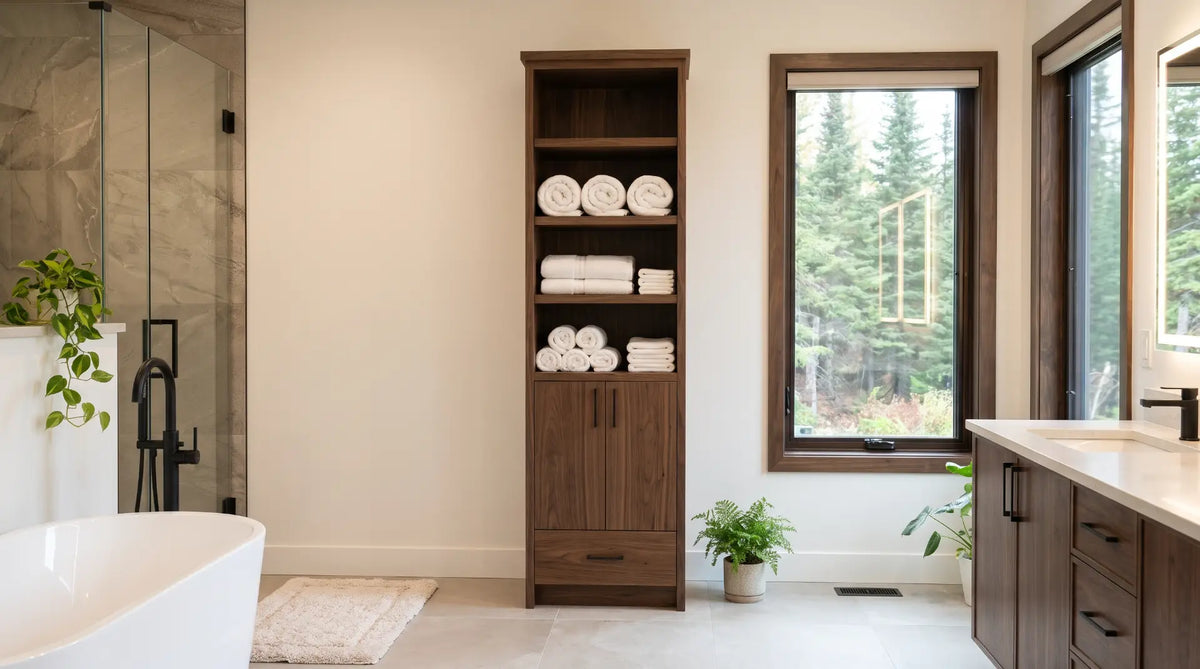
No linen closet doesn't mean no storage. It means storing up, not in. Here's the system Bathify's team walks Canadian customers through - freestanding linen towers, wall-mounted cabinets, open shelving, and towel bars - with the real products we sell for each, and honest advice on which one fits your bathroom.
At Bathify, the short answer we give customers with no linen closet is this: you still have three surfaces to store on - the floor, the wall, and open shelving - and the trick is building upward rather than outward. A freestanding linen tower turns a narrow slice of floor into closet-level capacity, a wall-mounted cabinet frees the floor entirely in a tight room, and open shelves or a towel bar handle the towels you reach for every day.
Most Canadian bathrooms without a closet are best served by combining two of those: a freestanding or wall cabinet for the bulk of the linens, plus a bar, hook, or warmer for towels in active use. Bathify carries all three formats, so this guide walks through which one fits your bathroom, how much you actually need to store, and the real products our team recommends for each. If linens are only one part of a bigger storage squeeze, our complete bathroom storage & organization guide is the hub this article supports.
Start with the "how much you need to store" section so you buy the right size the first time, then read the six solutions and the freestanding-vs-wall comparison to pick a format. If you already know what you want and just need the products, skip to Bathify's picks-by-budget near the bottom. For daily towels rather than stored linens, the towel-warmer and layout sections are the ones to read.

Before choosing where to put them, it helps to know what you're storing and roughly how much. The term "linens" is broader than it sounds: as the overview of household linens explains, it's used generically for woven bath, bed, and table textiles, whether or not they're actually made of flax. In a bathroom, that mostly means bath towels, hand towels, washcloths, and the occasional spare bath mat.
At Bathify, the rule of thumb our team gives is roughly three bath towels per person - one in use, one in the wash, one clean and ready - plus a few hand towels and a small stack of guest towels. For a two-person household, that's about six to eight bath towels to store at once. Knowing that number before you shop is the single most useful thing you can do, because it's the difference between buying storage that's genuinely enough and squeezing an overstuffed cabinet shut a month later.
Here are the six routes Bathify's team recommends most often, each tied to a real product category we carry. Most bathrooms end up using two of them together.
A tall, narrow cabinet with drawers, a door, and adjustable shelves. Bathify's single most recommended fix for no closet, because it delivers full linen storage in a footprint barely wider than a towel and needs no installation.
Mounts above the toilet or beside the vanity with nothing touching the floor, which keeps a small bathroom feeling open and the floor easy to clean. Closed doors hide the contents; shelves inside hold folded linens.
Wall shelves, with or without a railing, turn rolled towels into easy-reach storage and a bit of styling. The lowest-cost way to add linen space, and a strong pairing with a cabinet for the overflow.
A bar lets a towel dry flat between uses; a hook is quicker but bunches it up. Bathify's team treats these as storage for in-use towels, separate from where the clean, folded stock lives.
A wall or floor rack that holds several towels and keeps them warm and fully dry between uses - genuinely useful in a damp Canadian bathroom with no airing cupboard to fall back on.
The wall above the toilet is usually empty. A shelving or cabinet unit there adds a full column of linen storage without taking any new floor space at all.
Every one of these maps to a collection Bathify stocks: linen cabinets, storage cabinets, glass and metal shelving, towel bars, hooks and rings, and towel warmers. For the over-the-toilet route specifically, Bathify's over-the-toilet storage guide goes deeper.
The three closed-or-open storage formats each win in a different situation. Here's the comparison Bathify's team walks customers through before they choose.
| Factor | Freestanding Tower | Wall-Mounted Cabinet | Open Shelving |
|---|---|---|---|
| Capacity | Highest - drawers, door & shelves | Medium - shelves behind doors | Low to medium |
| Floor space used | Narrow footprint | None | None |
| Installation | None - just place it | Drilling into wall required | Drilling required |
| Hides clutter | Yes | Yes | No - on display |
| Renter-friendly | Yes | Check with landlord | Check with landlord |
| Best for | A spare corner & max storage | Tight floors & small rooms | Daily towels & styling |
In Bathify's experience, this is rarely an either-or. Our team most often pairs a freestanding tower or wall cabinet for the stored bulk with a run of open shelving or a towel bar for the towels in daily rotation - closed storage for the stock, open storage for what's in use.

A towel warmer is an underrated answer to the no-closet problem, and one Bathify's team raises often, because a closetless bathroom usually also lacks an airing cupboard to dry linens in. A heated rack does two jobs at once: it stores several towels on the wall or floor, and it keeps them warm and fully dry between uses. In a damp Canadian bathroom, that drying function matters more than the warmth.
The reason drying matters comes down to the fabric. As the overview of bath towels notes, they're typically thick terrycloth chosen for absorbency, which is exactly what makes a damp towel slow to dry on a crowded hook. A warmer keeps the towel open and heated so it's ready rather than musty. Bathify carries a full range in the towel warmers collection, in hydronic and electric formats and a wide set of finishes, so it coordinates with the rest of the room's hardware.
Once you've added storage, giving each type of linen a home keeps the system working. Here's the layout Bathify's team suggests for a no-closet bathroom.
| Item | Where It Goes | Why |
|---|---|---|
| Clean bath towels (stock) | Freestanding tower or wall cabinet, folded on shelves | Bulk storage behind doors keeps the room tidy and the towels dust-free |
| Towels in daily use | Towel bar, hook, or heated warmer | Needs airflow to dry between uses, not a sealed shelf |
| Hand towels & washcloths | A drawer or a small open shelf near the sink | Small items are easiest to grab from a shallow, reachable spot |
| Guest & spare towels | Lower tower drawers or over-the-toilet unit | Rarely used, so they can take the harder-to-reach storage |
| Rolled display towels | Open shelving | Doubles as storage and styling in a room with no closet to hide behind |
If your vanity has drawers, a couple of them can absorb hand towels and washcloths too - Bathify's vanity drawer organization guide covers how to zone those so linens and toiletries don't end up fighting for the same space.

At Bathify, our advice for a small, closetless bathroom is to build up, not out. Height and wall space are where a tight room still has room to give, so a tall narrow tower or a wall-mounted cabinet beats anything that spreads across the floor. A freestanding tower around 20 inches wide takes a footprint barely larger than a towel while running close to ceiling height, and a wall cabinet removes the floor footprint entirely. Bathify's over-the-toilet storage guide covers the other great small-room surface: the dead wall above the toilet.

If you rent, Bathify's honest recommendation is to lead with freestanding pieces, because a linen tower, open floor baskets, and over-the-toilet units add storage without drilling into walls you don't own. A freestanding tower is the standout here: full linen capacity, zero installation, and it moves with you to the next place. Save the wall-mounted cabinets and shelving for when you have your landlord's blessing or your own walls.
The most common worry Bathify's team hears about keeping linens in the bathroom is mustiness, and it's a fair one. Our honest answer: storing towels in a bathroom is fine as long as they go in dry and the room can shed its moisture. The real enemy isn't the bathroom - it's damp fabric sitting in a damp space with nowhere for the moisture to go.
Three habits handle it. Store only fully dry towels, never a slightly damp one. Keep stored linens in a cabinet with a little airflow rather than crammed and sealed tight. And run the exhaust fan during and after showers so the room itself dries out. This lines up with broad moisture-control guidance: as the US Environmental Protection Agency notes in its advice on mold and moisture, keeping surfaces and stored materials dry is the key to avoiding problems in a damp room. For towels in active rotation, a bar or a heated warmer that lets them dry fully beats a hook that bunches them up wet.
At Bathify, the pattern our team sees from Canadian customers with no linen closet is a clear preference for freestanding and wall-mounted cabinets over open shelving when it comes to storing the bulk of their linens - closed storage wins because it hides clutter in a room that has nowhere else to hide it. Open shelving and towel bars still sell well, but as the companion to a cabinet rather than the main solution.
Among the cabinets we carry, our tall freestanding linen towers draw the most interest from customers who tell us they have no closet at all, because a single tower solves the whole problem in one purchase and one corner. Renters, in particular, gravitate to the freestanding format for the obvious reason that it needs no drilling and moves with them. The question our team fields most in this category isn't "which cabinet is nicest" - it's "will one piece be enough," and for a one or two-person household, the honest answer is usually yes.
The through-line is that the customers happiest with their linen storage a year on are the ones who sized it to their real towel count up front and chose closed storage for the stock. That's the pattern Bathify steers people toward: measure your space, count your towels, and buy one piece that genuinely fits both.
A folded bath towel needs real depth. Before ordering, Bathify's team suggests folding one the way you actually will and measuring it, then checking the cabinet's interior shelf depth against that. A cabinet built for toiletries often can't take a folded bath towel front-to-back.
Open shelving is for the towels you want on display and in daily reach, not for the full stock. Move the bulk into a closed tower or wall cabinet and keep only a few rolled or neatly folded towels out. In a room with no closet, closed storage is what keeps it from reading as cluttered.
Common in older Canadian homes with settled floors. Look for a tower with levelling feet - the Rowan linen cabinet Bathify carries has adjustable tapered legs with levellers for exactly this - and anti-tip hardware for a tall, narrow piece is always worth using.
The one genuine risk of bathroom linen storage. Only ever store fully dry towels, give the cabinet a little airflow, and keep daily towels on a bar or warmer where they can dry out between uses rather than on a crowded hook.
The Bottom Line: Build Up, Store Closed
For a Canadian bathroom with no linen closet, Bathify's recommendation is consistent: build upward with a freestanding linen tower or a wall-mounted cabinet, store the bulk of your linens behind doors, and keep only daily-use towels out on a bar, shelf, or heated warmer. Count your towels before you shop - roughly three bath towels per person - so you buy a piece that's genuinely enough the first time.
If floor space is your constraint, go wall-mounted. If you want the most storage or you rent, go freestanding. If you just need a few daily towels handled, open shelving or a towel bar under $70 does it. Most bathrooms end up combining a cabinet with one open option, and that pairing is the one our team recommends most.
When you're ready, Bathify carries every one of these formats, shipped across Canada. The picks below are the exact budget ladder our team suggests working through.
Three real products Bathify currently sells, one per budget level, all with free ground shipping on orders over $50 and delivery across Canada. This is the ladder our team recommends for a bathroom with no linen closet, from a quick open shelf to a full freestanding tower.

The lowest-cost way to add linen space, and a natural pairing with any cabinet. Solid brass construction with a corrosion- and rust-resistant finish suited to a damp bathroom, with a railing that keeps rolled towels and toiletries from sliding off. Mount one near the shower for grab-and-go towels and let a cabinet carry the stock.

The floor-saving pick for a tight bathroom. Real black walnut veneer with two soft-close doors, an open shelf, and two adjustable interior shelves, so it holds a household's folded towels and toiletries while leaving the floor completely clear underneath. Mount it above the toilet or beside the vanity to turn dead wall space into closed linen storage.

Bathify's single most recommended answer to no linen closet. At 20 inches wide and 78 inches tall, it delivers closet-level storage in a footprint barely wider than a towel, with three full-extension soft-close drawers, a soft-close door, and two adjustable shelves for towels, toiletries, and everyday essentials. Real black walnut veneer with dovetail drawer construction and adjustable tapered legs with levellers for uneven floors. No installation needed, which also makes it the standout choice for renters.
Shop: Rowan 20" x 78" Freestanding Linen Cabinet at Bathify →
Not sure which format or size fits your bathroom? Bathify's support team can walk through the trade-offs before you order, and every piece ships across Canada.
No Closet? Shop Linen Storage at Bathify Canada
Freestanding linen towers, wall-mounted cabinets, open shelving, towel bars and heated towel warmers - real storage for bathrooms with no linen closet. Free ground shipping on orders over $50, delivered across Canada.


